
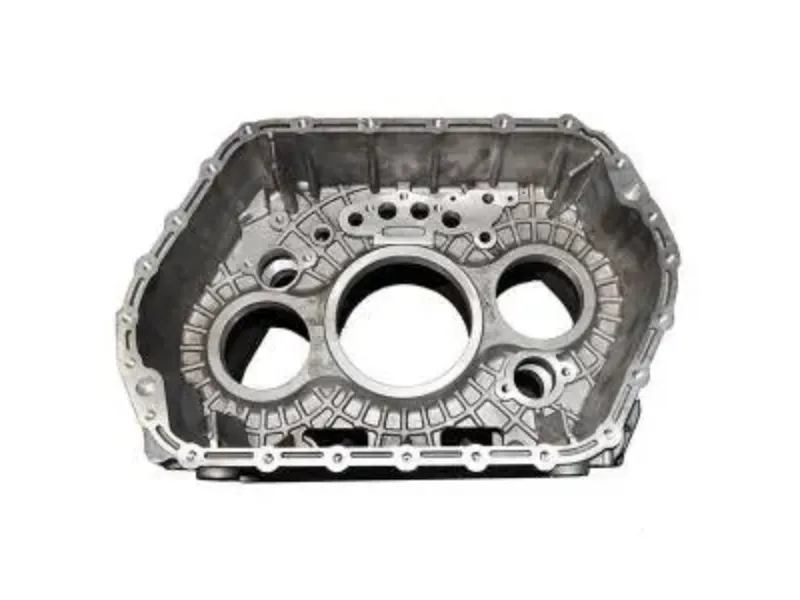
Einführung
Modern industrial equipment requires custom metal components with reliable mechanical performance, dimensional accuracy, and long-term durability. For OEM customers developing complex parts, selecting the right manufacturing process and China manufacturing partner is critical to achieving stable production results.
Welleshaft provides custom lost foam casting solutions for global OEM customers requiring complex industrial components. As a China-based custom industrial parts manufacturer, Welleshaft integrates lost foam casting, CNC machining, inspection, and secondary processing to support complete China contract manufacturing solutions from engineering review to final production.
Lost foam casting is an advanced evaporative pattern casting process that enables manufacturers to produce custom metal components with complex geometries, integrated structures, internal passages, and reduced machining requirements.
As a China-based custom industrial components manufacturer and OEM manufacturing partner, Welleshaft provides scalable manufacturing solutions beyond casting. By combining casting capabilities with machining, inspection, and supply chain coordination, Welleshaft helps customers develop reliable components for industrial equipment, automotive, robotics, and machinery applications.
Rather than acting as a single-process casting supplier, Welleshaft supports customers throughout the product development cycle, including engineering review, prototype manufacturing, production optimization, and final delivery.
With integrated manufacturing capabilities and engineering support, Welleshaft helps global customers simplify supplier management, improve production efficiency, and develop high-quality custom industrial components tailored to specific application requirements.
Submit Your Component RequirementsWhat Is Lost Foam Casting for Custom Industrial Components?
Lost foam casting is an evaporative-pattern casting process used to manufacture custom metal components with complex geometries. Unlike traditional casting methods that require removing the pattern before pouring, lost foam casting uses a disposable foam pattern that remains inside the mold during the casting process.
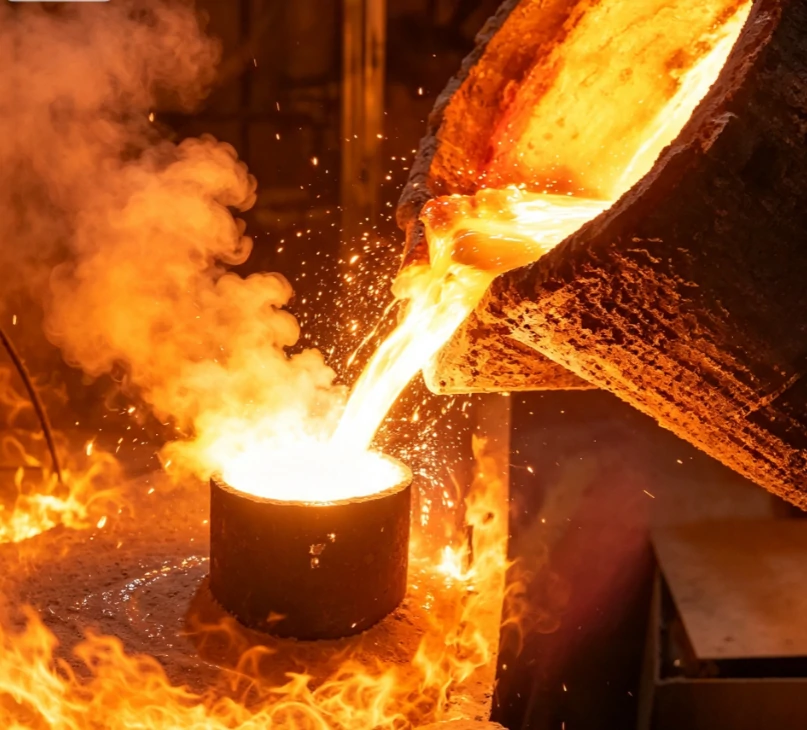
During pouring, the heat from the molten metal vaporizes the foam pattern, allowing the metal to fill the mold cavity and form the final casting.
Also known as evaporative pattern casting (EPC), lost foam casting is suitable for producing custom industrial components with complex geometries, internal passages, and integrated designs. As part of Welleshaft’s broader metal casting solutions, this process supports OEM projects requiring flexible designs and customized production.
This makes lost foam casting a suitable manufacturing process for OEM customers requiring customized metal components, design flexibility, and production efficiency.
For OEM manufacturers, this process offers greater design flexibility and supports near-net-shape production while reducing assembly requirements and machining operations.
Why Do OEM Engineers Choose Lost Foam Casting?
OEM engineers often select lost foam casting when component complexity, production efficiency, and design flexibility are key considerations.
Compared with conventional casting methods, lost foam casting can provide advantages for components with complex designs and specific manufacturing requirements:
| Manufacturing Requirement | Lost Foam Casting Advantage |
| Complex internal structures | Allows production of components with internal passages and integrated features |
| Component consolidation | Combines multiple design features into a single casting |
| Reduced machining requirements | Helps reduce secondary machining for suitable geometries |
| Customized component designs | Provides flexibility for engineered-to-order metal parts |
These characteristics make lost foam casting suitable for companies requiring custom metal components manufactured according to specific application and performance requirements.
How Does the Lost Foam Casting Process Work?
The lost foam casting process converts customer designs into finished metal components through a series of manufacturing steps, including foam pattern development, coating, molding, metal pouring, and inspection. Each stage affects the dimensional accuracy, surface condition, and final performance of the casting.
From pattern development to final inspection, each process stage affects the dimensional accuracy, surface quality, and performance requirements of custom lost foam casting components.
Step 1: Foam Pattern Development Based on Customer Design
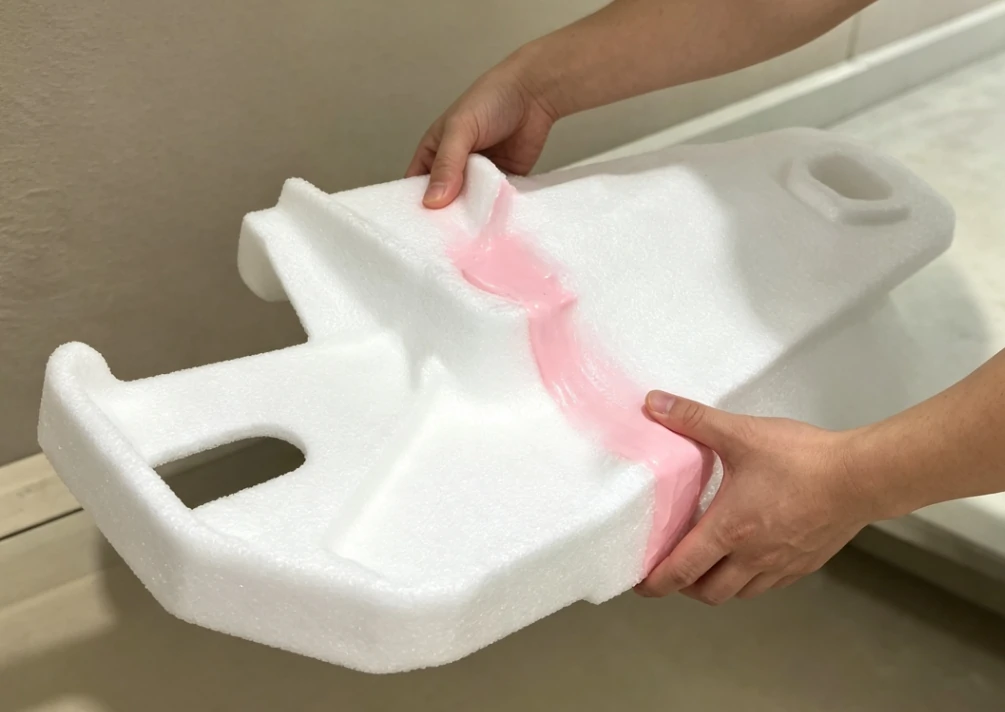
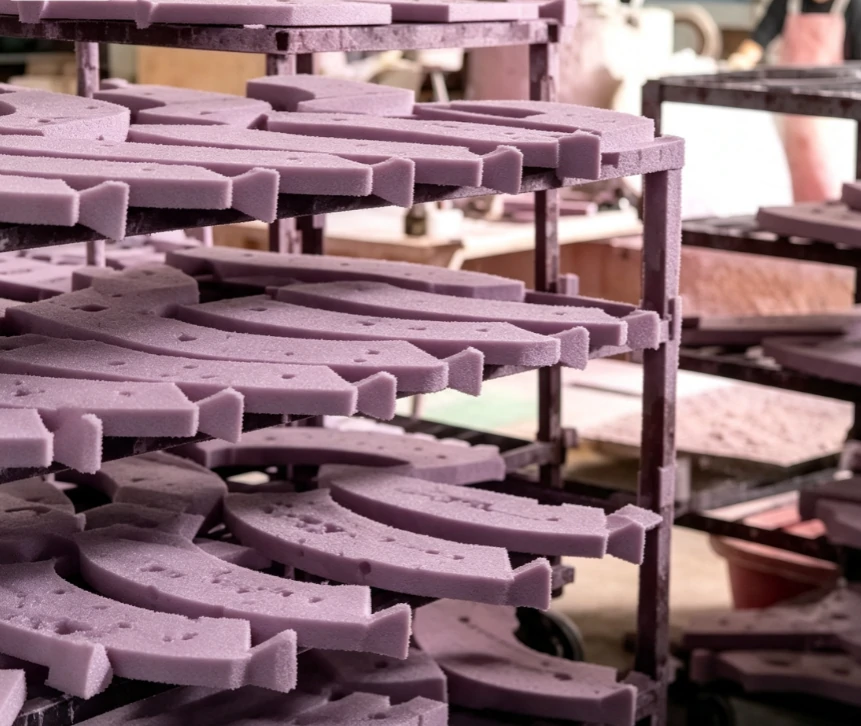
The process begins with creating a foam pattern based on customer CAD drawings or 3D models. During this stage, engineers review component geometry, structural requirements, and manufacturing feasibility to determine whether the design is suitable for lost foam casting production.
The foam pattern defines the final shape of the metal component and directly affects casting accuracy and surface quality.
During this stage, engineers evaluate key design factors, including:
- Component geometry
- Wall thickness
- Structural design
- Casting feasibility
- Machining requirements
For OEM projects, early communication between engineers and manufacturers helps identify possible design adjustments and improve manufacturing efficiency before production begins.
Step 2: Pattern Assembly and Gating System Design
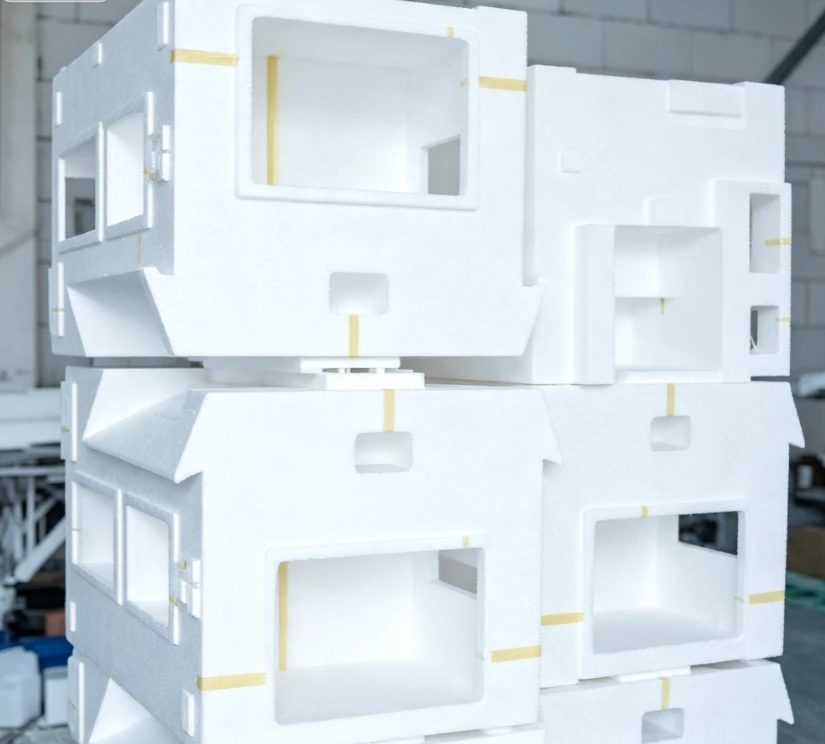
After the foam pattern is completed, the gating system is designed and assembled to control molten metal flow during casting.
The gating design affects:
- Metal flow behavior
- Filling performance
- Solidification characteristics
- Potential casting defects
For custom cast components with complex geometries, proper gating design helps control filling behavior and reduce casting risks during production.
Step 3: Refractory Coating Application
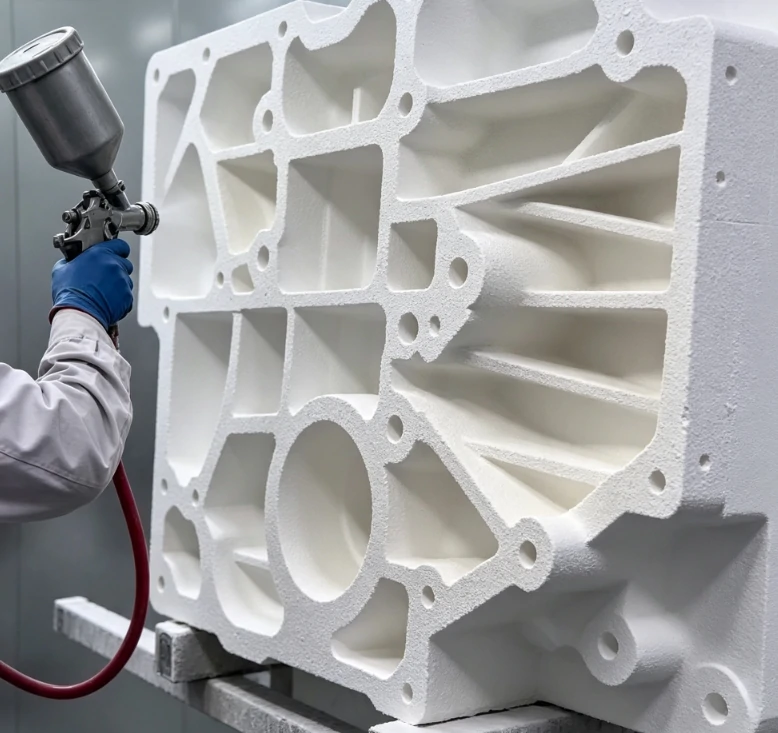
The foam pattern is coated with a refractory material to create a protective layer between the pattern and the surrounding sand.
The refractory coating maintains pattern stability, improves surface finish, controls metal penetration, and supports casting accuracy.
Since the coating directly affects the surface condition of the final casting, coating quality must be controlled to achieve the required component finish.
Step 4: Sand Compaction and Mold Preparation
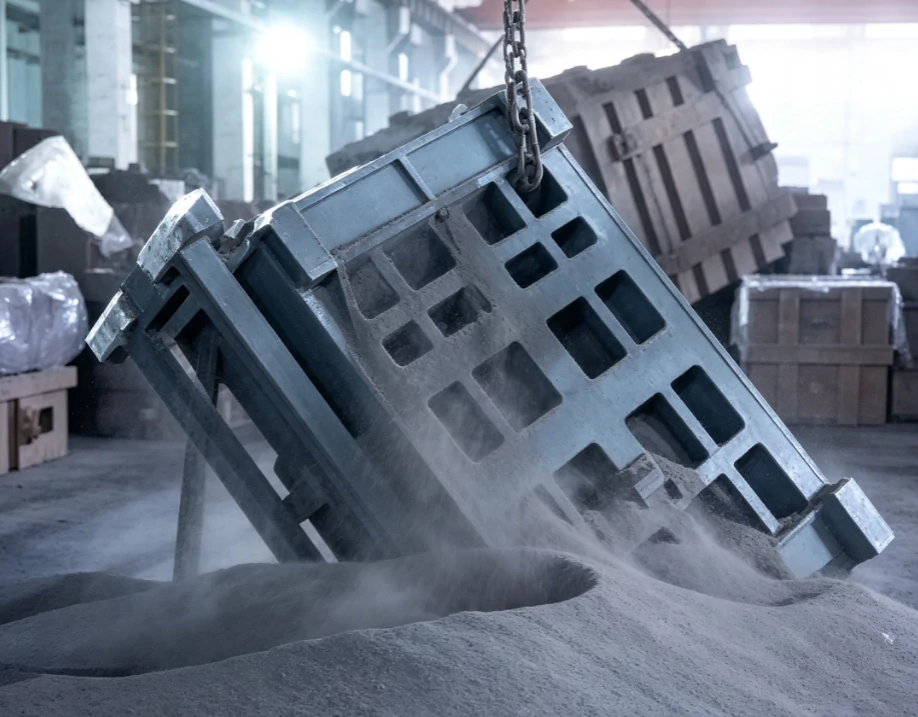
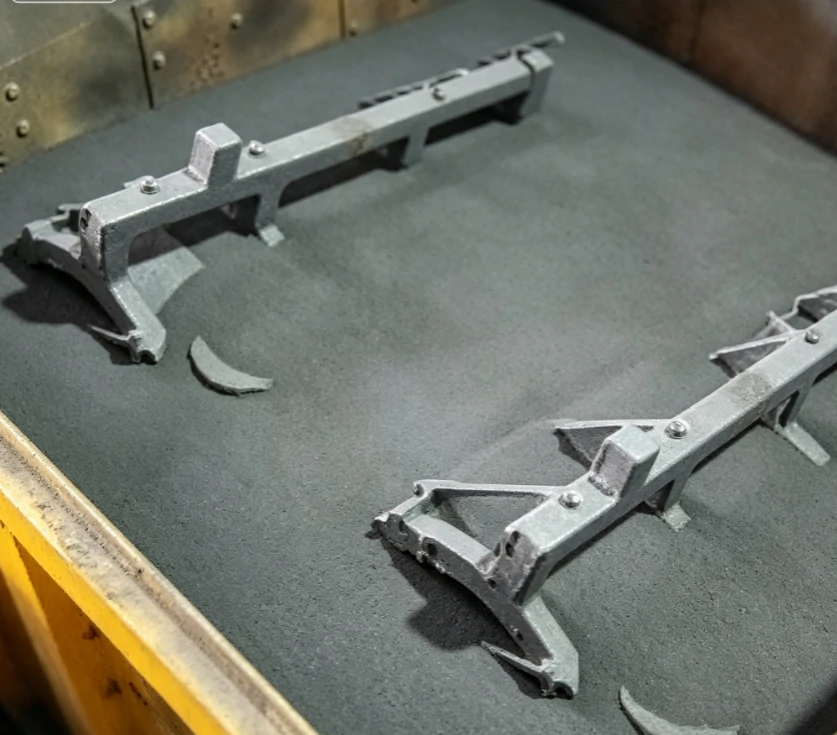
After coating, the foam pattern is placed into a flask and surrounded by unbonded sand. The sand is compacted to support the pattern during metal pouring and maintain mold stability.
Unlike traditional sand casting, lost foam casting does not require pattern removal before pouring. This allows manufacturers to produce complex shapes and integrated structures that are difficult to achieve with conventional methods.
Step 5: Metal Pouring and Casting Inspection
During pouring, molten metal replaces the evaporated foam pattern and forms the final casting after solidification.
After the casting is removed and cleaned, inspections are performed according to customer drawings and project specifications.
- Dimensional inspection
- Visual inspection
- Material verification
- Surface quality evaluation
For OEM customers, combining lost foam casting with CNC machining and inspection services allows finished components to meet required dimensions, functional requirements, and application specifications.
Discuss Your Custom Industrial Component ProjectWhy Choose Lost Foam Casting for Custom Metal Components?
Lost foam casting is selected for custom metal components that require complex geometries, integrated structures, and flexible manufacturing options.
For OEM customers, selecting a manufacturing method involves more than producing a metal part. The process must balance component design, material performance, production requirements, and overall manufacturing cost.
As a casting process for complex industrial components, lost foam casting offers specific advantages in design flexibility, machining requirements, and production adaptability.
| Manufacturing Requirement | How Lost Foam Casting Supports OEM Projects |
| Complex component designs | Produces components with internal passages, integrated structures, and complex geometries |
| Reduced machining requirements | Allows near-net-shape production and reduces secondary machining for suitable designs |
| Prototype and production needs | Supports both prototype evaluation and repeat production projects |
| Engineered-to-order components | Provides design flexibility for customized metal parts based on application requirements |
Complex Geometry Manufacturing Capability
Lost foam casting is often selected when component geometry includes complex shapes, internal passages, or integrated features that are difficult to achieve with conventional casting methods.
Because the foam pattern remains inside the mold during pouring, manufacturers can produce components with:
- Complex internal passages
- Integrated structural features
- Irregular geometries
- Reduced assembly requirements
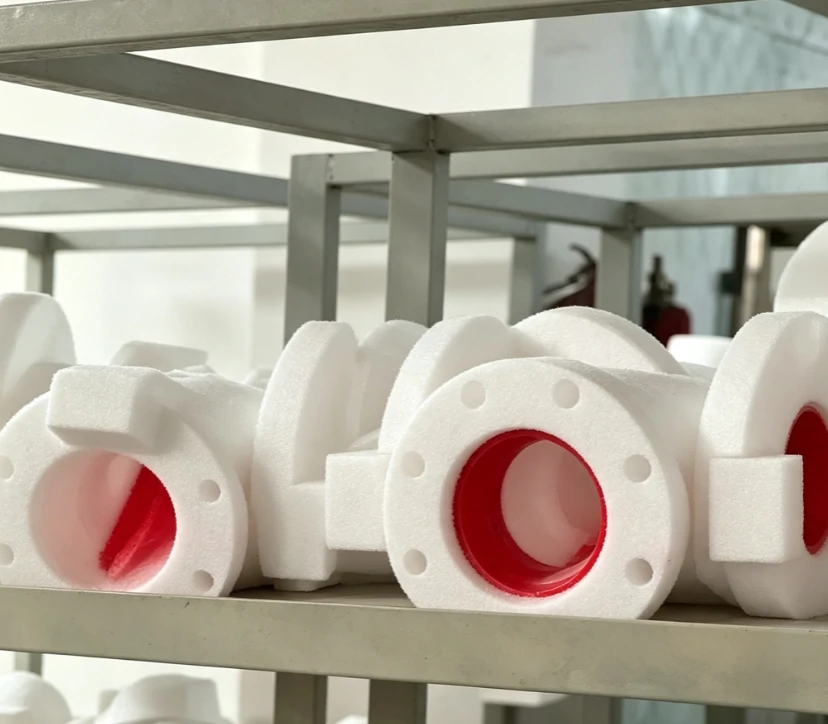
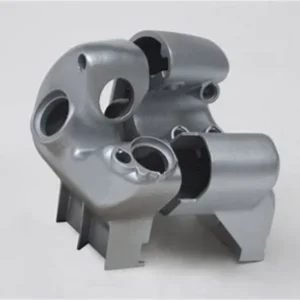
This makes lost foam casting suitable for components such as pump housings, valve bodies, machinery parts, and other custom industrial components requiring complex structures.
For OEM engineers, this design flexibility allows components to be developed according to specific operating requirements without being limited by traditional manufacturing constraints.
Reduced Machining Requirements for Near-Net-Shape Components
Lost foam casting can produce near-net-shape components that require less machining after casting for suitable designs.
For OEM customers, reducing secondary machining can simplify production planning and reduce additional processing steps.
Reducing machining requirements may help lower:
- Additional processing steps
- Material waste
- Manufacturing time
- Overall production complexity
For complex industrial components, combining casting and machining processes through a coordinated manufacturing approach can simplify production management and improve process consistency.
Suitable for Prototype Development and Production Manufacturing
Lost foam casting can support different production stages, from prototype development to volume manufacturing.
This flexibility makes lost foam casting suitable for companies looking for a long-term OEM manufacturing partner rather than a supplier focused on a single casting process.
For existing products, lost foam casting provides a stable solution for repeated manufacturing of customized components.
This production flexibility makes lost foam casting suitable for companies seeking a long-term OEM manufacturing partner rather than a single-process casting supplier.
Design Flexibility for Customized Industrial Components
Compared with some traditional manufacturing methods, lost foam casting offers more design freedom for customized industrial components.
Engineers can adjust component designs based on:
- Mechanical requirements
- Weight reduction objectives
- Installation conditions
- Performance expectations
- Production considerations
This flexibility makes lost foam casting a practical solution for bespoke metal components und engineered-to-order industrial parts that require specific design and performance characteristics.
What Are the Advantages of Lost Foam Casting?
Selecting the right casting method depends on component geometry, material requirements, production volume, and application conditions.
For OEM buyers, lost foam casting is a suitable option when custom metal components require complex designs, integrated structures, and reduced manufacturing constraints.
The following comparison shows where different casting methods are commonly applied:
| Component Requirement | Common Manufacturing Option |
| Complex internal structures and integrated designs | Lost Foam Casting |
| Small precision components requiring high surface finish | Feinguss |
| Large components with relatively simple geometry | Sandgießen |
| High-strength load-bearing components | Process evaluation based on application requirements |
Lost foam casting is not intended to replace every casting process. Instead, it offers an effective solution for complex industrial components where design flexibility, manufacturing efficiency, and reduced processing requirements are important considerations.
For OEM projects, evaluating component requirements at the early design stage helps determine the most suitable casting method and achieve a reliable manufacturing solution.
How Does Lost Foam Casting Compare with Investment Casting and Sand Casting?
Lost Foam Casting vs Sand Casting
Both lost foam casting and sand casting are used for industrial metal components, but they differ in mold preparation, design flexibility, and production considerations.
For OEM buyers, selecting between these two processes requires evaluating component complexity, production requirements, machining needs, and cost considerations.
| Evaluation Factor | Lost Foam Casting | Sandgießen |
| Component geometry | Suitable for complex shapes, internal passages, and integrated structures | Suitable for large components with relatively simple designs |
| Mold design | Reduces restrictions caused by parting lines and supports integrated features | Uses traditional mold designs with parting lines |
| Machining requirements | May reduce secondary machining for suitable component designs | Often requires additional machining after casting |
| Typical applications | Custom industrial components, machinery parts, pump housings, and valve bodies | Large castings, equipment parts, and general industrial components |
Lost foam casting is often selected for custom industrial components with complex designs, while sand casting solutions remain suitable for large components where traditional molding methods meet production requirements.
The most suitable process depends on component requirements, production quantity, and engineering objectives.
Lost Foam Casting vs Investment Casting
Investment casting is commonly selected for precision metal components requiring detailed geometries and high surface finish.
Lost foam casting may be more suitable for larger industrial components that require integrated structures or complex internal features.
For OEM buyers selecting between these two processes, key considerations include component size, dimensional requirements, production volume, and application needs.
| Evaluation Factor | Lost Foam Casting | Feinguss |
| Component size | Suitable for medium to large complex industrial components | Commonly used for smaller precision components |
| Design requirements | Suitable for integrated structures and internal passages | Suitable for detailed geometries requiring tight tolerances |
| Typical applications | Machinery components, pump housings, valve bodies, industrial parts | Precision components requiring fine surface finish |
| Primary consideration | Complex structure and manufacturing flexibility | Dimensional accuracy and surface quality |
How Should OEM Buyers Select the Right Casting Process?
Before selecting a casting process, OEM buyers should evaluate the following factors:
- Part size
- Material requirements
- Dimensional requirements
- Production volume
- Cost targets
Selecting the appropriate process during the design stage helps balance component performance, manufacturability, production cost, and delivery requirements.
For companies developing custom metal components, understanding the differences between lost foam casting, sand casting, and investment casting can help identify the most suitable manufacturing approach.
What Materials Are Used for Lost Foam Casting Components?
Material selection directly affects the strength, durability, and application performance of custom lost foam casting components.
The appropriate material depends on component requirements, including mechanical strength, operating conditions, wear resistance, corrosion resistance, and temperature exposure.
For OEM customers, material selection should match component function, production requirements, and expected service conditions.
| Material | Characteristics | Common Applications |
| Aluminum | Lightweight, corrosion-resistant, suitable for weight-sensitive components | Automotive parts, lightweight equipment components, industrial housings |
| Cast Iron | Good wear resistance and structural strength for industrial applications | Machinery components, equipment housings, heavy-duty parts |
| Steel | Higher strength and durability for demanding operating conditions | Heavy equipment components, structural parts, industrial machinery |
Aluminium Lost Foam Gießen
Aluminum lost foam casting is commonly selected for components requiring lightweight structures, corrosion resistance, and reduced component weight.
Typical applications include automotive components, lightweight equipment parts, and industrial housings where weight reduction and corrosion resistance are required.
Cast Iron Lost Foam Casting
Cast iron lost foam casting is suitable for industrial components requiring wear resistance, strength, and long service life.
Common applications include machinery components, equipment housings, and heavy-duty industrial parts.
Steel Lost Foam Casting
Steel lost foam casting is used for custom components requiring higher strength and durability under demanding operating conditions.
It is commonly used for heavy equipment parts, structural components, and industrial machinery applications where reliable mechanical performance is required.
Material Selection Support for OEM Customers
Selecting the correct material is a key step in custom metal component manufacturing.
For OEM projects, material selection should consider the component function, mechanical requirements, production needs, and cost considerations.
Welleshaft works with OEM customers to evaluate material requirements and recommend suitable manufacturing approaches for custom lost foam casting projects.
What Industrial Components Can Be Manufactured Using Lost Foam Casting?
Lost foam casting is used to manufacture customized metal components that require complex structures, integrated designs, and flexible production options.
This process is applied to industrial components used in machinery, transportation equipment, energy systems, and industrial equipment.
| Component Type | Manufacturing Considerations | Anwendungen |
| Pump Housing Components | Complex internal passages and integrated flow structures | Pumps and fluid handling equipment |
| Custom Valve Bodies | Internal structures, pressure requirements, and material selection | Industrial flow control systems |
| Heavy Equipment Components | Strength, durability, and operating conditions | Heavy machinery and equipment |
| Industrial Machinery Parts | Customized designs and non-standard component requirements | Industrial equipment and machinery systems |
Housing Components
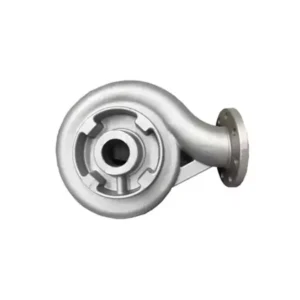
Pump housings often require complex internal passages and optimized flow structures. Lost foam casting allows manufacturers to produce custom pump housing components with integrated structures and fewer assembly requirements.
For OEM applications, pump housing manufacturing typically requires consideration of:
- Fluid flow requirements
- Material selection
- Pressure conditions
- Machining requirements
The flexibility of lost foam casting makes it suitable for pump components with specific structural and performance requirements.
Custom Valve Bodies
Valve bodies require accurate internal structures and reliable mechanical performance for industrial flow control applications.
Lost foam casting is suitable for custom valve bodies with complex internal structures used in:
- Industrial equipment
- Fluid systems
- Energy applications
- Process machinery
For OEM projects, the casting process helps manufacturers develop valve components according to specific application requirements.
Heavy Equipment Components
Heavy machinery requires durable metal components capable of handling demanding operating conditions.
Lost foam casting can be used to manufacture:
- Equipment housings
- Structural components
- Machinery parts
These applications require components with complex structures and durable material performance.
Industrial Machinery Parts
Industrial equipment manufacturers often require customized components rather than standard off-the-shelf parts.
Lost foam casting can support the production of custom industrial machinery parts, including:
- Machine components
- Custom brackets
- Structural metal parts
- Engineered industrial components
For companies developing specialized equipment, this process allows parts to be manufactured according to specific design requirements.
What Manufacturing Services Does Welleshaft Provide Beyond Lost Foam Casting?
One-Stop Contract Manufacturing Solutions for Custom Industrial Components
Lost foam casting is one of Welleshaft’s core manufacturing capabilities. Beyond casting, Welleshaft provides integrated manufacturing services for OEM customers requiring complete industrial component production.
As a China custom industrial components manufacturer, Welleshaft provides contract manufacturing services that combine casting, machining, finishing, and inspection for OEM projects.
By combining casting, forging, machining, finishing, and inspection processes within one manufacturing system, Welleshaft helps global customers simplify sourcing, improve production efficiency, and reduce the complexity of managing multiple manufacturing suppliers.
Integrated Manufacturing Capabilities for OEM Metal Parts
Different industrial applications require different manufacturing approaches. Welleshaft selects and combines suitable processes based on part structure, material requirements, mechanical performance, production volume, and application conditions.
| Manufacturing Process | Suitable Applications | Key Benefits |
| Lost Foam Casting | Complex-shaped metal components with internal cavities or reduced machining requirements | Flexible design options, reduced tooling limitations, and cost-effective production for complex parts |
| Feinguss | Precision components with detailed geometries and tight dimensional requirements | Excellent surface finish and high accuracy for complex metal parts |
| Forging | Load-bearing components exposed to high stress or impact forces | Improved strength, durability, and mechanical reliability |
| CNC Machining | Components requiring precise dimensions and functional surfaces | High accuracy and consistent quality for critical features |
| Wärmebehandlung | Parts requiring enhanced mechanical performance | Improves hardness, strength, wear resistance, and service life |
| Surface Finishing | Components requiring corrosion protection or improved appearance | Provides additional protection and meets application-specific requirements |
| Inspection Services | OEM components requiring quality verification before delivery | Ensures dimensional accuracy and compliance with customer specifications |
Complete Custom Manufacturing Support from Design to Production
Welleshaft works closely with OEM customers throughout the entire manufacturing process, including production planning, process selection, manufacturing, quality inspection, and final delivery.
Instead of coordinating separate suppliers for casting, machining, finishing, and inspection, customers can rely on one experienced manufacturing partner for custom metal components manufacturing. This integrated approach helps shorten communication cycles, improve quality consistency, and create a more reliable supply chain for industrial applications.
Whether customers need lost foam castings, precision machined parts, forged components, or fully finished assemblies, Welleshaft provides flexible one-stop manufacturing solutions in China to support global industrial equipment, automotive, robotics, and machinery manufacturers.
How Does Welleshaft Support OEM Customers from Prototype to Production?
Engineering Support and Custom Manufacturing Solutions for OEM Customers
For OEM customers, selecting a manufacturing partner involves evaluating engineering capability, production experience, quality control, and delivery performance.
A capable supplier should understand engineering requirements, support process selection, control production quality, and provide manufacturing support from prototype development to production.
Als China custom industrial components manufacturer, Welleshaft provides integrated OEM manufacturing support by combining engineering evaluation, process optimization, production capabilities, and quality control. This approach allows customers to turn product concepts and technical drawings into reliable industrial components ready for real-world applications.
Engineering Review and Design Evaluation for Custom Components
Before production begins, Welleshaft reviews customer drawings, 3D models, material specifications, and application requirements to evaluate manufacturing feasibility.
The engineering review focuses on key factors that influence manufacturing results:
| Engineering Review Item | Manufacturing Focus |
| Component structure | Evaluate geometry, complexity, and production feasibility |
| Material selection | Match material properties with application requirements |
| Manufacturing process | Select suitable casting, forging, machining, or forming methods |
| Machining requirements | Define tolerances, machining allowances, and critical dimensions |
| Quality requirements | Establish inspection standards before production |
| Production planning | Balance performance, cost, and manufacturing efficiency |
Early engineering communication helps identify potential risks before production starts and provides opportunities to optimize the design for better manufacturability and long-term performance.
Manufacturing Process Selection and DFM Support
Different industrial components require different manufacturing approaches depending on their geometry, mechanical requirements, production volume, and application environment.
Welleshaft provides Design for Manufacturing (DFM) support to evaluate component designs, select suitable processes, and identify potential production issues before manufacturing.
| Manufacturing Requirement | Recommended Process Options |
| Complex metal shapes with reduced machining requirements | Lost foam casting |
| Precision components with detailed geometries | Investment casting |
| High-strength components exposed to heavy loads | Forging |
| Tight dimensional accuracy and functional surfaces | CNC machining |
| Additional performance requirements | Heat treatment and surface finishing |
Through DFM analysis, Welleshaft helps improve manufacturing efficiency, control production costs, and create more stable production solutions for OEM applications.
Prototype to Production Manufacturing Support
For new product development projects, Welleshaft supports OEM customers from prototype manufacturing through production launch.
This allows OEM teams to validate component designs, confirm quality requirements, and reduce risks before full-scale production.
The typical workflow includes:
- Engineering review and manufacturability evaluation
- Prototype production
- Sample inspection and customer approval
- Production preparation
- Volume manufacturing
- Ongoing quality management
By combining prototype development with scalable production capabilities, Welleshaft helps customers establish reliable supply programs for industrial equipment, machinery, automotive, and automation applications.
How Does Welleshaft Simplify Custom Component Manufacturing?
Managing separate suppliers for casting, machining, finishing, and inspection can increase communication effort and make quality control more difficult.
Working with one experienced manufacturing partner enables OEM customers to:
- Reduce supplier coordination efforts
- Improve communication efficiency
- Maintain consistent quality standards
- Simplify production management
- Improve overall supply chain reliability
With comprehensive engineering support and flexible manufacturing capabilities, Welleshaft delivers custom component manufacturing solutions in China for global companies seeking a dependable partner from initial design review through final production.
Request a Manufacturing ReviewWhat Quality Control Methods Are Used for Custom Lost Foam Castings?
Quality Control for Custom Lost Foam Casting Components
For industrial components, quality control directly affects dimensional accuracy, component performance, and service life.
A qualified custom lost foam casting manufacturer should control quality throughout material verification, casting production, machining, and final inspection.
As a China custom casting manufacturer, Welleshaft applies structured quality control procedures to ensure that cast components meet customer drawings, material requirements, and application specifications. By integrating inspection throughout the manufacturing process, Welleshaft helps OEM customers receive consistent and reliable metal components for demanding industrial applications.
Material Verification for Casting Reliability
Material selection plays a critical role in determining the strength, durability, and performance of custom cast components. Before production, Welleshaft verifies material information and confirms that selected alloys meet project requirements.
Material control typically focuses on:
| Quality Control Item | Purpose |
| Material identification | Confirm that the correct raw material and alloy are used |
| Chemical composition verification | Ensure alloy composition meets required specifications |
| Mechanical property evaluation | Verify strength, hardness, and performance requirements |
| Material traceability | Maintain production consistency and quality records |
Proper material control helps ensure that lost foam casting components can withstand actual operating conditions, including mechanical loads, wear, and long-term service environments.
Dimensional Inspection for Manufacturing Accuracy
Dimensional accuracy is essential for industrial components that require precise assembly, machining, or direct replacement in existing equipment.
Welleshaft performs dimensional inspections based on customer drawings and technical requirements, including:
- Critical dimension measurement
- Tolerance verification
- Drawing comparison
- Final inspection documentation
For castings that require secondary machining, dimensional control is especially important to ensure smooth integration between casting processes and CNC machining operations.
Lost Foam Casting Quality Control During Production
Lost foam casting offers design flexibility for complex metal components, but maintaining process stability is essential for consistent quality. During production, Welleshaft monitors potential casting issues and adjusts process parameters to improve component reliability.
Key casting quality considerations include:
| Inspection Focus | Quality Objective |
| Surface condition | Reduce casting defects that affect appearance or performance |
| Internal structure | Identify potential porosity or structural inconsistencies |
| Filling performance | Ensure complete mold filling and accurate component formation |
| Process consistency | Maintain stable production quality across different batches |
Through effective process monitoring, Welleshaft improves casting consistency and reduces quality risks during mass production.
Integrated Inspection Support for Complete Component Manufacturing
For OEM projects requiring more than casting, Welleshaft provides coordinated inspection support across multiple manufacturing stages, including casting, machining, finishing, and final assembly evaluation.
This integrated custom casting inspection service allows customers to manage quality control through one manufacturing partner instead of coordinating separate suppliers for different processes.
Welleshaft’s quality approach covers:
- Casting quality verification
- CNC machining inspection
- Surface treatment evaluation
- Final product inspection
By combining manufacturing capability with systematic quality control, Welleshaft supports global OEM customers seeking a dependable partner for custom metal component manufacturing and long-term production supply.
What Are the Limitations of Lost Foam Casting?
Lost foam casting is suitable for many complex industrial components, but the process selection should be based on component design, material requirements, production volume, and application conditions.
Evaluating process limitations helps engineers and OEM buyers determine whether lost foam casting matches their component requirements and production objectives.
As a custom lost foam casting manufacturer, Welleshaft evaluates each project based on part design, application environment, production volume, and performance expectations to determine whether lost foam casting is the most suitable solution.
When Is Lost Foam Casting Not the Best Choice?
Lost foam casting is particularly effective for components with complex geometries, internal structures, or designs that are difficult to produce through traditional casting methods. However, the process selection should consider several key factors before production begins.
| Evaluation Factor | Key Considerations |
| Component design | Geometry, internal structures, and manufacturing complexity |
| Material requirements | Strength, wear resistance, corrosion resistance, and operating conditions |
| Production volume | Prototype, low-volume production, or repeated manufacturing |
| Machining requirements | Required tolerances and secondary processing needs |
| Application conditions | Load, temperature, and environmental requirements |
For applications requiring extremely high mechanical strength, specialized materials, or unique manufacturing characteristics, alternative processes such as forging, investment casting, or machining may provide better results.
Component Size and Production Requirements
The suitability of lost foam casting also depends on component size, pattern design, and production requirements.
Large or simple components may be better suited for other casting methods depending on production volume and cost requirements.
Before selecting a process, engineers should evaluate:
- Component dimensions and overall structure
- Pattern complexity and design feasibility
- Required production volume
- Manufacturing capability and quality requirements
A proper process evaluation helps avoid unnecessary production challenges and ensures the selected manufacturing method matches the final application.
Process Control Requirements for Reliable Lost Foam Casting
Compared with conventional casting methods, lost foam casting requires precise control of several production stages. Consistent results depend on proper management of foam patterns, coating quality, molding conditions, and pouring parameters.
Key process control areas include:
| Process Control Area | Impact on Casting Quality |
| Foam pattern quality | Affects component accuracy and surface condition |
| Coating process | Influences mold stability and surface quality |
| Sand compaction | Supports dimensional consistency during pouring |
| Metal pouring parameters | Affects filling quality and internal defects |
Working with an experienced custom lost foam casting supplier helps OEM customers reduce process risks, maintain production consistency, and achieve reliable component performance.
Why Choose Welleshaft as Your Custom Lost Foam Casting Manufacturer in China?
For companies sourcing custom industrial components from China, selecting a manufacturer with engineering capability and production experience is critical.
OEM customers need more than individual processes. They require engineering support, suitable process selection, consistent quality control, and stable production capacity.
As a China custom manufacturing supplier, Welleshaft provides integrated manufacturing solutions for companies requiring complex metal components. By combining multiple processes within one supply chain system, Welleshaft helps customers simplify sourcing and build more efficient production programs.
One-Stop Custom Manufacturing Solutions for Industrial Components
Instead of coordinating multiple suppliers for casting, machining, finishing, and inspection, customers can work with one manufacturer for complete component production.
Welleshaft’s integrated manufacturing capabilities include:
| Manufacturing Capability | Application Value |
| Lost foam casting | Produces complex metal components with flexible design options |
| Investment casting | Supports precision parts requiring detailed geometries and accuracy |
| Forging | Provides strong and durable components for demanding applications |
| CNC machining | Achieves precise dimensions and functional surfaces |
| Heat treatment | Improves mechanical properties and service performance |
| Surface finishing | Provides additional protection and application-specific finishes |
| Inspection services | Verifies component quality before delivery |
This one-stop custom manufacturing solution reduces supplier coordination efforts while maintaining flexibility across different production requirements.
Engineering Support for Custom Metal Components
OEM manufacturing requires more than producing parts according to drawings. Early engineering communication helps identify potential manufacturing challenges and improve component design before production begins.
Welleshaft supports customers through:
- Engineering drawing and 3D model review
- Manufacturing process evaluation
- Design for Manufacturing (DFM) recommendations
- Production feasibility analysis
This engineering process helps customers balance component performance, manufacturability, production cost, and delivery requirements.
Flexible Manufacturing from Prototype to Long-Term Production
Different projects require different production strategies. Whether customers are developing a new product or expanding an existing production program, Welleshaft provides flexible manufacturing support throughout the product lifecycle.
| Production Stage | Welleshaft Support |
| Prototype development | Design review, sample production, and validation |
| Low-volume production | Flexible manufacturing for product launch |
| Volume production | Stable production and quality control |
| Long-term supply | Ongoing manufacturing and delivery support |
This flexibility allows OEM customers to validate new designs, reduce development risks, and scale production according to market demand.
Reliable OEM Manufacturing Support for Global Customers
For companies seeking custom industrial components from China, selecting a supplier with both manufacturing capability and engineering experience is critical.
Welleshaft combines process expertise, quality management, and integrated production resources to support global OEM customers with reliable OEM metal component manufacturing solutions.
From initial engineering review to final production delivery, Welleshaft helps international customers establish a dependable manufacturing partnership in China.
Frequently Asked Questions About Custom Lost Foam Casting
Can Welleshaft Manufacture Lost Foam Casting Parts from Customer Drawings?
Yes. Welleshaft manufactures custom lost foam casting parts based on customer drawings, CAD models, and technical specifications.
Before production, the engineering team reviews the component design, evaluates manufacturability, and identifies the most suitable casting and secondary processing solutions. This early engineering support helps optimize designs, reduce production risks, and ensure the final components meet application requirements.
Is Welleshaft a Lost Foam Casting Supplier or a Custom Manufacturing Partner?
Welleshaft provides more than standalone casting services. As a China custom industrial components manufacturer, the company combines lost foam casting with CNC machining, heat treatment, surface finishing, and inspection services to support complete OEM manufacturing projects.
This integrated approach allows customers to source finished industrial components from one supplier instead of coordinating multiple manufacturing partners.
Can Lost Foam Casting Parts Be CNC Machined After Casting?
Yes. Many custom lost foam casting components require CNC machining after casting to achieve tighter tolerances, precise mounting surfaces, or critical functional dimensions.
By combining casting and machining capabilities, Welleshaft provides a complete manufacturing solution that reduces supplier coordination and helps customers receive ready-to-use components.
Can Welleshaft Support Prototype and Production Manufacturing?
Yes. Welleshaft supports OEM customers from prototype development to full-scale production.
Manufacturing solutions can be adjusted based on:
- Product development stage
- Component complexity
- Required production volume
- Quality and delivery requirements
This prototype-to-production capability allows customers to validate new designs, optimize manufacturing processes, and scale production efficiently.
Why Should OEM Buyers Choose a China Custom Lost Foam Casting Manufacturer?
Selecting an experienced China custom lost foam casting manufacturer allows OEM customers to access integrated manufacturing capabilities, engineering support, and flexible production options.
Welleshaft supports global customers with:
- Custom casting and metal component manufacturing capabilities
- Engineering evaluation and process optimization
- Flexible production solutions for different project stages
- Quality-controlled manufacturing support
By combining manufacturing experience with supply chain coordination, Welleshaft helps international OEM customers develop reliable sources for customized industrial components.
Welleshaft specializes in custom Lost Foam Casting, investment casting, and precision machining solutions. We manufacture complex metal parts with tight tolerances, advanced quality control, and reliable production support for global industrial applications.
 Deutsch (Österreich)
  English
  Português do Brasil
  Deutsch (Schweiz)
  English (UK)
  English (Australia)
  English (New Zealand)
  Deutsch
  Français du Canada
  Français
  Français de Belgique
  Italiano
  English (South Africa)
  Português
  Español
  Español de México
  Español de Perú
  Español de Colombia
  العربية
  日本語
日本語  Русский
  한국어
한국어  Tiếng Việt
  ไทย
ไทย
Reviews
There are no reviews yet.