

OEM Hypoid Gear Manufacturing for Custom Industrial Applications
Why Do OEM Applications Require Custom Hypoid Gear Components?
For OEM mechanical systems, gear requirements are often defined by the specific equipment design rather than standard product dimensions. Factors such as torque requirements, installation space, operating conditions, and expected service life determine the final gear specifications.
Compared with conventional bevel gear arrangements, hypoid gears provide greater flexibility in shaft positioning and can support compact transmission layouts. Their curved tooth geometry can also provide smooth engagement when the gear design, manufacturing accuracy, and assembly conditions are properly controlled. These characteristics make them suitable for mechanical systems where installation space, torque transmission, and drivetrain configuration are important considerations.
When developing custom hypoid gear components, engineers need to consider not only the gear geometry but also material selection, machining accuracy, heat treatment, surface requirements, and inspection methods. Proper control of these manufacturing factors directly affects gear performance, durability, and consistency in actual operation.
For applications requiring improved transmission performance and customized mechanical solutions, engineers can explore custom hypoid gear solutions for industrial applications based on specific load requirements, installation conditions, and operating environments.
Welleshaft is a China-based OEM manufacturer of custom mechanical components, specializing in drawing-based production of non-standard industrial parts and gears.
What Are Hypoid Gears?
Hypoid gears are a type of bevel gear system designed to transmit torque between two non-intersecting shafts, typically positioned at approximately 90 degrees. Unlike conventional bevel gears, their pinion and gear wheel operate with an offset shaft arrangement, giving engineers greater flexibility in drivetrain layout and installation dimensions.
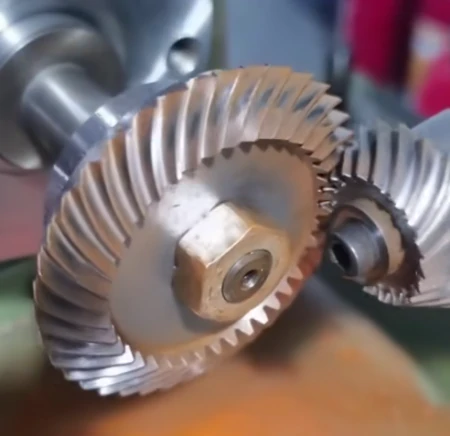
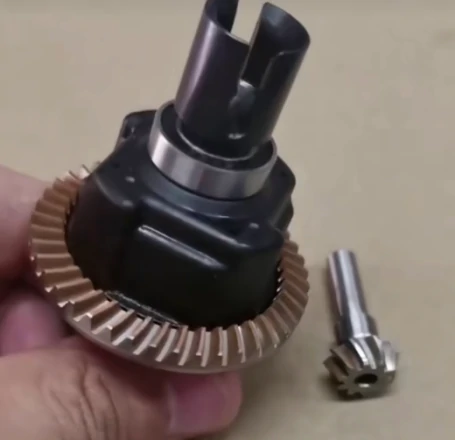
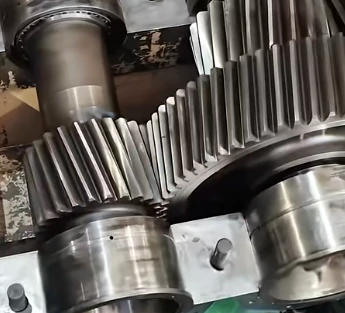
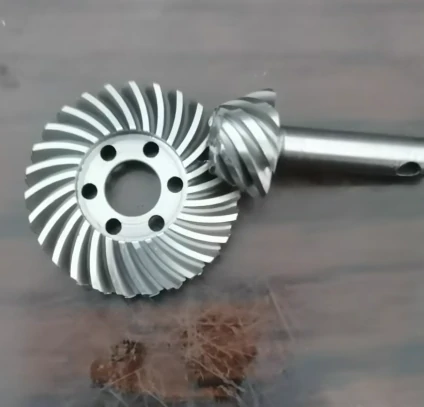
A typical hypoid gear set consists of a smaller pinion and a larger mating gear, often called a ring gear or crown gear. Its spiral tooth geometry creates a combination of rolling and sliding contact, influencing friction, heat generation, wear, and lubrication requirements. This design makes hypoid gears widely used in automotive differentials and selected industrial transmission systems.
For OEM projects, a hypoid gear set must be manufactured as a matched pair rather than as two independent components. The pinion and gear wheel need compatible tooth profiles, mounting dimensions, backlash, and contact characteristics to achieve the required meshing performance. This makes custom hypoid gear components particularly important when standard gear specifications cannot meet an equipment manufacturer’s dimensional or operating requirements. When sourcing a custom hypoid gear manufacturer in China, buyers should therefore evaluate not only machining capability but also specialized tooth accuracy inspection, heat treatment, and post-heat-treatment finishing.
How Do Hypoid Gears Work?
A hypoid gear set transfers torque through the meshing of spiral teeth on the pinion and the larger mating gear. As the pinion rotates, it drives the gear wheel according to the specified transmission ratio. Because the two shafts are offset rather than intersecting, the tooth surfaces experience a combination of rolling and sliding contact. This arrangement allows hypoid gears to transmit power in compact drivetrain layouts while accommodating shaft positions that conventional bevel gears cannot provide.
The degree of sliding depends on the shaft offset, tooth geometry, spiral angle, and operating conditions. Although this design offers greater flexibility in transmission layout, it also generates friction and heat at the mating tooth surfaces. Therefore, hypoid gear design must consider tooth geometry, mounting accuracy, load distribution, and operating conditions to maintain consistent meshing performance.
The transmission ratio is determined by the tooth counts of the pinion and gear wheel. However, the performance of a custom hypoid gear set also depends on shaft offset, mounting dimensions, and tooth contact characteristics. These factors influence torque transmission, speed reduction, backlash, and load distribution. For OEM manufacturers, coordinating these requirements during custom hypoid gear manufacturing helps ensure that the finished gear pair meets the intended operating and installation specifications.
Lubrication is equally important because sliding contact can generate considerable friction under load. Hypoid gear oil is formulated to protect mating tooth surfaces under high-pressure conditions and reduce wear. The appropriate lubricant should follow the equipment manufacturer’s specifications, taking into account transmitted load, rotational speed, operating temperature, and working environment. For OEM applications, lubrication requirements should be considered alongside gear geometry, material selection, heat treatment, and inspection criteria.
Key Design Characteristics of Hypoid Gear Components
The performance of custom hypoid gear components depends on how the pinion and gear wheel are designed to work together. Gear diameter and tooth count are only part of the design.Shaft offset, tooth geometry, mounting dimensions, and contact conditions affect torque transmission and load distribution. For OEM applications, these factors must match the equipment’s installation space, operating loads, and performance requirements before manufacturing.
Shaft offset provides drivetrain layout flexibility but also affects tooth geometry, bearing loads, mounting distances, and contact patterns. Custom hypoid gear design must therefore account for shaft positions, bearing support, and housing dimensions.
Tooth geometry is equally important. The spiral teeth engage progressively to support smooth meshing. Parameters such as spiral angle, tooth profile, and lead influence contact behavior and load distribution. Actual performance also depends on machining accuracy, lubrication, and assembly alignment. Therefore, precision hypoid gear machining must follow the approved tooth geometry and specified tolerances.
The pinion and gear wheel must be manufactured and inspected as a matched pair. Their tooth geometry, mounting distance, backlash, and contact pattern must meet the specified requirements. Even if individual components meet dimensional tolerances, incompatible geometry or positioning can affect meshing performance. Controlling both components as a gear set is therefore essential in custom hypoid gear manufacturing.
These requirements should be defined before production. Approved drawings should specify tooth geometry, shaft positions, mounting dimensions, and permissible backlash. For OEM buyers, providing complete specifications at the quotation stage helps us assess production feasibility and identify potential engineering issues early.
Advantages and Limitations of Hypoid Gears
Advantages of Hypoid Gears
Hypoid gears are particularly useful in transmission systems where shaft positioning and installation space are important design considerations. The offset shaft arrangement allows engineers to position the pinion and gear wheel without intersecting axes, offering greater flexibility in compact drivetrain designs. This makes custom hypoid gear sets suitable where conventional bevel gears cannot meet the required mounting dimensions or layout.
Another advantage is the progressive engagement of their spiral teeth. When the tooth geometry, mounting position, and contact pattern are properly controlled, hypoid gears can provide smooth power transmission and help reduce operating noise. Depending on the gear dimensions and application requirements, they can also transmit substantial torque within a relatively compact assembly. However, these benefits depend on material selection, heat treatment, tooth accuracy, lubrication, and operating conditions. For OEM projects, a custom hypoid gear manufacturer must consider these factors together to achieve the specified transmission performance.
Limitations of Hypoid Gears
The main limitation of hypoid gearing comes from the sliding contact between mating tooth surfaces. This movement generates friction and heat, making suitable lubrication essential, particularly under high loads or demanding operating conditions. Compared with some conventional gear arrangements, hypoid systems may also require more complex manufacturing processes and closer control of tooth geometry. These factors can increase production costs and make lubricant selection, installation accuracy, and maintenance planning more important. OEM engineers should evaluate these requirements alongside transmission performance, available space, operating speed, and expected service life before selecting a hypoid gear system.
Materials and Heat Treatment for Custom Hypoid Gears
Material selection is essential in custom hypoid gear manufacturing because the pinion and gear wheel must withstand repeated tooth contact, torque, and operating loads. Case-hardening alloy steels are commonly used for heavily loaded applications, providing a hard, wear-resistant tooth surface and a tougher core. Depending on the design, suitable materials may include 20MnCr5, 18CrNiMo7-6, and SAE 8620. The final choice depends on gear dimensions, load conditions, fatigue requirements, heat treatment, and specified mechanical properties.
For demanding applications, hypoid gear heat treatment is often designed around the required tooth surface hardness, core strength, and effective case depth. Carburizing followed by hardening and tempering is a common route for case-hardened gear components, while other treatments may be selected according to the material and engineering requirements. Heat treatment can also cause dimensional changes or distortion, potentially affecting tooth profile, lead, pitch, and runout. The manufacturing sequence must therefore coordinate pre-heat-treatment machining with the required finishing allowance and post-heat-treatment operations. Precision hypoid gear machining after thermal processing helps bring critical tooth geometry and dimensional features within the specified tolerances.
Material and process verification is essential when sourcing custom hypoid gears. Quality records may include material certificates, hardness and case-depth results, and traceable heat treatment records. Confirming material grade, heat treatment, finishing, and inspection requirements before production helps OEM buyers avoid components that meet dimensional tolerances but fail in service.
Industrial Applications of Hypoid Gear Systems
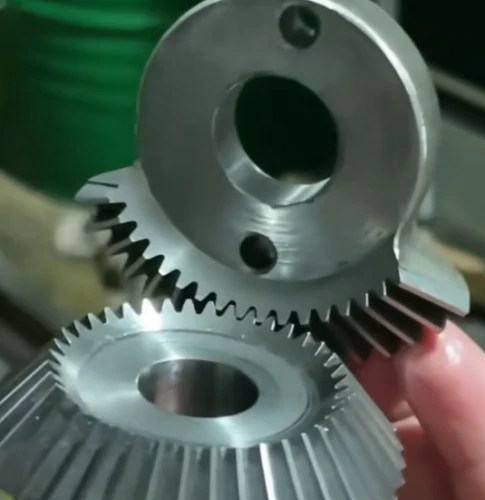
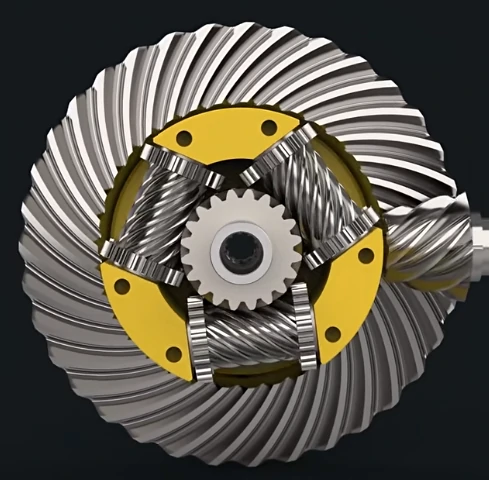
Hypoid gears are commonly used in automotive differentials, where offset shafts improve drivetrain packaging while transmitting torque. Custom designs accommodate specific shaft offsets, gear ratios, mounting dimensions, and load requirements.
Beyond automotive applications, hypoid gearing can also be considered for selected industrial power transmission systems. Its suitability depends on the equipment’s torque requirements, operating speed, gear ratio, installation space, lubrication conditions, and duty cycle.
Where the offset shaft arrangement offers packaging advantages, a custom hypoid gearbox may provide a suitable solution. However, gear selection should depend on the actual mechanical design and operating requirements.
For railway, marine, heavy machinery, and aerospace-related equipment, buyers must also consider operating conditions, reliability targets, and applicable standards. Hypoid gearing should only be used when validated for the application. Providing equipment details helps the manufacturing partner assess gear geometry, materials, heat treatment, machining, and inspection requirements before production.
Hypoid Gears vs. Spiral Bevel Gears
Hypoid gears and spiral bevel gears both use curved teeth to transmit torque between shafts, but their shaft arrangements differ. In a spiral bevel gear set, the shaft axes intersect, whereas a hypoid gear set uses non-intersecting, offset axes. This difference affects the gear geometry, tooth contact, mounting arrangement, and lubrication requirements.
| Comparison | Hypoid Gears | Spiral Bevel Gears |
| Shaft arrangement | Non-intersecting, offset axes | Intersecting axes |
| Tooth form | Curved spiral teeth | Curved spiral teeth |
| Contact behavior | Combined rolling and sliding contact, with significant sliding influenced by gear geometry and offset | Rolling and sliding contact, depending on tooth geometry and operating conditions |
| Lubrication | Requires lubricant suitable for hypoid contact conditions | Depends on gear design, load, and operating conditions |
| Installation layout | Allows shaft offset for greater drivetrain packaging flexibility | Designed for intersecting shaft arrangements |
| Key design considerations | Shaft offset, tooth geometry, contact pattern, backlash, and sliding conditions | Shaft angle, tooth geometry, contact pattern, and mounting accuracy |
The main advantage of hypoid gears is their ability to accommodate offset shaft arrangements, which can be useful in compact drivetrains and applications with specific installation constraints. Spiral bevel gears are more suitable when the input and output shafts need to intersect. Both designs require accurate tooth geometry, appropriate mounting conditions, and controlled contact patterns to achieve the intended transmission performance. The choice between hypoid gears vs. spiral bevel gears should therefore depend on the equipment’s actual mechanical requirements rather than assuming one design is universally superior.
For OEM projects, engineers should also consider transmitted load, operating speed, efficiency expectations, noise, lubrication, maintenance, and manufacturing cost. When developing custom hypoid gears for OEM applications, the shaft offset, material selection, heat treatment, tooth machining, and gear accuracy inspection must all be considered as part of the same manufacturing plan.
How Welleshaft Manufactures Custom Hypoid Gear Components
At Welleshaft, custom hypoid gear manufacturing begins with an engineering review of the drawings and transmission requirements. Our engineering team evaluates the gear ratio, shaft offset, tooth geometry, material grade, tolerances, heat treatment, and inspection standards. This review helps us establish a manufacturing route for the pinion and gear wheel as a matched pair, taking machining accuracy and subsequent processing into account.
Once the requirements are confirmed, we arrange blank preparation and specialized tooth machining for both components. Our machining process follows the specified tooth geometry, focusing on tooth profile, lead, pitch accuracy, and dimensional consistency. We also consider the mating relationship between the pinion and gear wheel throughout production to achieve the required meshing performance and transmission accuracy.
After tooth machining, Welleshaft selects heat treatment based on material and mechanical requirements, including carburizing, hardening, and tempering. Since heat treatment can affect dimensions and tooth geometry, we plan post-treatment finishing to restore tooth accuracy before final inspection.
The final stage involves specialized gear accuracy inspection and verification of the matched pinion and gear wheel. Welleshaft can support checks of tooth profile, tooth lead, pitch, runout, backlash, and tooth contact pattern according to the approved drawings and inspection requirements. These measurements help evaluate whether the finished components meet the specified geometric tolerances and meshing requirements. By connecting engineering review, specialized tooth machining, heat treatment, post-treatment finishing, and gear accuracy inspection, Welleshaft supports OEM buyers requiring custom hypoid gear components manufactured to project-specific specifications.
Submit Your Drawings for ReviewHow We Inspect Custom Hypoid Gear Components
We inspect custom hypoid gear components throughout production to ensure that the pinion and gear wheel meet the approved drawings and transmission requirements. Our quality control process covers dimensional accuracy, tooth geometry, matched-pair meshing, and material properties. Since hypoid gears operate as a matched pair, we evaluate both individual component accuracy and the interaction between the mating gears.
During dimensional inspection, we use CMMs and precision measuring instruments to check critical features such as shaft diameters, bores, mounting surfaces, and other drawing-defined dimensions. We also perform specialized hypoid gear accuracy inspections to verify tooth profile, lead, pitch, and runout against the specified tolerances.
For the finished gear set, we check backlash and tooth contact patterns to evaluate the meshing relationship between the pinion and gear wheel. These results help us assess contact conditions and identify potential issues that may affect load distribution, operating noise, and gear wear.
We also verify material and heat treatment requirements through material certificates, hardness results, and relevant heat treatment records. After finishing, we recheck critical dimensions and gear accuracy where required. Before shipment, we prepare the relevant inspection documentation to help OEM customers trace measurement results and confirm compliance with the approved specifications.
How to Choose a Custom Hypoid Gear Supplier in China for OEM Projects
Selecting a custom hypoid gear supplier in China involves more than comparing prices and delivery times. OEM buyers need to ensure the supplier can manufacture accurate tooth geometry, control shaft positioning, and maintain proper meshing between the pinion and gear wheel.
Engineering capability is especially important for non-standard designs. Before production, the manufacturer should review shaft offset, gear ratio, tooth geometry, material, tolerances, and mounting dimensions. A qualified custom hypoid gear manufacturer should identify potential machining and inspection issues early to ensure the finished gear pair meets the drawing requirements.
Specialized gear production is essential for precision hypoid gears. General CNC machining experience alone is not enough. The manufacturing process may include dedicated pinion and gear wheel tooth machining, heat treatment, and post-treatment finishing. Since heat treatment can affect tooth geometry, buyers evaluating hypoid gear manufacturers in China should ask how these processes are coordinated and final accuracy is verified.
Inspection requirements should be defined before production. Beyond dimensional checks, inspection may cover tooth profile, lead, pitch, runout, backlash, and tooth contact patterns. Material certificates, heat treatment records, and gear accuracy reports help verify compliance. Buyers should also confirm how nonconforming parts are identified and handled.
A quotation for custom hypoid gear components should cover the drawing revision, material, machining and heat treatment, setup costs, order quantity, inspection scope, and delivery schedule. Any exclusions or technical details should be clarified before production to avoid unexpected costs.
For OEM projects, a suitable custom hypoid gear supplier should explain the manufacturing route, inspection plan, and acceptance criteria based on approved drawings. Reviewing technical responses and quality documentation helps buyers evaluate suppliers beyond unit price alone.
Why Choose Welleshaft for Custom Hypoid Gear Components?
We provide one-stop contract manufacturing solutions in China for overseas OEM customers sourcing non-standard mechanical components. We coordinate engineering review, machining, heat treatment, finishing, and quality verification according to project drawings and technical requirements, helping buyers manage multi-process components through one manufacturing partner.
For custom hypoid gear components, we support specialized tooth machining for hypoid pinions and gear wheels, followed by heat treatment and post-treatment finishing where required. Since heat treatment can affect tooth geometry, these processes must be coordinated to achieve the required accuracy and meshing performance of the complete gear set.
Our gear inspection capabilities include tooth profile, lead, pitch, and runout checks, as well as backlash and tooth contact pattern verification. Depending on project requirements, quality documentation can also include material certificates, hardness results, and heat treatment records to verify compliance with the agreed specifications.
We also support other custom mechanical components requiring multiple manufacturing processes. Based on approved drawings, we review technical requirements, coordinate suitable production resources, and establish quality checkpoints throughout manufacturing to maintain process consistency.
For overseas buyers seeking a custom hypoid gear manufacturer in China, Welleshaft coordinates drawing-based production, from gear machining and heat treatment to finishing and inspection. We also support OEM projects involving multiple non-standard mechanical components.
Request a Free Quote for Custom Hypoid GearsFrequently Asked Questions About Custom Hypoid Gear Components
What is a hypoid gear?
A hypoid gear is designed to transmit torque between two offset shafts whose axes do not intersect. Its curved teeth create both rolling and sliding contact between the pinion and gear wheel. This arrangement provides flexibility in transmission layout, particularly where the input and output shafts cannot share an intersecting axis.
What is the difference between hypoid gears and spiral bevel gears?
The key difference is the relationship between the shaft axes. Spiral bevel gears have intersecting axes, while hypoid gears operate between offset, non-intersecting axes. This difference affects tooth geometry, contact conditions, lubrication, and installation space. The choice between hypoid gears and spiral bevel gears depends on the transmission layout, operating load, efficiency requirements, and available space.
What is a hypoid gearbox used for?
A hypoid gearbox uses a hypoid gear set to transfer power between offset shafts. One familiar application is the automotive differential, where the gear arrangement accommodates the drivetrain layout. Other applications must be evaluated against the required gear ratio, torque, operating speed, lubrication conditions, and installation requirements before selecting a custom hypoid gearbox.
Which materials are commonly used for hypoid gear components?
Alloy steels are commonly considered for custom hypoid gear components because their strength, hardness, and wear resistance can be adjusted through suitable heat treatment. The material grade depends on tooth loading, fatigue requirements, operating conditions, and the specified service life. The final selection should follow the engineering requirements of the gear set rather than a standard material choice applied to every project.
Why do hypoid gears require heat treatment?
Hypoid gear teeth experience repeated contact stress and sliding during operation. Heat treatment helps provide the required surface hardness and supporting core properties to resist wear and fatigue. The process must suit the selected material and application. Where heat treatment changes tooth geometry, post-heat treatment gear finishing may be needed to restore the specified accuracy.
How is the accuracy of hypoid gears inspected?
A complete inspection may include tooth profile, lead, pitch, and runout measurements, as well as backlash and tooth contact pattern checks between the mating gears. These results help assess both individual gear accuracy and how the pinion and gear wheel mesh together. Material verification, hardness results, and heat treatment records can also be included in the hypoid gear inspection process, depending on the project specifications.
Can custom hypoid gear components be manufactured from OEM drawings?
Yes. Custom hypoid gear components for OEM applications can be manufactured according to approved drawings and technical specifications. The review should cover the gear geometry, shaft offset, material, tolerances, heat treatment, and inspection criteria. Because the pinion and gear wheel function as a matched pair, their manufacturing and verification requirements need to be considered together before production begins.
What information is needed to request a quotation for custom hypoid gears?
When contacting a custom hypoid gear manufacturer, buyers should provide the latest drawings or technical specifications, required material, order quantity, and target delivery schedule. Gear geometry, shaft offset, mounting dimensions, heat treatment requirements, and inspection criteria are also important for evaluating the manufacturing route. If the gears belong to a larger transmission assembly, application details can help clarify operating conditions and avoid gaps during the quotation review.
Welleshaft provides custom hypoid gear components and OEM mechanical manufacturing solutions in China. Based on customer drawings, we support precision machining, process planning, and quality control for non-standard industrial parts.
Reviews
There are no reviews yet.