
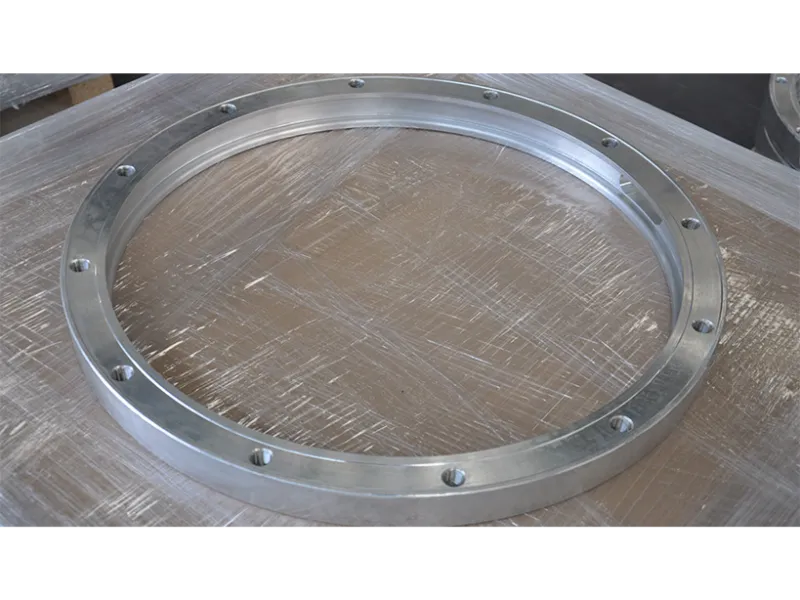
What Is Ring Rolling?
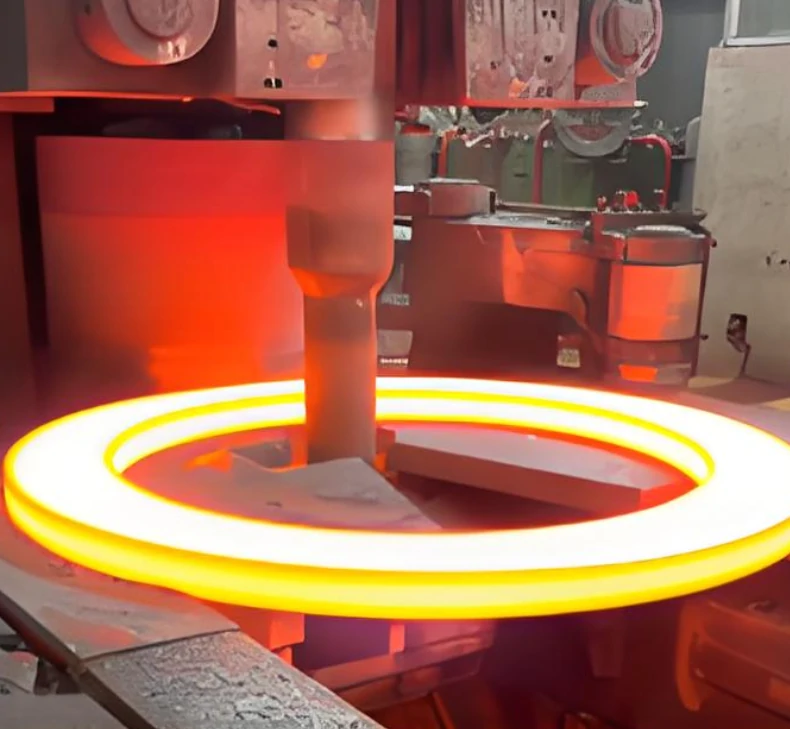
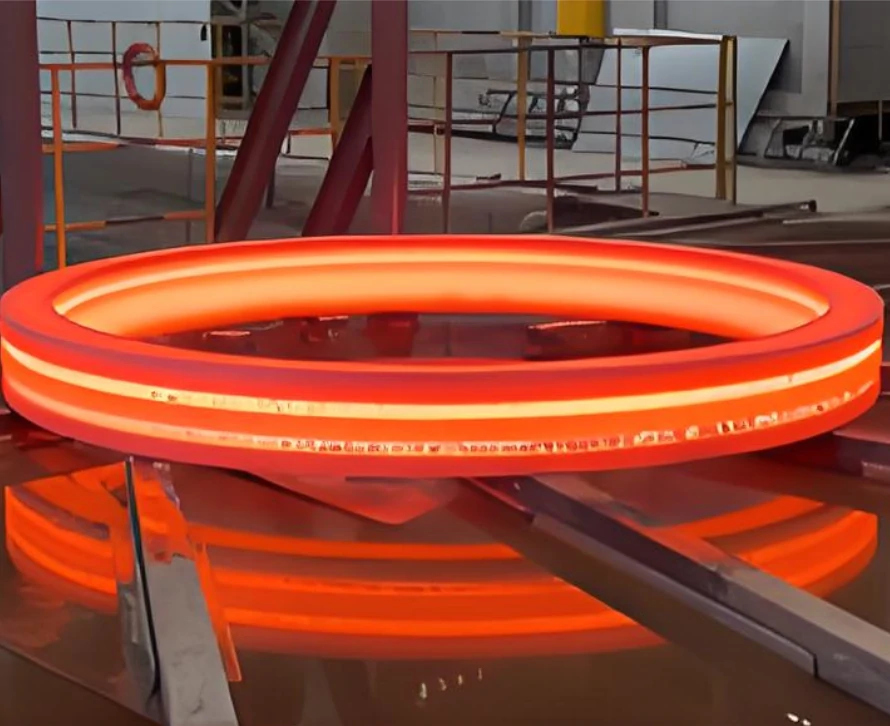
Ring rolling is a controlled metal forming process used to manufacture seamless rolled rings with defined diameters, wall thicknesses, and cross-sectional profiles. A heated ring preform is placed between forming rolls and gradually expanded through radial and axial deformation.
For most OEM applications, ring rolling produces a near-finished forged component rather than a final part. Additional processes, including heat treatment, CNC machining, surface treatment, and inspection, are usually required to meet final drawing specifications.
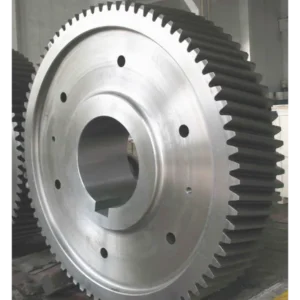
This process is widely used for bearing rings, gear rings, flanges, turbine rings, and other large ring-shaped components. Unlike roll forging, which reduces and elongates heated billets to produce shafts, axles, and gear blanks, ring rolling focuses on expanding and shaping ring preforms.
A complete manufacturing route integrates forming, machining, heat treatment, and inspection based on material specifications, tolerances, and quality requirements. This enables OEM customers to source finished industrial components through a single manufacturing partner.
How Does the Ring Rolling Process Work?
The ring rolling process normally starts with material preparation and preform production before the ring is progressively expanded and shaped through controlled deformation. The process parameters vary according to the material grade, ring size, cross-sectional design, production volume, and required mechanical properties. For custom rolled rings, the initial preform design and rolling parameters directly influence later operations, including heat treatment, machining allowance, and inspection requirements. These factors should be evaluated during process planning to avoid manufacturing issues in later stages.
Material Preparation and Preform Production
Production begins by selecting and cutting the required steel or alloy into a billet suitable for the component size and forming route. Material grade, heat number, and traceability are normally confirmed before heating and forging. The billet is then heated to the appropriate forming temperature and converted into a ring preform. Depending on the component size and material, the billet may first undergo upsetting and piercing to create a suitable ring preform before rolling.
Ring Rolling and Controlled Deformation
The heated preform is placed between the main roll and mandrel, where controlled radial deformation progressively reduces the wall thickness and increases the ring diameter. Axial rolls can also control the ring height and help maintain the required cross-sectional profile during rolling. Rolling parameters must be controlled according to the material grade, ring size, and cross-sectional profile. Improper deformation control may result in dimensional variation, uneven wall thickness, or difficulties during subsequent machining.
This stage is particularly important when manufacturing seamless rolled rings for industrial applications. The final dimensions are approached progressively rather than being produced in a single deformation step. The rolling process therefore needs to maintain stable deformation and consistent geometry throughout production, especially for larger rings or components with more complex cross-sections.
Dimensional Control and Heat Treatment
During and after rolling, key dimensions such as diameter, height, and cross-sectional profile are checked against component requirements. After forming, the ring may undergo normalizing, annealing, quenching and tempering, or other specified heat treatment processes to enhance mechanical properties based on the material grade and application needs. Heat treatment is also an important step in custom ring rolling projects where controlled hardness and mechanical performance are required.
CNC Machining and Finishing
Rolled rings normally require additional machining before they can be used as finished components. Depending on the drawing, the machining route may include turning, boring, drilling, milling, grinding, or other CNC machining operations. Machining removes the required allowance from the forged or rolled surface and brings the component to its final dimensions and tolerances. Surface treatment may also be added when the application requires improved wear resistance, corrosion protection, or a specified surface condition.
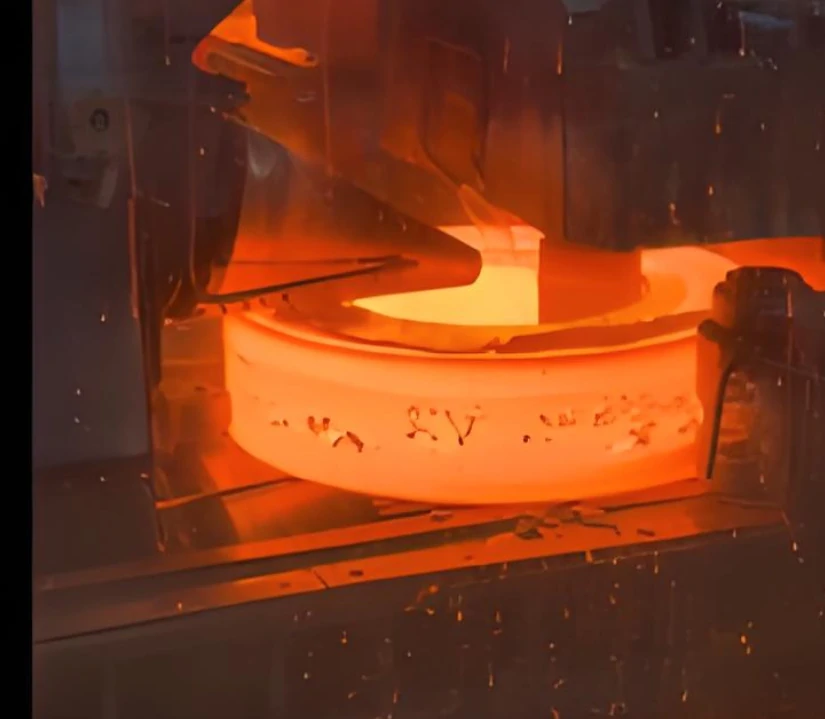
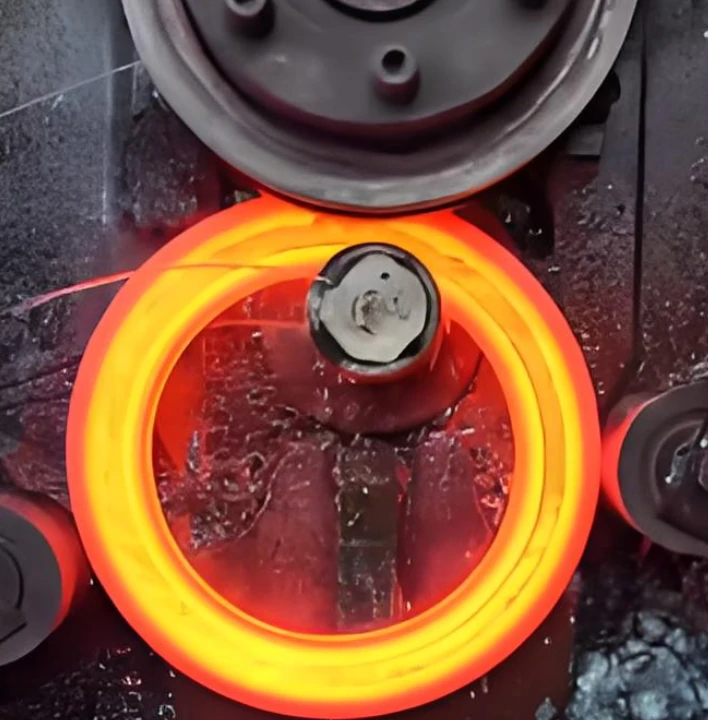
How Are Seamless Rolled Rings Manufactured for OEM Components?
Seamless rolled rings are manufactured without welded joints, making them suitable for applications requiring continuous material structure and reliable mechanical performance. The process starts with a forged billet or preform, which is pierced and expanded through radial and axial rolling to achieve the required diameter, height, and cross-sectional profile.
During seamless rolled ring manufacturing, controlled deformation reduces wall thickness while increasing ring diameter. This process creates continuous grain flow and improves material efficiency compared with machining large rings from solid stock. Final quality depends on material condition, preform design, deformation control, and dimensional requirements.
After rolling, custom rolled rings typically require further processing, including heat treatment, CNC machining, surface treatment, and inspection, to meet drawing specifications for mechanical properties, tolerances, and surface performance.
For OEM buyers, the manufacturing process is developed according to component drawings and technical requirements, combining forming and secondary processes to produce finished seamless rolled ring components.
Materials Used for Ring Rolling
The selection of ring rolling materials depends on the performance requirements of the finished component. Factors such as strength, hardness, wear resistance, corrosion resistance, operating temperature, fatigue performance, and machinability should be considered. Material grade also influences forming conditions, heat treatment, machining allowance, and inspection requirements.
Carbon steel and alloy steel are commonly used for industrial rings requiring high strength, toughness, and reliable mechanical performance. Alloy steels are suitable for components exposed to heavy loads or fatigue conditions, while stainless steel is preferred for applications requiring corrosion resistance and long-term durability. Tool steels and high-performance alloys may be selected for demanding environments requiring high hardness, wear resistance, or temperature resistance.
For custom ring rolling, material selection should match the component design, load conditions, operating environment, production volume, and machining requirements. The chosen material must also support the required forming process, heat treatment, and quality standards.
What Sizes of Seamless Rolled Rings Can Be Manufactured?
The manufacturing capability of seamless rolled rings depends on forming equipment, material grade, ring geometry, and application requirements. Unlike standard products, custom rolled rings are produced according to engineering drawings that define dimensions, cross-sectional profile, and machining allowance.
For OEM projects, ring dimensions should be evaluated together with the complete manufacturing route. Large-diameter rings may require suitable forging equipment, controlled rolling, heat treatment, and machining capabilities to meet final drawing requirements.
Typical project evaluation factors include:
- Outside diameter and inside diameter requirements
- Ring height and cross-sectional profile
- Material grade and mechanical properties
- Machining allowance after rolling
- Heat treatment requirements
- Final dimensional tolerances and inspection standards
For custom seamless rolled rings, 2D drawings or 3D CAD models help evaluate manufacturability and required processes, including CNC machining, heat treatment, and inspection.
What Are Seamless Rolled Rings Used For?
Seamless rolled rings are used for industrial components requiring continuous structure, reliable performance, and dimensional accuracy, including bearing rings, gear rings, flanges, turbine rings, and pressure-related components.
Typical applications include wind turbine components, pressure equipment, industrial gear systems, mining machinery, heavy-duty transmission systems, and energy equipment. These applications often require reliable mechanical properties, controlled dimensions, and traceable material quality. The required design can vary significantly between applications. A large structural ring for heavy equipment may require a different preform, rolling capacity, heat treatment, and machining route from a smaller precision ring used in mechanical equipment.
For this reason, custom ring rolling should be evaluated according to the finished component rather than the application category alone. Ring diameter, cross-sectional profile, material grade, operating loads, production quantity, and required tolerances all influence the appropriate manufacturing route. Additional processes, including heat treatment, CNC machining, surface treatment, and NDT, may be required to meet final specifications. OEM buyers should provide drawings, material details, quantity, tolerances, and inspection requirements for supplier evaluation. The appropriate manufacturing route should be determined according to component geometry, material grade, operating conditions, and inspection requirements.
Send Your Drawings and Get a Custom Manufacturing Solution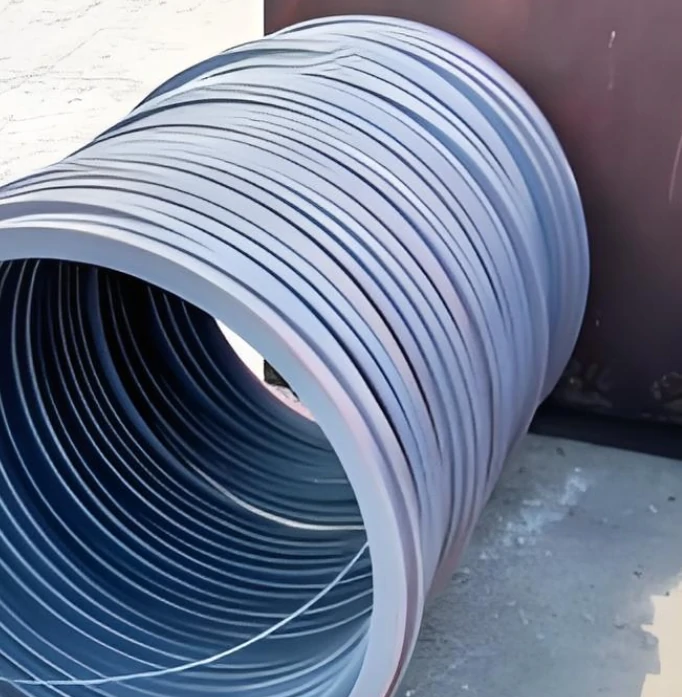
Ring Rolling vs Roll Forging
Ring rolling and roll forging are related metal forming processes, but they are used for different component geometries and manufacturing needs. The main differences include billet shape, deformation direction, and final component design.
| Process | Component Geometry | Typical Applications | Main Purpose |
|---|---|---|---|
| Ring Rolling | Ring-shaped components with controlled wall thickness and cross-section | Seamless rolled rings, bearing rings, gear rings, flanges, turbine rings | Expands and shapes ring preforms through radial and axial deformation |
| Roll Forging | Elongated components such as shafts and bars | Shafts, axles, gear blanks | Reduces and elongates heated billets through controlled deformation |
| Open Die Forging | Large and simple geometries | Large shafts, blocks, heavy components | Forms large parts without dedicated dies |
| Closed Die Forging | Complex near-net shapes | Automotive and industrial forged components | Uses dies to achieve repeatable shapes and dimensions |
Selecting the right forging process depends on the component geometry, material, production volume, and performance requirements. Ring-shaped parts are typically produced by ring rolling, while shafts and elongated components are often made through roll forging. Large simple parts may require open die forging, whereas complex high-volume components are usually better suited for closed die forging.
For custom forged components, key factors such as billet design, material grade, deformation requirements, machining allowance, tolerances, heat treatment, and inspection should be evaluated together.
For OEM buyers, an experienced manufacturing partner can review drawings and technical specifications to determine the most suitable process. The selected method can then be combined with secondary operations, including heat treatment, CNC machining, surface treatment, and inspection, to produce finished components.
Ring Rolling vs Ring Forging
Ring forging is a broad term for forging methods used to produce ring-shaped components, while ring rolling is a specific process that expands and shapes a ring preform between rolls. In many applications, ring rolling is part of the overall ring forging manufacturing route rather than a separate alternative.
The best method depends on the required ring geometry, material, dimensions, and production requirements. Ring rolling is ideal for seamless rolled rings requiring controlled expansion, defined cross-sectional profiles, and consistent dimensions. Other ring forging methods may be selected for very large, simple geometries or applications with different deformation and production requirements.
For custom ring forging and custom ring rolling, the manufacturing route should be determined from the finished component rather than from the process name alone. Ring diameter, wall thickness, cross-section, material grade, mechanical requirements, production quantity, machining allowance, and final tolerances all influence the choice of forming method. The available forging equipment and subsequent heat treatment and machining capabilities also need to be considered.
A custom ring component may therefore require more than one forming operation. Depending on the design, the route can combine billet preparation, forging and piercing, ring rolling, heat treatment, CNC machining, surface treatment, and final inspection. For OEM buyers sourcing custom forged components, Welleshaft can evaluate these requirements and coordinate the appropriate manufacturing route for the finished non-standard industrial component.
Advantages of Ring Rolling for Custom Components
The main advantages of ring rolling come from forming components through controlled plastic deformation rather than machining them from solid stock. This improves material utilization, reduces machining allowance, and develops continuous grain flow around the ring, which can support consistent mechanical performance under load.
Ring rolling is also well suited for large-diameter rings and components requiring controlled dimensions and cross-sectional profiles. Compared with machining large rings from solid material, rolled preforms provide a more efficient starting geometry for custom rolled rings and other non-standard industrial components.
However, the effectiveness of ring rolling depends on factors such as material grade, ring geometry, preform design, equipment capability, rolling parameters, and production requirements. The process should therefore be evaluated based on the specific component requirements.
For custom ring rolling, the complete manufacturing route may include preform forging and piercing, ring rolling, heat treatment, CNC machining, surface treatment, and dimensional or NDT inspection to achieve the final specifications.
CNC Machining and Heat Treatment of Rolled Rings
A rolled ring is typically a near-finished forged component rather than a final machined part. After rolling, machining allowance is retained to achieve the required dimensions, tolerances, and surface conditions through subsequent machining. For custom rolled rings, the allowance should be considered during billet preparation, preform forging, and ring rolling.
Depending on the drawing requirements, CNC machining of seamless rolled rings may include turning, boring, drilling, milling, grinding, and other precision operations. The machining process depends on the ring geometry and required features, such as bores, flange surfaces, mounting holes, grooves, and functional surfaces. Proper allowance helps achieve final specifications while reducing unnecessary machining time.
Heat treatment is another critical stage because mechanical properties depend on the material grade and application requirements. Processes such as normalizing, annealing, quenching and tempering may be applied to achieve the required hardness, strength, and toughness.
For custom component manufacturing, forming, heat treatment, machining, and inspection should be planned together. Material condition and heat treatment can affect machining performance and final dimensions. Welleshaft supports integrated manufacturing from ring rolling and heat treatment to CNC machining and inspection for custom industrial components.
Quality Inspection for Seamless Rolled Rings
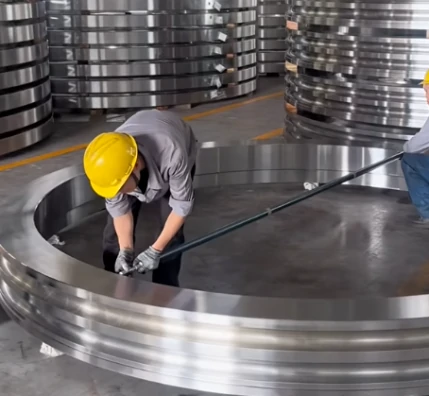
Quality control for seamless rolled rings covers the complete manufacturing process, from material preparation and forming to heat treatment, machining, and final inspection. The goal is to verify not only final dimensions but also material traceability, mechanical properties, and internal and surface quality.
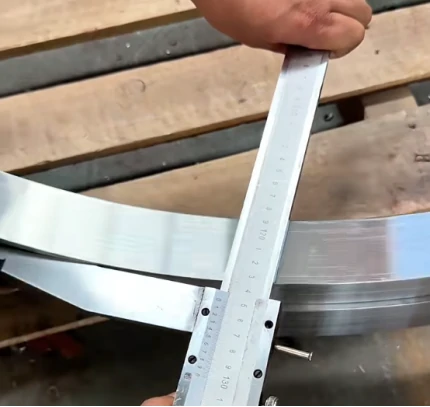
Material verification begins before production by checking the material grade, heat number, and related documentation. After forging and ring rolling, dimensional inspection confirms key features such as ring diameter, height, and wall thickness. Hardness and mechanical testing may also be performed after heat treatment to verify the required properties.
For critical applications, ultrasonic testing of forged rings can detect internal defects, while magnetic particle inspection can identify surface and near-surface discontinuities in suitable materials. The selected NDT inspection method depends on material type, component geometry, service conditions, and applicable standards.
After machining, CNC dimensional inspection verifies the finished ring against the approved drawing and tolerances. Surface condition and machined features are also checked before shipment. For custom rolled rings, the inspection plan should be defined according to the component requirements and applicable standards.
Welleshaft provides integrated quality control with material verification, inspection, hardness testing, NDT, and CNC inspection for custom industrial components.
Custom Ring Rolling Services for OEM Industrial Components
Welleshaft provides custom ring rolling services for OEM components requiring specific dimensions, material grades, mechanical properties, machining tolerances, and inspection requirements. Each project is evaluated based on the component drawing, material specifications, and quality requirements.
The manufacturing route may include forging and piercing, ring rolling, heat treatment, CNC machining, surface treatment, and final inspection. These processes are selected according to the component geometry, material, quantity, tolerances, and performance requirements. This approach is suitable for custom rolled rings, seamless rings, forged rings, and other non-standard industrial components.
For OEM buyers, one manufacturing partner simplifies procurement and coordinates forming, heat treatment, machining, and inspection. Welleshaft develops practical solutions based on drawings, material specifications, and inspection requirements.
How to Choose a China Ring Rolling Manufacturer
When selecting a China ring rolling manufacturer, overseas buyers should evaluate more than equipment and production capacity. The key is whether the supplier can control the complete manufacturing process, from material preparation and preform production to ring rolling, heat treatment, CNC machining, and final inspection. Material traceability, process control, dimensional accuracy, and technical documentation should meet the requirements of the finished component.
For custom ring rolling projects, buyers should confirm whether the supplier can handle 2D drawings, 3D CAD models, and secondary processes such as machining, surface treatment, and NDT inspection to deliver custom rolled rings and other non-standard components.
OEM buyers should also verify whether the supplier can provide finished components rather than only perform the ring rolling operation. Factors such as ring geometry, material selection, production volume, machining allowance, tolerances, and performance requirements can influence the final manufacturing route.
Working with a China ring rolling manufacturer that coordinates multiple production stages can simplify procurement and supplier management. Welleshaft integrates forging, ring rolling, heat treatment, CNC machining, surface treatment, and inspection to provide complete custom manufacturing solutions for industrial components.
Why Choose Welleshaft for Custom Component Manufacturing
Welleshaft provides one-stop contract manufacturing solutions for non-standard industrial components, helping OEM buyers manage multiple production processes through one coordinated supply chain. The manufacturing route is developed based on the finished component requirements, combining forming, machining, finishing, and quality control as needed.
Depending on the component design, the process may include ring rolling, roll forging, forging, CNC machining, heat treatment, surface treatment, dimensional inspection, and non-destructive testing.
Welleshaft coordinates qualified production resources according to the approved drawings, material specifications, production volume, tolerances, and inspection requirements to deliver finished custom components.
Contact Our Team for Your Project Requirements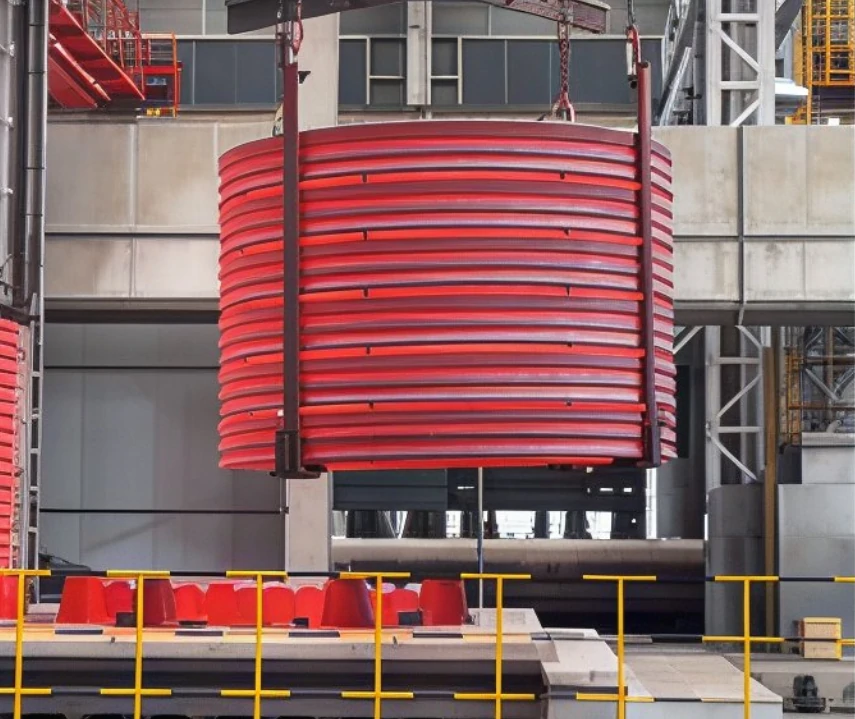
What Information Is Needed for a Custom Ring Rolling Project?
To evaluate a custom ring rolling project, manufacturers typically review the available component information, including a 2D drawing or 3D CAD model, material grade, dimensions, cross-sectional profile, production quantity, and performance requirements. This helps determine whether ring rolling is suitable and what preform design and secondary processes are needed.
Factors such as heat treatment, machining tolerances, surface treatment, inspection standards, and quality documentation can affect the forming route, machining allowance, and final inspection plan. Reviewing these details early helps establish an effective manufacturing approach.
For other custom forged components, buyers should provide key details such as geometry, forging requirements, mechanical properties, machining features, and operating conditions to avoid unsuitable process selection.
Based on the technical information, Welleshaft develops a suitable manufacturing solution by combining forming, CNC machining, heat treatment, surface treatment, and inspection for non-standard industrial components.
Frequently Asked Questions
What Is Ring Rolling?
Ring rolling is a metal forming process used to produce ring-shaped components from a forged or pierced ring preform. During the process, controlled radial and axial deformation progressively reduces the cross-section while increasing the ring diameter. This makes ring rolling suitable for producing seamless rolled rings with defined dimensions and cross-sectional profiles for industrial applications.
What Is the Difference Between Ring Rolling and Roll Forging?
Ring rolling and roll forging use controlled deformation, but they are intended for different component geometries. Ring rolling expands and shapes a ring preform to produce seamless rolled rings, while roll forging progressively reduces and elongates a heated billet to produce components such as shafts, axles, and gear blanks. The appropriate process depends on the finished component rather than the process name alone.
What Are Seamless Rolled Rings Used For?
Seamless rolled rings are widely used in bearing systems, gear assemblies, flanges, turbine equipment, pressure components, wind power systems, and heavy machinery. Custom rolled rings are also available for OEM applications where standard sizes or materials cannot meet specific component requirements.
What Materials Can Be Used for Ring Rolling?
Common ring rolling materials include carbon steel, alloy steel, stainless steel, and other alloys suitable for the required forming and heat treatment conditions. Material selection depends on factors such as mechanical properties, operating temperature, corrosion resistance, wear requirements, and the intended application. For custom ring rolling, the material grade should be confirmed together with the component drawing and required final properties.
Can Ring Rolled Components Be CNC Machined?
Yes. Ring rolling normally produces a near-finished forged shape rather than a finished machined component. Depending on the drawing, CNC machining of rolled rings may include turning, boring, milling, drilling, grinding, or other operations to achieve the required dimensions, tolerances, and functional features. Heat treatment and inspection may also be included before or after machining according to the component requirements.
Welleshaft provides one-stop contract manufacturing solutions fornon-standard industrial components, combining ring rolling, forging, CNC machining, heat treatment, surface finishing, and inspection for OEM buyers.

 English
  Português do Brasil
  Deutsch (Österreich)
  Deutsch (Schweiz)
  English (UK)
  English (Australia)
  English (New Zealand)
  Deutsch
  Français du Canada
  Français
  Français de Belgique
  Italiano
  English (South Africa)
  Português
  Español
  Español de México
  Español de Perú
  Español de Colombia
  العربية
  日本語
日本語  Русский
  한국어
한국어  Tiếng Việt
  ไทย
ไทย
Reviews
There are no reviews yet.