
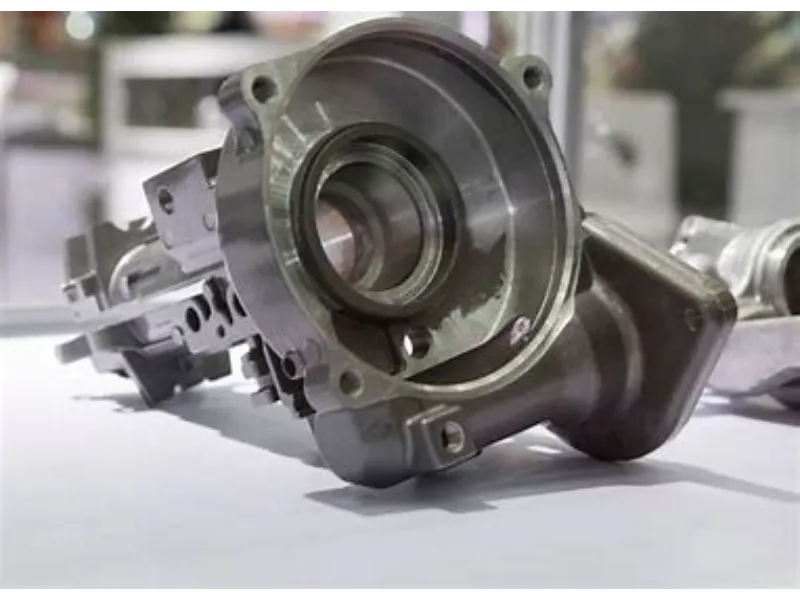
What Is Die Casting and How It Works in Manufacturing?
Die casting is a high-pressure metal forming process where molten metal is injected into a hardened steel mold (die) to produce precise parts. Controlled temperature and pressure ensure the metal fills the cavity, solidifies quickly, and yields stable components with minimal dimensional variation.
Similar to plastic injection molding, die casting defines parts through a mold cavity. It is mainly used for non-ferrous metals with good flow and low melting points, such as aluminum, zinc, magnesium, and copper alloys, making it ideal for complex, repeatable components.
Two main systems exist: manufacturers use hot chamber machines, which integrate the melting furnace and handle zinc, magnesium, or lead alloys; and they use cold chamber machines, where operators pour molten metal from an external furnace, suitable for higher-melting-point metals like aluminum and copper alloys.
Die casting produces components with tight dimensional control, smooth surfaces, and strong structural consistency, enabling rapid replication of complex shapes without extensive secondary machining. Tolerances can be very tight, especially for zinc and aluminum parts.
A major advantage is near-net-shape production: the reusable steel die supports high-volume output, unlike sand or investment casting, where molds are often consumed.
What Are the Different Types of Die Casting Processes in Industry?
Hot Chamber Die Casting Process
Hot chamber die casting, sometimes called gooseneck die casting, is ideal for low-melting-temperature metals like zinc, magnesium, and certain lead or tin alloys. In this method, the molten metal is held inside the machine itself. The system uses a “gooseneck” to deliver the molten metal directly into the mold cavity.
The mold consists of two halves: a stationary die half fixed to the machine and a movable die half that ejects the finished casting. The plunger lifts to allow metal into the shot chamber, then pushes it into the closed mold under high pressure.This process allows manufacturers to fill even complex geometries accurately. After the metal cools and solidifies, the machine ejects the casting, and operators prepare the mold for the next cycle.
Manufacturers favor this process for high-volume production because it delivers fast production speeds, consistent quality, and high dimensional accuracy with minimal post-processing.Its advantages include improved surface quality, extended die life, and reduced porosity in die cast parts.
Cold Chamber Die Casting Process
Cold chamber die casting is suited for high-melting-temperature metals such as aluminum, brass, copper, and some magnesium alloys. Unlike hot chamber casting, the molten metal is prepared in a separate furnace and only brought to the machine immediately before injection.
Once transferred into the shot chamber, a hydraulic ram forces the metal into the die under very high pressure, typically ranging from 2,000 psi to 20,000 psi. This results in dense die castings with minimal porosity and excellent surface finish.The mold configuration resembles hot chamber dies, featuring fixed and movable halves, and operators inject the metal either horizontally or vertically depending on the machine.
Manufacturers often choose cold chamber die casting for parts that require higher mechanical strength and durability because high-melting-point metals produce tougher, more heat-resistant castings.This method works well for both thin and thick-walled components and accommodates detailed designs. After solidification, castings may go through trimming, shot blasting, or machining to meet precise tolerances.
Key Differences Between Hot and Cold Chamber Die Casting
| Fonctionnalité | Hot Chamber Die Casting | Cold Chamber Die Casting |
| Metal Type | Low-melting-point alloys (zinc, magnesium, lead/tin) | High-melting-point alloys (aluminum, brass, copper) |
| Molten Metal Source | Inside casting machine | External furnace, transferred to shot chamber |
| Cycle Speed | Faster, suitable for high-volume production | Slower, suitable for medium/low volume |
| Equipment Wear | Less wear on the die due to lower temperatures | Higher wear due to higher temperatures |
| Application | Small to medium parts with tight tolerances | Components requiring strength, durability, complex shapes |
Both hot and cold chamber processes produce precision die cast parts efficiently, but material selection and production volume determine the most suitable method.
Choosing Between Hot and Cold Chamber Die Casting
- Use hot chamber die castingwhen working with low-melting alloys and high-volume production, prioritizing speed and cycle efficiency.
- Use cold chamber die castingfor high-melting alloys and parts requiring superior mechanical strength, surface detail, and dimensional stability.
Understanding the differences ensures proper die casting process selection, maximizing efficiency, reducing defects, and extending mold life.
How Do the Various Types of Die Casting Process Differ
Die casting is not a single manufacturing method—it includes several process variations designed for different part geometries, material behaviors, and quality requirements. Each process controls how molten metal enters and fills the mold, which directly affects porosity, surface finish, cycle time, and structural performance.
Below are the main types of die casting processes used in modern manufacturing.
Gravity Die Casting
Gravity die casting relies on natural gravitational force to guide molten metal into the mold cavity instead of using high injection pressure.Operators pour the metal manually or use an automated ladling system, allowing it to flow into the cavity under its own weight.
Manufacturers commonly use this method for simpler part designs with relatively thick wall sections. Manufacturers favor this method when cost control is a priority and ultra-high precision is not required. They often select aluminum alloys because these metals offer good flow characteristics and stable solidification behavior.
Key characteristics of Gravity Die Casting:
- Lower tooling and equipment cost
- Suitable for medium to low complexity components
- Best for symmetrical or simple geometries
- Commonly used with aluminum alloys
Vacuum Die Casting
In vacuum die casting, air is actively removed from the mold cavity before molten metal is injected. This vacuum environment helps reduce trapped gases and minimizes turbulence during filling.
As a result, the final cast parts typically have fewer internal defects and improved structural integrity. This makes the process suitable for components that require better mechanical performance or post-processing treatments.
Advantages of Vacuum Die Casting:
- Reduced porosity and gas entrapment
- Improved density and surface quality
- Better suitability for heat treatment
- More consistent mechanical properties
This process is often chosen for precision components where internal quality is more critical than production speed.
Squeeze Die Casting
Squeeze die casting combines casting and forging principles. In this method, operators pour molten metal into the mold cavity, and the machine then applies extremely high pressure as the mold closes to compress the material during solidification.
This pressure improves material density and ensures that the molten metal fully fills complex or narrow sections of the mold.
It is particularly effective for materials with higher viscosity and applications requiring enhanced strength.
Key benefits of Squeeze Die Casting:
- High density and low porosity
- Excellent mechanical strength
- Improved filling of complex geometries
- Strong structural performance after solidification
Semisolid Die Casting (Thixoforming)
Semisolid die casting, also known as thixoforming, processes metal in a partially solid state rather than fully molten. The material is heated until it reaches a semi-solid “slurry” condition and then injected into the mold under controlled pressure.
Because manufacturers do not keep the material fully liquid, the flow remains more stable and shrinkage decreases significantly during cooling. This improves dimensional accuracy and repeatability. Manufacturers widely use this method when they require high precision and reduced deformation.
Advantages of Semisolid Die Casting:
- Lower shrinkage compared to traditional methods
- Improved dimensional stability
- Reduced thermal stress on molds
- Higher accuracy in complex parts
Pressure Die Casting
Pressure die casting is one of the most widely used high-speed manufacturing methods in the industry. It uses a combination of high pressure and rapid injection speed to force molten metal into every corner of the mold cavity.
This ensures excellent replication of fine details and produces smooth surface finishes, even for highly complex geometries.
It is commonly used in mass production environments where consistency and efficiency are essential.
Key features of Pressure Die Casting:
- High injection speed and pressure
- Excellent surface finish quality
- Suitable for complex and detailed parts
- High production efficiency for large volumes
What Is Die Casting Design Geometry and Its Role in Production?
Die casting design geometry plays a major role in determining how molten metal flows, fills the cavity, cools, and solidifies during production. Proper geometry design directly affects stress distribution, grain structure, shrinkage, and the risk of porosity in die cast parts. Different alloys also respond differently to thermal stress and solidification behavior, making geometry planning critical for both part quality and manufacturing efficiency.
Several design factors must be evaluated during the early stages of die casting part design, including:
- Surface finishing requirements
- Metal flow behavior and fluidity
- Shrinkage control
- Post-casting inspection accessibility
- Solidification consistency
- Risks of thermal cracking or deformation
Careful geometry optimization helps improve casting stability, reduce defects, and extend die life.
Draft
In die casting design, draft angle refers to the slight taper added to vertical walls and surfaces to allow smooth ejection from the mold. The required angle depends on:
- Surface texture
- Wall depth
- Alloy type
- Part complexity
Insufficient draft can lead to sticking, surface damage, or difficulty during ejection. Proper draft design improves mold release and reduces wear on the die.
Fillet Radii
Fillet radii in die casting help strengthen components by reducing stress concentration at sharp internal corners. Instead of allowing stress to accumulate in one small area, rounded transitions distribute force more evenly across the part structure.
Benefits of proper fillet design include:
- Reduced cracking risk
- Improved metal flow
- Better structural durability
- Lower chances of distortion during cooling
Rounded corners also improve filling performance and minimize weak points inside the casting.
Parting Line
The parting line is the location where the two die halves meet during the casting process. It defines how the mold separates and determines:
- Internal and external part surfaces
- Ejector side and cover side orientation
- Flash formation areas
- Overall mold complexity
A well-positioned die casting parting line simplifies tooling design and improves production consistency.
Bosses
Bosses in die casting are raised cylindrical or structural features used for mounting points, fasteners, or support locations. Proper boss design helps maintain consistent wall thickness while minimizing the need for additional machining operations after casting.
Well-designed bosses can:
- Improve structural support
- Reduce sink marks
- Maintain dimensional stability
- Lower secondary processing costs
Ribs
Ribs in die casting are thin structural sections added to strengthen parts without significantly increasing weight. They also improve molten metal flow by guiding material through difficult sections of the die cavity.
Additional advantages of ribs include:
- Enhanced stiffness and rigidity
- Faster and easier ejection
- Reduced material usage
- Better filling of thin-wall areas
Proper rib placement improves both casting performance and part strength.
Holes and Windows
Holes and windows in die casting parts require careful design because they can interrupt molten metal flow and complicate part ejection. These features generally need larger draft angles to prevent sticking between the casting and die surfaces.
Poorly designed openings may cause:
- Incomplete filling
- Air entrapment
- Increased porosity
- Ejection damage
Optimizing the shape and placement of holes and windows helps maintain smooth metal flow and consistent casting quality.
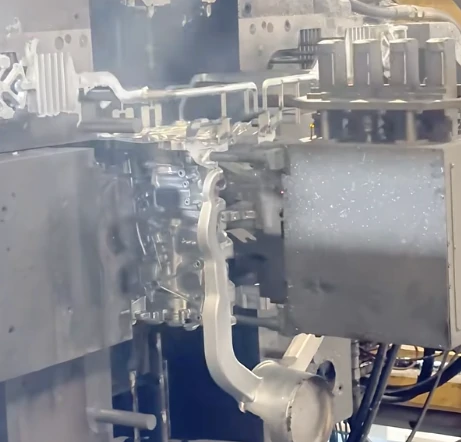
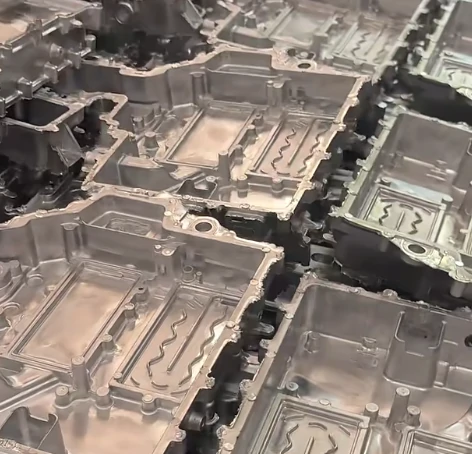
How to Design a Mold for Die Casting for Precision Parts?
The design of a die casting mold directly affects part quality, production efficiency, dimensional stability, and tooling lifespan. Manufacturers typically make a standard die casting die from hardened steel alloys, and it consists of two primary sections: the fixed half, often called the cover die, and the movable ejector half.
Molten metal enters the mold cavity through a tapered sprue opening. Inside the die system, runners and gates guide the metal flow into the cavity while maintaining controlled filling conditions. After solidification, ejector pins push the casting out of the mold safely and efficiently.
To maintain stable operating temperatures, the die also includes cooling and lubrication channels. Cooling systems help manage thermal expansion and reduce overheating, while lubricants prevent sticking between the casting and mold surface. In most operations, water-based lubricants mixed with oil are commonly used to improve release performance and surface finish quality.
The service life of a die casting mold can range from thousands to hundreds of thousands of cycles depending on alloy type, injection pressure, thermal stress, and maintenance practices. Since tooling represents a major investment in the die casting process, proper mold design is critical for controlling long-term production costs.
Types of Dies Used in Die Casting
Different production requirements require different die casting die designs. Manufacturers select die structures based on production volume, part complexity, and casting size.
Single Cavity Die
A single cavity die produces one casting during each injection cycle. This type of die is commonly used for low-volume production, prototype manufacturing, or large components requiring high clamping force. It is also suitable for parts with complicated geometries or multidirectional features.
Multiple Cavity Die
A multiple cavity die allows several identical parts to be produced simultaneously within one shot. This design improves production efficiency and lowers per-part manufacturing costs in high-volume applications.
Combination Die
Manufacturers design a combination die, sometimes called a family die, to cast several different but related components in the same cycle. They often assemble these parts together later. This approach helps improve productivity while reducing material waste and tooling setup time.
Unit Die
A unit die uses interchangeable inserts installed inside a larger master mold base. Manufacturers keep the primary die structure fixed while swapping different inserts to produce various components. This method helps reduce tooling costs and shortens setup time for smaller parts, although operators must consider insert size and weight limitations.
Important Factors in Die Casting Mold Design
Successful mold design for die casting requires balancing manufacturability, metal flow behavior, cooling performance, and final part quality. Several important design principles should be evaluated during the development stage.
Draft Angles
Proper draft angles in die casting allow cast parts to release smoothly from the mold cavity without surface damage. In most cases, draft angles between one and three degrees are recommended depending on part geometry and surface texture.
Wall Thickness
Uniform wall thickness is essential for maintaining stable solidification and minimizing casting defects. Thick sections may increase the risk of shrinkage porosity, while extremely thin areas can create warpage, incomplete filling, or dimensional distortion.
Avoid Sharp Corners
Rounded edges and smooth transitions are preferred in die casting part design. Sharp corners tend to create localized stress concentrations that may lead to cracking or premature mold wear.
Undercuts
Excessive undercuts can complicate part ejection and increase tooling complexity. Minimizing undercuts helps simplify mold construction and improves production efficiency.
Parting Line Design
The parting line is the separation point between the two mold halves. Its location should be carefully selected to avoid affecting critical surfaces, dimensional tolerances, or cosmetic areas of the casting.
Gate and Runner Design
The arrangement of gates and runners plays a major role in molten metal flow behavior. Proper gate design in die casting helps achieve balanced filling, reduced turbulence, and fewer internal defects.
Ejector Pin Placement
Correct ejector pin placement prevents deformation or marking on finished components. Pins should be positioned in structurally strong areas to ensure stable part removal.
Surface Finish Requirements
The condition of the mold cavity surface directly influences the final casting appearance. A smoother mold finish generally improves surface quality and helps reduce visible defects on the finished part.
What Are the Steps in the Die Casting Process from Start to Finish?
Manufacturers typically organize the die casting process into a series of controlled stages to ensure stable production, consistent part quality, and repeatable dimensional accuracy. While details may vary depending on alloy type, component complexity, and machine setup, the core workflow generally follows a structured sequence from mold preparation to final finishing.
Mold Design and Preparation
The first stage in the die casting process steps begins with detailed mold design. Engineers define cavity geometry based on product requirements and create a steel tool capable of withstanding high temperature and pressure conditions.
Modern mold development often uses CAD-based modeling and simulation tools to evaluate metal flow behavior, thermal distribution, and potential defect risks before production begins. Once the design is finalized, the mold is manufactured through precision machining and tested for dimensional accuracy.
Before casting starts, the mold surface is treated with a release agent. This lubricant layer helps reduce friction, stabilize temperature control, and prevent molten metal from sticking to the cavity surface.
Clamping the Die
In this stage, the two halves of the mold are securely locked together under high mechanical force. The clamping system ensures that the cavity remains sealed during metal injection, preventing leakage and maintaining dimensional stability.
The required clamping force depends on the part size, projected area, and injection pressure used in the process.
Metal Preparation and Injection
The next phase of the die casting process steps involves preparing the alloy material, typically aluminum, zinc, or magnesium, by melting it in a controlled furnace system.
Cooling and Solidification
After injection, the molten metal begins to cool inside the mold. This stage must be carefully controlled to ensure uniform solidification and stable microstructure formation.
Cooling channels integrated within the mold help regulate temperature and reduce thermal imbalance. Proper cooling minimizes internal defects such as shrinkage, porosity, and distortion, which directly impact the final mechanical performance of the part.
Part Ejection
Once the casting has fully solidified, the mold opens and the component is released using an integrated ejector system.
The ejector pins in die casting apply controlled force to push the part out without damaging the surface or altering dimensional accuracy. Proper pin positioning is essential to avoid deformation, marking, or stress concentration on finished surfaces.
Trimming and Finishing Operations
The final stage of the die casting process steps involves removing excess material such as gates, runners, and flash formed during injection.
Additional finishing operations may include surface cleaning, machining, polishing, or coating to meet final product specifications and improve functional or aesthetic performance.
How Is Die Casting Performed?
Manufacturers perform die casting by controlling how they clamp the mold halves, inject the metal, and allow the part to solidify inside the cavity. In typical production, they tightly close the two mold halves using a hydraulic press to lock the sealing surfaces fully, preventing any leakage of molten material during filling. Depending on the product design and material requirements, they may preheat the mold or keep it at a lower temperature to influence flow behavior and final part quality.
To improve efficiency in mass production, manufacturers design many dies with water-cooled tooling systems that accelerate heat removal and shorten solidification time. Even so, manufacturers still experience longer overall cycle times compared to plastic injection molding because metals require them to remove significantly more thermal energy before they can safely eject the parts.This difference in cooling demand becomes a key factor in production planning, especially for high-volume manufacturing.
Why Is Die Casting Used in Manufacturing?
The main purpose of Why Is Die Casting Performed is to enable efficient production of lightweight metal parts that combine precision, strength, and consistency at scale.
One of the key advantages of Why Is Die Casting Performed is its ability to produce components at relatively low unit cost while maintaining high output efficiency. Compared with other forming processes, die casting supports fast production cycles, making it suitable for industries where volume demand is high and consistency is critical.
In many cases, alternative manufacturing methods tend to increase overall production cost, slow down lead times, or compromise surface quality and accuracy. As a result, Why Is Die Casting Performed remains a preferred solution when balancing cost efficiency, production speed, and part quality is essential.
What Is High-Pressure and Low-Pressure Die Casting?
High-Pressure Die Casting (HPDC)
Manufacturers widely use High-Pressure Die Casting (HPDC) as the primary industrial die casting method for mass production. In this process, they inject molten metal into a steel mold at extremely high speed and pressure, typically ranging from 1,000 to 20,000 psi.
The die is first preheated, then filled rapidly with molten metal under strong pressure. This pressure is maintained until solidification is complete, ensuring that the material fully occupies even the most complex mold features.
After casting, parts usually undergo trimming, machining, or surface finishing to achieve final specifications.
Key Characteristics of High-Pressure Die Casting
- Extremely fast filling of mold cavities
- Excellent dimensional accuracy for complex geometries
- High productivity for large-scale manufacturing
- Suitable for thin-wall and intricate components
Applications of High-Pressure Die Casting
High-Pressure Die Casting Applications are widely seen in automotive, electronics, aerospace, and industrial equipment, including:
- Engine pistons and housings
- Medical device enclosures
- Electronic device casings
- Industrial structural brackets
This method is ideal when precision and production efficiency are both critical.
Low-Pressure Die Casting
Low-Pressure Die Casting uses a much gentler approach compared to HPDC. Instead of forceful injection, molten metal is pushed into the mold using controlled gas pressure, typically between 7 and 30 psi.
Because the filling process is slower and more controlled, the metal flows smoothly into the cavity, reducing turbulence and minimizing internal defects such as porosity.
This makes the process especially suitable for parts that require improved structural integrity and uniform wall thickness.
Key Advantages of Low-Pressure Die Casting
- Lower risk of porosity and internal defects
- Better mechanical consistency in large components
- Improved wall thickness uniformity
- Stronger structural performance after solidification
Low-Pressure Die Casting Applications
Low-Pressure Die Casting Applications are commonly used for larger and more demanding components such as:
- Automotive engine blocks
- Wheel rims
- Structural housings
- Heavy-duty industrial components
This method is often selected when part size and internal quality are more important than extreme production speed.
Cold-Chamber Die Casting
Manufacturers design cold-chamber die casting for alloys with high melting points, particularly aluminum-based materials.
In this process, operators first pour molten metal into a separate shot chamber using a ladle. A hydraulic plunger then forces the metal into the die cavity under high pressure, typically between 2,000 and 20,000 psi.
Because manufacturers keep the melting furnace separate from the injection system, the equipment avoids heat damage, making the process suitable for high-temperature alloys.
Key Features of Cold-Chamber Die Casting
- Suitable for high melting point metals (e.g., aluminum alloys)
- High injection pressure ensures complete mold filling
- Strong and durable finished components
- Widely used in structural and automotive parts
Hot-Chamber Die Casting
Hot-Chamber Die Casting is a faster and more efficient process designed for low-melting-point alloys such as zinc, tin, lead, and magnesium.
In this method, the metal is kept molten inside the machine itself. A built-in hydraulic system directly injects the molten metal into the mold, significantly reducing cycle time.
Because the system is integrated, this method supports high-speed production and is widely used for small to medium-sized precision parts.
Key Features of Hot-Chamber Die Casting
- Very fast production cycle
- High efficiency for mass production
- Excellent for small, detailed components
- Limited to low-melting-point alloys
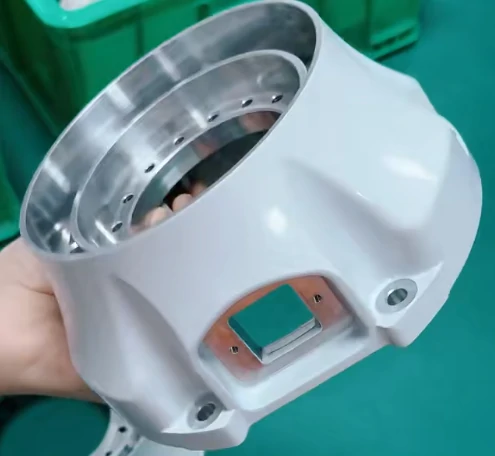
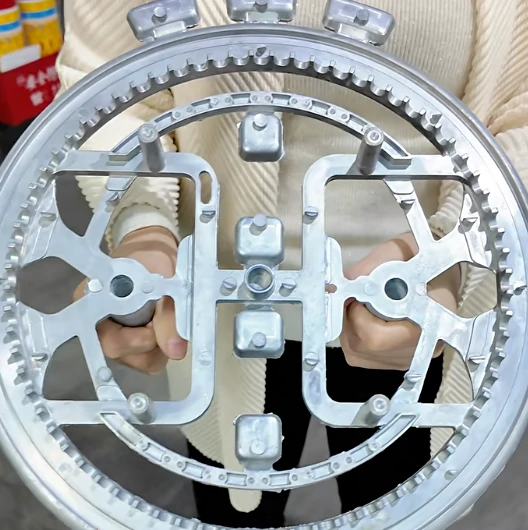
How Does 3D Printing Improve Die Casting Efficiency?
How Does 3D Printing Help Die Casting plays an important role in reducing development risk and controlling upfront manufacturing costs. Since die casting tooling requires hardened steel molds and precise cavity machining, any design mistake at an early stage can lead to expensive rework and delays. For this reason, manufacturers often introduce additive manufacturing during the design validation phase to improve efficiency and reduce trial-and-error costs.
In practical development workflows, multiple iterations of 3D-printed plastic prototypes are commonly produced to test form, fit, and basic structural behavior. These early models help engineers evaluate limits, tolerances, load paths, stress distribution, and potential failure areas before committing to final tooling. This stage significantly improves design confidence and reduces uncertainty in later production.
After initial validation, manufacturers typically use a more refined prototype—such as a CNC-machined sample or high-quality metal 3D-printed prototype—for performance verification. This version allows them to test more accurately under real operating conditions, helping confirm durability and mechanical stability before they move into tool steel mold production. As a result, 3D printing helps die casting by enabling faster design iteration, reducing tooling risk, and improving final product reliability.
What Materials Are Used in Die Casting Processes?
Below is a practical breakdown of the most commonly used die casting materials and where they are typically applied.
Magnesium Die Casting
Magnesium Die Casting is widely chosen for applications where lightweight design is critical. It offers an excellent strength-to-weight ratio and allows production of extremely thin wall sections due to its low melt viscosity.
Manufacturers often use magnesium components in automotive housings, aerospace-adjacent industrial parts, and portable electronics where reducing weight improves efficiency and handling.
When magnesium solidifies, it forms a refined grain structure that improves mechanical stability and performance. It also provides good vibration damping, which is useful in structural components.
Limitations of Magnesium:
- Higher cost compared to zinc in some applications
- Requires controlled processing due to oxidation sensitivity
- Not ideal for extremely high-load structural parts
Zinc Die Casting
Zinc Die Casting is known for its excellent castability, dimensional stability, and ability to produce highly detailed components. It is often selected for small to medium parts where surface finish and precision matter more than extreme strength.
Zinc alloys (such as Zamak series) flow easily into complex molds, making them suitable for thin-wall and intricate geometries. This also results in long tool life due to lower melting temperatures.
Typical applications include electronic housings, connectors, gears, and decorative hardware.
Advantages of Zinc Die Casting:
- High dimensional accuracy and repeatability
- Excellent surface finish
- Strong impact resistance for small parts
- Low die wear and extended mold life
Limitations of Zinc:
- Not suitable for high-temperature environments
- Lower corrosion resistance compared to aluminum without coatings
Aluminum Die Casting
Manufacturers widely use aluminum die casting in modern production. They favor it for its balance of lightweight properties, strength, corrosion resistance, and thermal conductivity.
Common aluminum alloys such as A380 and ADC12 are capable of forming complex geometries with thin walls, making them ideal for high-volume production.
Manufacturers widely use this material in automotive components, heat sinks, electronic housings, battery enclosures, and structural frames.
During solidification, aluminum forms a dendritic microstructure that enhances strength and durability, especially when properly controlled.
Advantages of Aluminum Die Casting:
- High strength-to-weight ratio
- Excellent heat dissipation and electrical conductivity
- Natural corrosion resistance from oxide layer
- Suitable for complex and thin-wall designs
Limitations of Aluminum:
- Higher shrinkage during cooling may affect precision
- Risk of porosity if process control is insufficient
- Some alloys may be less impact-resistant compared to zinc or magnesium
Copper Die Casting
Manufacturers rarely use copper die casting because of its extremely high melting temperature and processing difficulty. When they do use it, they typically rely on specialized high-pressure equipment.
Copper offers excellent electrical and thermal conductivity, making it suitable for niche applications such as electrical components and specialized industrial parts.
Limitations of Copper:
- High thermal shock risk during casting
- Difficult and costly processing
- Limited die life due to extreme temperatures
Tin-Based Alloys Die Casting
Tin-Based Alloys Die Casting is used in low-load and decorative applications. Tin alloys have very low melting points and excellent fluidity, which allows smooth mold filling with minimal tool wear.
Advantages:
- Low melting temperature
- Minimal die wear
- Good surface detail reproduction
Limitations:
- Low mechanical strength
- Limited structural applications
Lead Die Casting (Limited Use)
Lead Die Casting has significantly decreased in modern manufacturing due to environmental and safety concerns. However, it is still used in some specialized applications such as battery components and radiation shielding.
Lead alloys offer excellent density and corrosion resistance in specific environments.
Limitations of Lead:
- Environmental and regulatory restrictions
- Poor suitability for modern mechanical components
- Reduced usage across most industries
Other Die Casting Materials
In addition to the main alloys, several other metals may also be used in specific applications:
Bronze、Brass、Tin、Magnesium alloys、Zinc-based alloys、Aluminum alloys.
Each material is selected based on a balance of performance, manufacturability, and cost efficiency.
Material Selection in Die Casting
Choosing the right alloy in What Materials Are Used in Die Casting is critical for achieving the desired product performance. Engineers typically evaluate several key factors before selecting a material:
- Mechanical strength requirements
- Weight constraints
- Corrosion resistance
- Thermal and electrical conductivity
- Production volume and cost efficiency
For example, lightweight applications often favor aluminum or magnesium, while precision small parts typically rely on zinc alloys.
Key Comparison of Common Die Casting Materials
Aluminum vs Zinc vs Magnesium
- Aluminum Die Casting→ best for lightweight structural and thermal applications
- Zinc Die Casting→ best for precision, detail, and surface finish
- Magnesium Die Casting→ best for ultra-lightweight and high stiffness requirements
Each material has unique processing behavior, which directly impacts tooling design, cycle time, and final part performance.
How Does Die Casting Compare to Other Manufacturing Processes?
Die Casting vs. Sand Casting
When compared to sand casting, die casting demonstrates clear advantages:
- Requires less machiningand post-processing.
- Achieves superior dimensional tolerancesand higher production efficiency.
- While both processes can experience porosity defects, die casting allows better control to minimize them, unlike sand casting.
- Produces smoother surface finishes.
- Demands less labor during production.
- Uses durable steel molds, whereas sand casting relies on sand molds.
- Capable of producing thin-walled parts, which is difficult for sand casting.
Die Casting vs. Plastic Injection Molding
Compared to plastic injection molding, die casting offers:
- Superior mechanical properties— parts are stronger, harder, and more heat-resistant.
- Greater dimensional stability, ideal for precision components.
- Enhanced durability, making parts more resistant to stress, weathering, and heavy loads.
- Faster production cycles, allowing high-volume manufacturing in shorter times.
- Plastic parts may degrade under UV light, while die cast metal componentsretain performance outdoors.
Die Casting vs. Forging
While forging shapes metal through extreme compressive forces, die casting provides benefits in certain contexts:
- Can produce complex geometriesthat are difficult or impossible to forge.
- Offers better dimensional control.
- Supports thin-walled components, which forging struggles to achieve.
- Typically requires lower tooling coststhan forging.
Forged parts are denser and stronger and can handle larger sizes, but die cast parts allow more intricate shapes, thinner sections, and tighter tolerances.
Die Casting vs. Stamping
Stamping is efficient for producing steel or alloy parts quickly and in lightweight forms. However, die casting:
- Can often consolidate multiple stamped components into a single part.
- Produces components with closer dimensional accuracyand less waste.
- Supports more complex shapesand internal features that stamping cannot achieve.
- Frequently reduces assembly steps due to part consolidation.
Die Casting vs Permanent Mold Casting
Manufacturers typically determine the selection of a casting method based on factors such as design complexity, production volume, cost structure, and required finishing operations. In real manufacturing practice, choosing between die casting vs permanent mold casting depends on balancing precision requirements with economic efficiency and production speed.
Both die casting and permanent mold casting use reusable metal molds shaped to the final geometry of the part. This is a key difference compared with sand casting, but the two processes differ significantly in how molten metal is introduced and solidified inside the mold cavity.
What Are the Advantages and Disadvantages of Die Casting Technology?
Die casting is a popular method for producing durable metal components with high precision, especially when large quantities are needed. The process brings many benefits, but it also has some limitations that engineers and manufacturers need to weigh carefully. Here’s a closer look at the advantages and disadvantages of die casting.
Advantages of Die Casting
Fast Production for Large Volumes
One of the main benefits of die casting is speed. Once a mold is ready, it can churn out parts quickly, making it ideal for high-volume production. This efficiency helps reduce overall manufacturing time and costs for mass-produced components.
Complex Thin-Walled Parts
Die casting excels at creating intricate parts with thin walls and internal structures without sacrificing strength. For example, aluminum alloys can achieve wall thicknesses as low as 0.5mm, while zinc alloys can go down to roughly 0.3mm. This makes the process perfect for compact, lightweight components where space and weight are critical.
High Mechanical Properties
Parts made through die casting benefit from rapid solidification under high pressure, which creates a dense, uniform internal structure with fine grains. This results in strong, rigid components with excellent wear resistance and durability, suitable for demanding mechanical applications.
Dimensional Accuracy
Die casting delivers precise, repeatable geometry. Tolerances are tight, often reaching IT13–IT15 standards, and even higher (IT10–IT11) for precision-critical parts. This stability minimizes the need for additional machining and ensures consistent quality across production runs.
Smooth Surface Finish
The high-pressure filling of the mold produces a clean, smooth surface. When tooling and process parameters are well-controlled, post-processing like polishing or machining is often minimal or unnecessary. Parts can frequently go straight to assembly, which shortens production cycles.
Cost-Effectiveness for Mass Production
Although the initial investment in molds and equipment is substantial, die casting becomes highly economical for large runs. Fewer secondary operations and minimal machining requirements further reduce overall production costs.
Flexibility for Inserts and Add-Ons
Threaded inserts, bearings, and other embedded components can easily be incorporated during casting, improving assembly efficiency and reducing extra labor.
Automation-Friendly
Modern die casting lines can be highly automated, lowering labor needs while maintaining consistent quality and repeatable results.
Disadvantages of Die Casting
High Upfront Tooling Costs
Every mold must be precision-engineered, which requires significant investment. For small batch runs, these costs can make die casting economically unfeasible.
Material Limitations
The process mainly supports non-ferrous metals like aluminum, zinc, and magnesium. High-melting-point metals, such as steel or copper alloys, reduce die life and increase operational risk, limiting material options.
Size and Production Restrictions
Large parts are difficult to produce because mold and press sizes are limited. Combined with the high setup cost, die casting is generally unsuitable for low-volume or oversized parts.
Porosity and Other Defects
Air and gas can become trapped during high-speed metal injection, leading to porosity and other defects like shrinkage or flash. These issues can weaken structural integrity and complicate machining.
Long Lead Times
Designing, testing, and producing molds take considerable time, delaying the start of production. This makes the process less suitable for projects requiring quick turnaround or small quantities.
Die Wear and Maintenance
Repeated exposure to high-temperature molten metal and thermal cycling reduces die life. Dies may need frequent maintenance or replacement, especially when processing metals with higher melting points.
High Energy Consumption
Operating furnaces and equipment at extreme temperatures consumes significant energy and often requires environmental controls.
Design Constraints
Deep undercuts or highly complex features increase tooling complexity and costs. Most dies are optimized for simple ejection paths, so designs often need to adapt to these limitations.
What Are the Applications of Die Casting in Different Industries?
Die casting is a versatile manufacturing process, widely used across multiple industries where precision, strength, and repeatability are essential. The method allows the production of complex shapes with excellent surface finish, making it suitable for structural, decorative, and functional components.
Below is an overview of the most common applications of die casting:
Automotive Applications
Automotive manufacturing is one of the largest consumers of die-cast components. Both internal combustion engine (ICE) and electric vehicle (EV) parts are commonly produced using die casting, particularly aluminum die casting for its strength-to-weight advantages.
Typical automotive applications include:
- Engine blocks and motor housings
- Gearbox and differential housings
- Vehicle wheels and suspension components
- Thermostat housings and interior structural members
- Brackets and mounting hardware
Die casting allows manufacturers to produce lightweight yet robust components, supporting fuel efficiency and EV range improvements.
Aerospace Applications
In the aerospace sector, aluminum die casting is extensively used for parts that require lightweight and high-strength characteristics. Components such as:
- Engine casings
- Landing gear fittings
- Cockpit controls and interior panels
- Structural brackets
Die-cast components reduce overall aircraft weight while maintaining precise tolerances and mechanical reliability, crucial for performance and safety.
Electronics Applications
Electronics benefit from die casting due to its ability to produce precise housings and components with EMI and RFI shielding. Common examples include:
- Enclosures for computers, smartphones, and cameras
- Heat sinks and thermal management components
- Connectors, brackets, and housings for electrical devices
Materials such as aluminum, zinc, and magnesium are frequently selected for their electrical conductivity, heat dissipation, and dimensional stability.
Consumer and Furniture Applications
In consumer products and furniture, die casting enables production of both decorative and functional elements:
- Chair legs and furniture connectors
- Decorative trims and hardware
- Product chassis and enclosures for home appliances
The process ensures consistent quality and strength, even for aesthetically detailed parts.
Medical Applications
Médical components also leverage die casting for high-precision, durable parts. Applications include:
- Surgical instruments
- Medical device housings
- Orthopedic implants and support structures
Aluminum and stainless steel alloys are preferred for their biocompatibility, corrosion resistance, and strength.
Construction Applications
In construction, die casting is used for structural and architectural components:
- Window frames and curtain wall fittings
- Door handles, locks, and joiners
- Cladding panels and decorative trim
The process ensures dimensional accuracy and uniform quality, essential for building safety and durability.
Other Industrial Applications
Military and defense: Die casting produces vehicle components, weapon parts, and system housings where strength and reliability are critical.
Toys: Although plastics dominate today, die-cast zinc alloys such as ZAMAK are still used for collectible or high-end toy parts.
Consumer electronics: High-performance housings for computers, cameras, and mobile devices continue to rely on precise die-cast parts.
What Are the Variations of Die Casting Methods?
Different die casting variations are developed to solve specific manufacturing challenges related to material flow, porosity, dimensional accuracy, surface quality, and production efficiency. The selection of a suitable die casting process usually depends on alloy type, product structure, mechanical performance requirements, and production scale. Each method offers unique advantages for different industrial applications.
Pore Free Die Casting
Pore free die casting is designed to reduce internal gas porosity inside cast components. Before molten metal enters the mold cavity, oxygen is introduced into the die. During filling, the molten metal reacts with the oxygen, which helps eliminate trapped gases and minimizes bubble formation inside the casting.
This method is commonly used when manufacturers require parts with improved weldability, better heat treatment capability, and fewer internal voids in cold chamber die casting applications.
Acurad Die Casting Process
The Acurad die casting process focuses on producing castings with high density and improved dimensional stability. The term Acurad represents “accurate, reliable, and dense.” This process combines controlled filling techniques with directional solidification to improve casting integrity.
Advanced thermal analysis and flow simulation are often integrated into the process to optimize filling behavior. Additional pressure is applied during partial solidification using a dual-piston system, helping reduce shrinkage defects and improving the quality of heat treatable castings.
Gravity Die Casting
In gravity die casting, molten metal flows into a permanent mold naturally under gravity rather than high injection pressure. Because the filling process is smoother, turbulence and oxidation are significantly reduced.
The molds may operate in vertical, horizontal, or inclined positions depending on the part geometry. Components produced through gravity casting generally provide strong mechanical properties, excellent rigidity, and improved structural consistency, making this method suitable for aluminum and magnesium alloy parts.
Investment Die Casting
Investment casting, also called lost wax casting, uses a wax pattern coated with ceramic material to create the mold cavity. Once the ceramic shell hardens, the wax is melted and removed, leaving a detailed cavity for molten metal filling.
This process is often selected for parts requiring intricate geometries, fine surface finishes, and precise dimensional control. After solidification, the ceramic shell is broken away to release the finished metal casting component.
Vacuum Assisted High Pressure Die Casting
Vacuum assisted high pressure die casting improves mold filling by removing air from the die cavity before injection. The mold system is sealed, and vacuum pressure helps draw molten metal into thin sections and complex geometries more efficiently.
By reducing trapped air during filling, this process helps lower porosity levels while improving surface quality and mechanical performance. It is widely used for lightweight structural components and precision aluminum parts.
Semi-Solid Die Casting
In semi-solid die casting, the alloy is processed in a semi-liquid slurry condition before injection into the mold cavity. The partially solidified material is continuously stirred to maintain a uniform structure before being forced into the die under pressure.
This technique can produce components with smoother surfaces, tighter dimensional tolerances, and refined microstructures. Semi-solid metal casting is frequently used in applications requiring high strength and superior surface appearance.
Low Pressure Die Casting
Low pressure die casting uses controlled gas pressure to move molten metal upward from a holding furnace into the die cavity through a riser tube. Unlike conventional high-pressure methods, the metal fills the mold more gradually and evenly.
Continuous pressure is maintained throughout solidification to ensure complete cavity filling and reduce shrinkage defects. After the casting solidifies, excess molten metal flows back into the furnace, improving material utilization. Low pressure die casting is commonly applied in the production of aluminum wheels, structural housings, and other parts requiring enhanced mechanical strength.
Why Choose welleshaft for Precision Die Casting?
At welleshaft, we deliver reliable Precision Die Casting solutions with stable quality control and ISO 9001:2015 certified processes, ensuring consistent performance across every project. Our engineering team provides practical support in die casting services, helping with material selection, tooling optimization, and manufacturability improvements to reduce cost and improve part quality. We also offer a wide range of alloy options and custom die casting solutions, along with multiple surface finishing services for die cast parts to meet both functional and appearance requirements. A fast online quotation system with optional DFM analysis and production tracking helps improve efficiency and transparency.
Advanced Manufacturing Capability in Precision Die Casting
The Precision Die Casting process at welleshaft is designed for high accuracy, repeatability, and efficient mass production, making it suitable for complex geometries and tight tolerances. It supports stable output with high-speed manufacturing, strong part performance, and flexible design integration that reduces assembly steps. Our engineers assist early in the design stage to avoid defects and optimize tooling, while automated equipment and robotics ensure consistency in high-volume production die casting services, with full process control from mold development to finishing and packaging.
High-Volume Die Casting Applications and Part Types
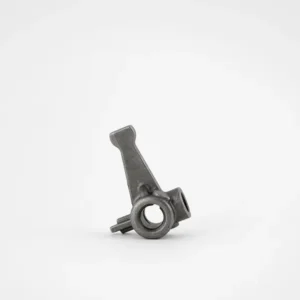
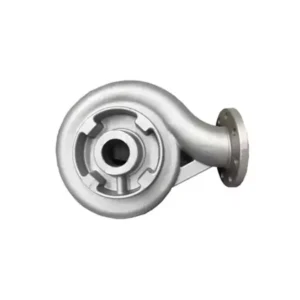
Our high-volume production die casting services are widely used for producing housings, gears, bushings, pumps, lighting structures, electrical enclosures, and valve components, all requiring consistent strength and precision. The process is optimized for long production runs, ensuring stable quality, repeatability, and cost efficiency across industrial applications.
Surface Finishing Services for Die Cast Parts
We provide multiple surface finishing services for die cast parts, including shot blasting, vibratory finishing, electroplating, painting, powder coating, anodizing, acid etching, and chemical coloring, to enhance both durability and appearance. Different materials may require specific surface preparation, while zinc and aluminum alloys generally achieve high-quality finishing with minimal processing.
Reliable Partner for Precision Die Casting Solutions
At welleshaft, we focus on delivering consistent, cost-effective Precision Die Casting solutions supported by strong engineering expertise and stable production capability. Our goal is to ensure reliable quality, efficient manufacturing, and on-time delivery from prototype development to full-scale production.
What Are the Frequently Asked Questions About Die Casting?
How to Reduce the Porosity of Die Castings?
Porosity in die castings is one of the most common defects and usually comes from trapped gas or poor process control. To reduce it, the production process needs tighter stability and better control of metal flow.
- Strengthen quality control in die castingacross every stage, from melting to ejection
- Apply suitable additives during melting to help release dissolved gases
- Ensure proper die lubrication after each cycle to stabilize filling behavior
- Use vacuum assistance to reduce air entrapment inside the cavity
- Improve die casting mold designto support smoother and more uniform molten metal flow
A well-balanced process and optimized tooling design significantly reduce internal gas-related defects.
How to Reduce Tooling Cost in Die Casting?
Lowering die casting tooling cost is mainly about simplifying structure and avoiding unnecessary complexity in design and machining.
- Simplify part geometry and avoid non-functional intricate features
- Minimize extremely thin wall sections that often require secondary machining
- Avoid overly strict tolerances unless functionally required
- Reduce undercuts or complex features that require advanced CNC operations
A design that balances performance and manufacturability helps control mold investment and long-term production costs.
Why Is Aluminum Frequently Chosen for Automotive Die Cast Components?
Aluminum die casting in automotive applications is widely used because of its balanced performance characteristics.
Key advantages include:
- High strength-to-weight ratio
- Natural corrosion resistance
- Excellent heat dissipation capability
These properties help reduce vehicle weight while improving fuel efficiency and overall performance.
What Are the Benefits of Using Zinc in Die Casting?
Zinc die casting advantages make it ideal for precision and high-volume production:
- Excellent surface finish quality
- High dimensional accuracy and tight tolerances
- Strong ductility and impact resistance
- Low melting point, which reduces tool wear
It is commonly used for small, detailed, and durable components.
How Durable Are Die Casting Products?
The durability of die cast parts varies depending on stress, environment, and material choice. While they may have limitations in corrosion resistance, impact strength, or wear resistance, proper design optimization allows them to perform well in demanding applications over long service periods.
Ce blog a été fourni par Équipe d'ingénierie Welleshaft. Mr. Xu, a senior die casting engineer with 10+ years of experience, ensures reliable precision die casting solutions, custom alloy options, and ISO 9001:2015 certified processes for industrial clients worldwide.
 Français
  English
  Português do Brasil
  Deutsch (Österreich)
  Deutsch (Schweiz)
  English (UK)
  English (Australia)
  English (New Zealand)
  Deutsch
  Français du Canada
  Français de Belgique
  Italiano
  English (South Africa)
  Português
  Español
  Español de México
  Español de Perú
  Español de Colombia
  العربية
  日本語
日本語  Русский
  한국어
한국어  Tiếng Việt
  ไทย
ไทย
Avis
Il n’y a pas encore d’avis.