
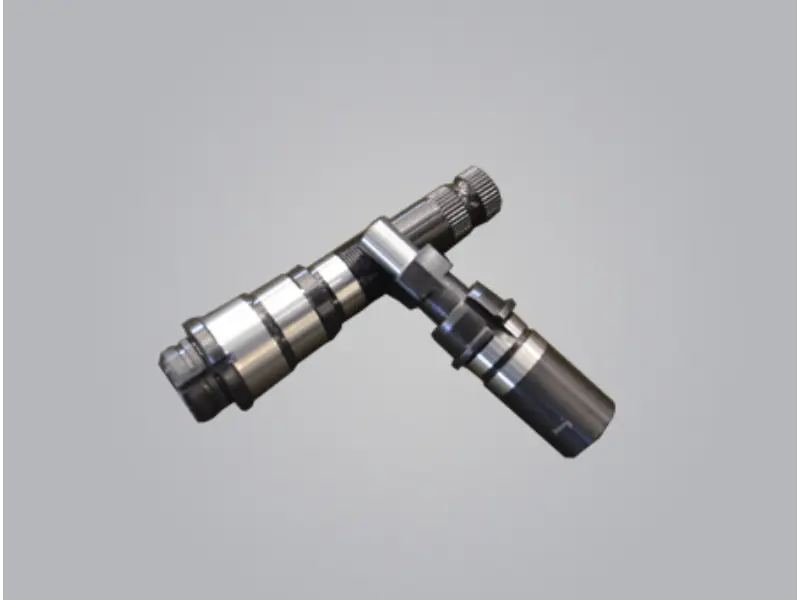
What is the output shaft?
The output shaft is a key component in any power transmission system. Its main job is to transfer rotational power from the gearbox or transmission to the final working parts, such as wheels, axles, or industrial equipment.
In simple terms, it’s the last stage of power delivery inside a drivetrain.
In real applications, the output shaft doesn’t just rotate—it carries adjusted torque coming from the gearbox and delivers it to the load side. This means it often works under high stress, changing loads, and continuous operation conditions.
From an engineering point of view, it acts as the bridge between the internal power system and the external working mechanism. Poor stability control can affect the overall transmission performance.
What types of output shafts are available?
Engineers design output shafts in different structures based on torque demand, weight requirements, space limitations, and assembly methods.
Solid Output Shafts
This is the most common design. It consists of a single solid piece of metal without any hollow section.
It offers excellent strength and rigidity, making it suitable for heavy-duty applications where durability is more important than weight reduction.
Hollow Output Shafts
Engineers design hollow shafts by removing the center of solid shafts. In some setups, they even use the hollow space to pass cables or fluids through.
You’ll often see them in automotive or automation systems where lightweight design matters.
Splined Output Shafts
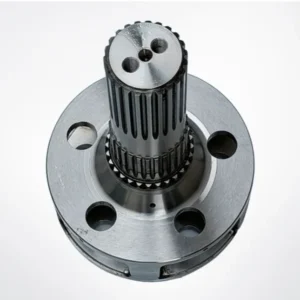
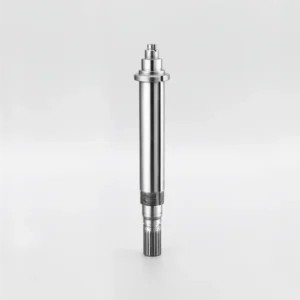
Splined shafts come with grooves along the surface that lock into matching parts. This design ensures strong torque transfer without slipping, and engineers commonly use it in gearboxes and drivetrain assemblies.
Tapered Output Shafts
Tapered shafts slowly decrease in diameter, forming a cone shape. This helps parts align more naturally and creates a tighter, more secure fit when assembled.
Quick comparison
| Type | What it’s like | Main strength | Where it’s used |
| Solid | Full metal body | Strong and durable | Heavy-duty machinery |
| Hollow | Center removed | Lightweight but still strong | Automotive, robotics |
| Splined | Grooved surface | No-slip torque transfer | Transmissions, drivetrains |
| Tapered | Cone-shaped | Better alignment & fit | Precision assemblies |
What materials are used for output shafts?
Material selection plays a major role in determining the strength, durability, and service life of an output shaft.
- Manufacturers commonly use carbon steel because it offers a good balance of strength and cost.It is suitable for general industrial applications.
- Engineers often select alloy steel for higher performance requirements. It provides better fatigue resistance, toughness, and wear performance.
- Engineers use stainless steel in environments where corrosion resistance is critical, such as humid or chemically exposed conditions.
- Chromoly steel (chromium-molybdenum alloy) performs well under impact and dynamic loading, making it suitable for more demanding applications.
- Forged steel improves internal grain structure through the forging process, resulting in higher strength and better resistance to shock loads.
- Case carburizing steel is designed for surface hardening. The outer layer becomes extremely hard and wear-resistant, while the core remains tough and ductile, making it ideal for long-life, heavy-load applications.
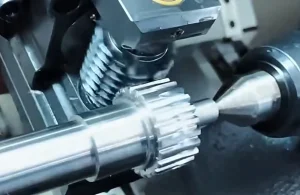
How Does Output Shaft CNC Machining Manufacturing Process Work?
CNC machining is the core process used in output shaft production. It ensures high precision, repeatability, and stable quality across batches.
In most cases, multiple machining processes are combined to complete one shaft.
CNC Machining Techniques for Output Shaft Production
Modern CNC machining plays a central role in shaping and refining output shafts with high precision:
- Turning
- Milling
Machinists use milling when they need to add features like keyways, splines, slots, or other non-round shapes, ensuring the shaft can properly transmit torque.
- Grinding
Grinding is a finishing step that helps achieve tight tolerances and a smoother surface, improving both wear resistance and overall running stability.
- Drilling
This is used to make precise holes for bolts, fasteners, or assembly needs in the system.
- Threading
Threading creates internal or external screw threads on the shaft, allowing it to connect securely with other parts.
Traditional Machining Methods in Output Shaft Manufacturing
Even as CNC machining becomes the standard, manufacturers still use many traditional machining methods in output shaft manufacturing. They often combine these methods with CNC processes to improve accuracy and ensure the part performs well in real applications.
- Lathe machining is usually the starting point for shaping the shaft. It’s mainly used to produce precise cylindrical forms and achieve a smooth surface finish on rotating parts.
- Broaching is typically used when you need internal features like keyways. It’s a fast and reliable way to create accurate internal shapes that ensure proper fitting and torque transfer.
- Machinists mainly apply hobbing to cut gears and spline profiles. This process helps ensure the teeth or splines form correctly so everything runs smoothly during power transmission.
- Heat treatment comes after machining. This step doesn’t change the shape, but it improves the material itself—making the shaft harder, stronger, and more durable for long-term use under stress.
What Are the Output Shaft Surface Finishing Processes?
Surface finishing is essential for improving performance and extending service life.
Polishing reduces surface roughness, helping lower friction during operation.
Plating, such as chrome coating, improves surface hardness and wear resistance.
Anodizing is mainly used for aluminum parts, forming a protective oxide layer that improves corrosion resistance.
Coating methods like powder coating or painting provide additional protection against moisture, chemicals, and environmental exposure.
How is quality control performed in output shaft machining?
Quality control is a key part of output shaft machining because it makes sure every shaft meets the required standards for accuracy, strength, and long service life.
- Dimensional Inspection
We use high-precision measuring tools to check all key dimensions and make sure they match the required tolerances, so the shaft fits and aligns properly during assembly. - Material Verification
- Surface Condition Check
- Functional Testing
Each shaft is tested under simulated or real working conditions to make sure it performs reliably in the actual system.
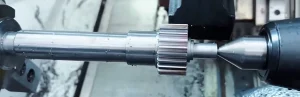
What Are the Output Shaft Salient Features in Precision Manufacturing?
In precision manufacturing, output shafts are expected to meet several key requirements:
High dimensional accuracy ensures proper assembly and smooth operation.
Good surface quality reduces friction and improves durability.
Strong corrosion resistance allows stable performance in harsh environments.
High wear resistance ensures long service life under continuous load.
What factors influence the cost of manufacturing output shafts?
The cost of manufacturing output shafts is determined by several key technical and production-related factors that directly affect material usage, machining time, and overall process complexity.
Material selection is one of the primary cost drivers, as different grades of metals or alloys vary significantly in price and performance characteristics required for load-bearing applications.
Machining complexity also has a major impact on overall cost. Designs that require tighter tolerances, intricate geometries, or multiple precision machining operations typically increase production time and tooling requirements.
Production volume plays an important role in cost efficiency. Larger batch sizes generally reduce per-unit manufacturing costs due to economies of scale and optimized machine utilization.
Surface finishing requirements further influence total cost, as additional processes such as polishing, plating, or coating increase both processing time and operational steps needed to meet performance and durability standards.
What is the difference between a drive shaft and an output shaft?
The drive shaft and output shaft are both key elements in vehicle power transmission, but they differ significantly in function, position, and structural design.
Drive Shaft:
The drive shaft is used to transfer rotational power from the transmission to the vehicle’s differential. It is typically installed along the longitudinal axis of the vehicle, spanning a longer distance between drivetrain components. To handle suspension movement and alignment variations during driving, it is commonly designed with universal joints or flexible couplings.
Output Shaft:
The output shaft is responsible for delivering power from the transmission or gearbox directly to the final drive system. It is positioned inside or immediately connected to the transmission housing. Compared with the drive shaft, it has a more compact structure and is engineered to withstand higher torque demands, making it suitable for direct power output applications.
Why choose Welleshaft for output shaft parts manufacturer?
Output shafts are key for smooth torque transfer in machines and vehicles. At Welleshaft in China, we focus on material selection, machining, and strict quality checks to ensure real-world performance—improving durability, efficiency, and reliability.
We use high-quality stainless steel and selected alloys that meet industry standards. Our process ensures tight tolerances and consistent parts for mechanical and automotive systems.
We also offer custom sizes, surface treatments, and performance options. With competitive pricing and step by step inspection, Welleshaft delivers reliable output shaft manufacturing that cuts risk, keeps quality steady, and helps customers stay competitive globally.
FAQs
What is the difference between input shaft and output shaft?
The input shaft receives engine power via the clutch and feeds it into the gearbox. The output shaft delivers the adjusted torque to the driveshaft and wheels. Input shaft speed is close to engine speed; output shaft speed varies by gear, affecting acceleration.
How do I know if my output shaft is bad?
Output shaft issues often cause shaking, humming/grinding noises, or vibrations from the transmission. Other signs include oil leaks (worn seals), rough gear changes, slow shifting, dashboard warning lights, or faulty speedometer readings. These problems usually stem from worn bearings or seals.
What is the output shaft of an engine?
The engine output shaft transfers power from the transmission to the final drive (e.g., axles or wheels), converting engine power into motion under high loads. It requires strength, durability, and proper lubrication/sealing to reduce wear and ensure smooth operation.
Are main shaft and output shaft the same?
No, they are different. The input shaft connects to the engine, running at higher speed with less torque. The output shaft sends power to the drivetrain at lower speed but higher torque.
This blog was provided by the Welleshaft Engineering Team. Welleshaft produces output shafts and CNC machined parts for industrial and automotive applications. Led by Mr. Xu, the team focuses on machining processes, material selection such as carbon steel, alloy steel, and stainless steel, and strict dimensional and quality inspections to ensure every part meets drawing requirements and tolerance standards for global customers.
 Русский
  English
  Português do Brasil
  Deutsch (Österreich)
  Deutsch (Schweiz)
  English (UK)
  English (Australia)
  English (New Zealand)
  Deutsch
  Français du Canada
  Français
  Français de Belgique
  Italiano
  English (South Africa)
  Português
  Español
  Español de México
  Español de Perú
  Español de Colombia
  العربية
  日本語
日本語  한국어
한국어  Tiếng Việt
  ไทย
ไทย
Отзывы
Отзывов пока нет.