
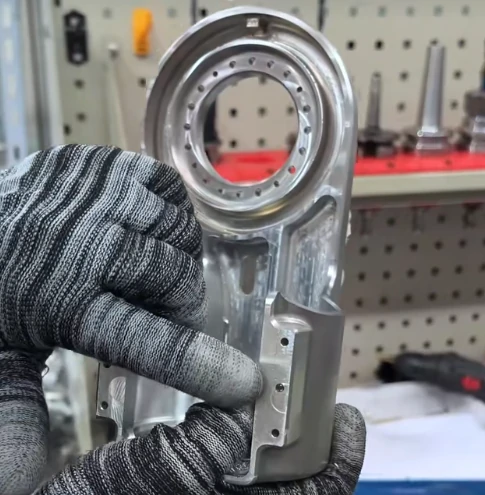
Why Investment Casting for Robotics Parts Is Becoming a Key Manufacturing Solution?
Robotic systems—especially in industrial automation and collaborative robots—depend on parts that are not only strong but also dimensionally precise and capable of handling complex geometries. That’s why investment casting (lost-wax casting) is increasingly being used for robotics parts manufacturing, particularly for components where traditional machining alone can drive up cost or struggle with intricate shapes.
Investment casting is used for robotics parts like housings, joints, brackets, and load-bearing components requiring precision and consistency. Compared with CNC machining, it reduces material waste and improves efficiency for complex parts.
However, it is not suitable for every design. Engineers must consider geometry limits, machining requirements, and surface finishing needs. When properly applied, investment casting provides a balance of cost, precision, and manufacturability for modern robotics production
Why Should You Choose Investment Casting for Robotics Parts?
Investment casting (lost-wax casting) is ideal for robotics parts with complex designs that are difficult to machine. It forms features like curved surfaces, internal cavities, and integrated structures while reducing machining effort.
For medium-to-high volume production, it provides consistent dimensions and repeatable quality, making it suitable for robotic assembly applications.
Another practical benefit is reduced machining waste. Compared with heavy CNC machining, investment casting uses far less raw material removal, which helps control cost—especially for metal parts that would otherwise require extensive cutting.
Investment casting provides consistent dimensional repeatability, helping robotics components fit and operate smoothly. Common applications include robot arm brackets, joint housings, gearbox housings, mounting bases, and structural connectors that require strength, stability, and long-term durability.
What Are the Advantages of Investment Castings for Robotics Parts?
In real-world robotics parts manufacturing, investment casting (lost-wax casting) stands out because it solves several practical production problems at the same time—not just one. When parts get more complex or production needs scale up, its advantages become more obvious.
Complex geometry capability
One of the biggest strengths is the ability to form shapes that are hard to machine. Internal cavities, reinforcing ribs, curved surfaces, and integrated structures can be created directly during casting, instead of being built step-by-step with multiple machining processes.
Near-net shape production
Investment casting produces parts very close to final dimensions, which means less reliance on extensive CNC machining. In practice, this helps reduce both machining time and material waste—especially important when working with metal robotics components that would otherwise require heavy cutting.
Material flexibility
It works well with commonly used engineering metals like stainless steel, carbon steel, and alloy steel, giving engineers the freedom to choose materials based on strength, wear resistance, or load requirements.
Good surface finish
Compared with rough raw machining or sand casting, investment casting generally delivers a smoother surface straight out of the mold. That usually means fewer secondary polishing or finishing steps before assembly.
Scalability
Whether it’s early-stage prototypes or stable medium-volume production, the process can adapt without needing a complete redesign of the manufacturing method.
Summary Table
| Feature | Benefit in Robotics Parts |
| Geometry flexibility | Supports complex robotic structures and integrated designs |
| Surface quality | Lowers finishing and polishing workload |
| Material options | Suitable for strength-focused metal components |
| Dimensional stability | Improves fit and assembly accuracy in robotic systems |
| Cost efficiency | Reduces overall CNC machining effort and waste |
How Are Investment Castings Applied in Robotics Parts Manufacturing?
In robotics parts manufacturing, investment casting (lost-wax casting) is mainly used for structural and mechanical components. It is ideal for strong, load-bearing metal parts where complex shapes and stability are more important than electronic precision.
Typical Application Flow
In real production, the workflow usually follows a fairly standard path:
First comes design optimization (DFM), where engineers adjust the part structure to make sure it can be cast properly without defects or unnecessary complexity.
Next is wax pattern creation, which forms the exact replica of the final component.
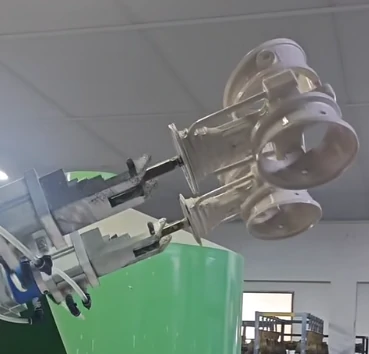
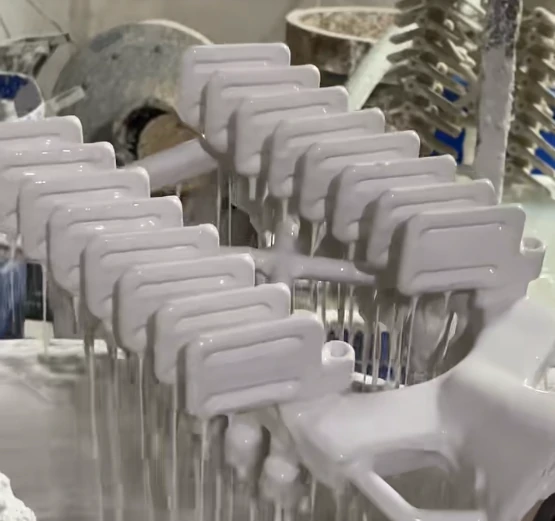
After that, multiple layers of ceramic are built up in the ceramic shell building stage, creating a hard mold that can withstand high-temperature metal pouring.
Then comes metal pouring, typically using materials like stainless steel or alloy steel, depending on strength and wear requirements.
Once the metal solidifies, the ceramic shell is removed in the shell removal and rough casting stage.
The part usually goes through heat treatment afterward to improve mechanical properties like hardness and durability.
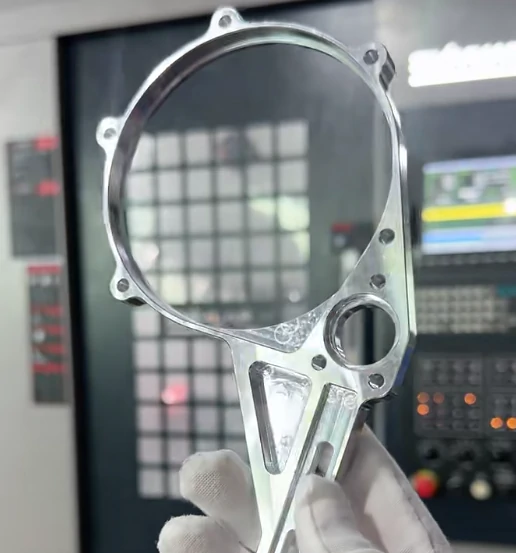
For functional surfaces, CNC finishing (critical surfaces) is often applied to achieve tighter tolerances where needed.
Finally, inspection and assembly validation ensures the component meets dimensional and performance requirements before moving into the robotics system.
Real Application Areas in Robotics
Investment casting is commonly used in:
- Industrial robot arms
- Automated production lines
- Packaging robots
- Welding robots (mainly structural components, not electronic parts)
These applications typically involve parts that need strength, rigidity, and repeatable geometry under continuous motion and load.
Not typically used for
- Motors
- Sensors
- Electronic control boards
Those components require electrical or micro-precision manufacturing processes that are outside the scope of investment casting.
In short, this process fits best where robotics meets structural engineering—supporting the frame, motion stability, and mechanical reliability rather than electronic control functions.
Get DFM Review for Robotics CastingsWhat Capabilities Do Robotics Investment Castings Offer?
Robotics investment casting focuses on delivering reliable performance under mechanical stress. It helps manufacturers produce metal parts with consistent function and durability for moving systems
Core Capabilities
One of the main strengths is high structural rigidity. The cast structure can support complex robot frames and joints without easily deforming under load.
Investment casting delivers strong load-bearing performance for arms, brackets, and connectors under continuous or dynamic loads. Proper alloy selection improves wear resistance, making these parts suitable for repetitive motion applications.
Another key point is assembly alignment precision. While casting alone doesn’t handle final tight tolerances, it provides a stable base geometry that helps downstream assembly fit more reliably.
Over time, these parts also show long-term mechanical stability, meaning they hold their shape and performance even after extended use in industrial automation systems.
Engineering Perspective
From an engineering standpoint, robotics components often require ±0.1–0.3 mm tolerance (with post-machining). That’s why investment casting is usually paired with CNC finishing rather than used alone.
They also need stable thermal performance, especially in environments where machines run continuously and heat buildup can affect structural accuracy.
On top of that, fatigue resistance under repetitive motion is important—robot joints and moving arms cycle thousands of times, so the material and structure must stay reliable over long periods.
In most cases, investment casting provides the near-net shape, and CNC machining is used afterward to fine-tune critical surfaces and meet final tolerance requirements.
How Can Quality Be Ensured with Rigorous Testing of Robotics Investment Castings?
In robotics parts manufacturing, quality control isn’t something you treat as an afterthought. Robotics systems rely on consistent motion and mechanical stability, so even small defects in robotics investment castings can lead to performance issues over time. That’s why testing is built into the process from multiple angles—not just at the end.
Common Inspection Methods
Different inspection methods are used depending on what needs to be checked:
CMM measurement is mainly used to verify dimensional accuracy, ensuring the cast part matches the required geometry before it goes into assembly.
X-ray inspection helps detect hidden internal issues like porosity or voids that aren’t visible from the outside but can affect long-term strength.
For surface-related problems, magnetic particle testing (MT) is often applied to identify cracks or discontinuities on ferromagnetic materials.
Dye penetrant testing (PT) works in a similar way but is used for surface defect checks on a wider range of metals, highlighting fine cracks or openings.
Finally, mechanical testing is used to confirm real-world performance, such as strength and load capacity, especially for load-bearing robotics components.
Key Quality Focus Areas
In practice, several quality points are closely controlled throughout production:
Porosity control is critical because internal voids can weaken structural integrity and shorten service life.
Shrinkage prevention is managed during casting and cooling stages to avoid deformation or dimensional instability.
Surface defect elimination ensures parts don’t have cracks, rough spots, or imperfections that could affect assembly or movement.
Dimensional repeatability across batches is also a big focus, since robotics systems often rely on interchangeable parts that must fit consistently every time.
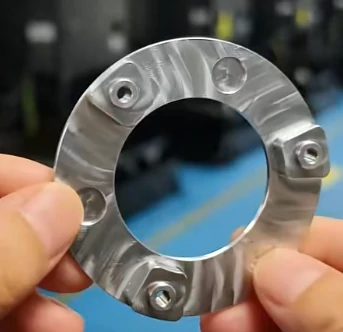
What Are the Challenges and Considerations of Robotics Investment Casting?
Even though robotics investment casting is widely used in robotics parts manufacturing, it still comes with a few practical limitations that engineers and buyers need to keep in mind. It’s a strong process, but it only works well when the design and process control are handled properly from the start.
Main Challenges
One common point is that tighter tolerances require CNC finishing. In most real cases, the casting itself gets you close to the final shape, but critical surfaces still need machining to meet precision requirements.
Another factor is longer lead time compared to machining. Since the process involves multiple steps—wax pattern, shell building, casting, and heat treatment—it naturally takes more time than simple CNC production.
There’s also the issue of high initial tooling cost (wax molds). For low-volume projects, this upfront investment can feel heavy, even though it pays off better in medium or large production runs.
From a design point of view, there are limitations for ultra-thin walls, since very thin structures can be difficult to cast consistently without defects or deformation.
And like many casting processes, there is a porosity risk if process control is weak, which can directly affect mechanical strength and long-term reliability.
Engineering Considerations
On the engineering side, proper gating and riser design is critical. If metal flow and solidification are not well planned, defects can easily form inside the part.
Material selection affects wear and fatigue life, especially in robotics systems where components are exposed to continuous motion and load cycles.
It’s also important that the design follows DFM (Design for Manufacturability) principles early. If the geometry is not suitable for casting from the beginning, it often leads to extra cost, redesign work, or unnecessary machining later.
How Does welleshaft Provide Precision Investment Castings Solutions for the Robotics Parts Industry?
In robotics parts manufacturing, suppliers typically fall into two categories: casting-only foundries or machining-focused workshops. However, robotics components require a more integrated engineering approach, where dimensional stability, repeatability, and assembly readiness are as important as geometry accuracy.
Welleshaft provides a full-process engineering-driven investment casting solution, rather than isolated casting or machining services. The goal is to deliver components closer to assembly-ready robotic parts, minimizing downstream rework.
The process starts with DFM engineering support, where parts are reviewed for castability, load paths, and machining feasibility. Compared with standard foundries that proceed directly to tooling, this reduces design iterations and tooling risks.
Production uses precision stainless steel and alloy steel investment casting, optimized for robotic components such as brackets, housings, and connectors, balancing strength, weight efficiency, and dimensional stability.
After casting, CNC machining is fully integrated, ensuring critical surfaces and interfaces meet tight assembly tolerances.
Quality is controlled through a multi-layer inspection system, including CMM measurement and NDT methods (X-ray, MT, PT), ensuring both internal integrity and surface reliability.
Finally, batch consistency control ensures stable performance across production runs, which is essential for robotics systems operating in scalable manufacturing environments.
Compared with conventional suppliers that separate casting and machining processes, Welleshaft provides a connected engineering workflow from design validation to final inspection, ensuring robotics components are both manufacturable and reliably integrable into automated systems.
Request Robotics Casting QuoteWhat Are the Most Common Questions About Robotics Investment Casting Parts?
Can investment casting be used for all robot parts?
Not really. It’s mainly used for structural and mechanical components. Parts like frames, brackets, or housings are a good match. But when it comes to electronics, sensors, or actuators, investment casting isn’t applicable.
Is CNC still needed after casting?
Yes, in most real cases. Even though investment casting gets the part close to shape, CNC machining is still required for critical surfaces to reach final dimensional tolerances and ensure proper assembly fit.
Is investment casting suitable for high-precision robotics?
It supports medium precision levels, especially for structural components. But if the application demands very tight tolerances, a hybrid approach with CNC finishing is usually necessary to reach the required accuracy.
What is the typical production volume?
It’s generally best suited for medium batch production. Once tooling is ready, it becomes more cost-effective for repeated runs, but it’s not ideal for ultra-low volume, one-off parts due to the upfront mold cost.
This blog was provided by the Welleshaft Engineering Team, led by Mr. Xu, specializing in precision investment casting, CNC machining, and quality inspection solutions for robotics and industrial manufacturing applications.

 Português
  English
  Português do Brasil
  Deutsch (Österreich)
  Deutsch (Schweiz)
  English (UK)
  English (Australia)
  English (New Zealand)
  Deutsch
  Français du Canada
  Français
  Français de Belgique
  Italiano
  English (South Africa)
  Español
  Español de México
  Español de Perú
  Español de Colombia
  العربية
  日本語
日本語  Русский
  한국어
한국어  Tiếng Việt
  ไทย
ไทย