
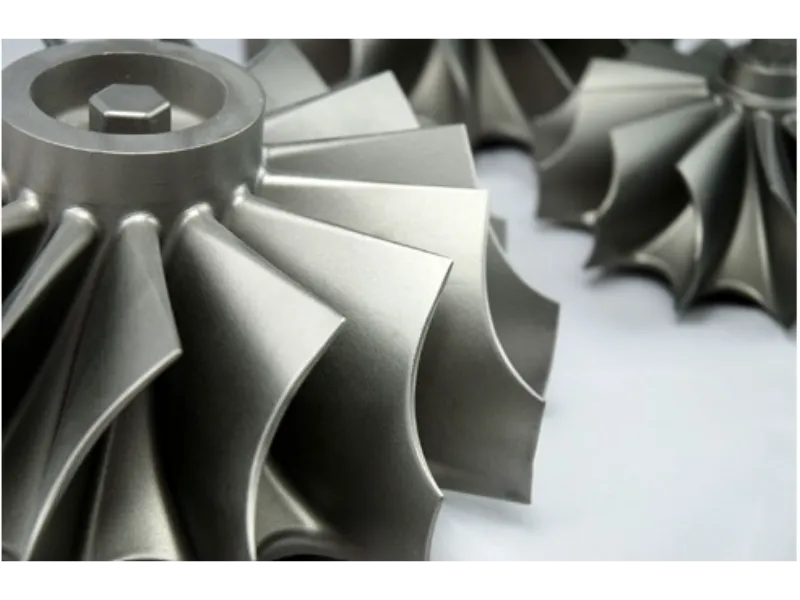
What is Vacuum Investment Casting?
Vacuum investment casting is an advanced variation of traditional investment casting, designed to produce metal components with exceptional precision and reliability.Unlike conventional open-air casting, this method uses a vacuum to reduce air and gas, improving material integrity and lowering defects such as porosity and inclusions.
The process begins with a wax pattern assembled on a central runner system called a “tree.” Multiple layers of ceramic slurry and refractory coating are applied to build a strong mold shell. After wax removal by heating, a hollow cavity remains that replicates the final component geometry.
In vacuum investment casting, molten metal is poured into the preheated ceramic mold under vacuum conditions. By removing trapped gases, the process improves metal flow and enables precise reproduction of complex shapes, fine details, and thin walls. This produces high-quality castings with excellent mechanical properties and minimal machining requirements.
Vacuum investment casting is ideal for applications requiring high precision, surface quality, and structural integrity, especially in aerospace, medical, and high-performance engineering industries.
Why Use Vacuum Investment Casting for Precision and Complex Metal Components?
Vacuum investment casting provides several key benefits compared to conventional investment casting, making it a preferred choice for high-precision and high-performance components.
Reduced Porosity and Improved Durability
Controlling gas porosity is a major challenge in most metal casting methods, as trapped air can compromise part strength and long-term reliability. By performing the casting under vacuum, air and gas pockets are minimized, producing metal parts with enhanced structural integrity and greater durability.
Enhanced Surface Quality
The vacuum environment helps achieve a smoother and more uniform surface directly from the mold. This superior surface finish reduces the need for extensive post-casting machining, polishing, or coating, lowering production time and costs while maintaining high-quality standards.
Ability to Produce Complex Geometries
With vacuum investment casting, manufacturers can replicate intricate and delicate designs that are difficult or impossible with other casting methods. The process excels at forming thin-wall sections, sharp edges, and fine features, making it ideal for parts with complex geometries and detailed functional elements.
Material Flexibility
This process is compatible with a wide range of metals, including stainless steel, nickel-based superalloys, cobalt-based alloys, and titanium alloys.Highly oxygen-reactive metals can be cast without oxidation, preserving critical mechanical properties and ensuring consistent performance in demanding applications.
Overall, vacuum investment casting delivers precision, versatility, and strong material control, producing defect-free, high-quality components with excellent surface finish and complex geometries.
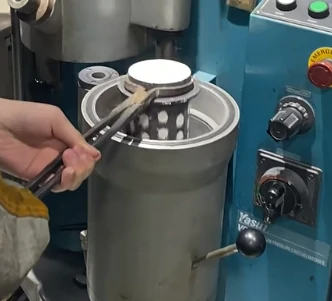
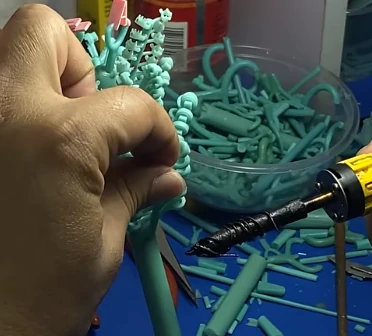
How Does the Vacuum Investment Casting Process Work Step by Step?
Vacuum Investment Casting is an advanced version of the conventional investment casting process, designed to manufacture highly detailed metal components with excellent dimensional accuracy and minimal post-processing requirements.
The process begins by producing a wax replica that matches the final component geometry. We repeatedly coat this wax pattern with ceramic slurry and refractory materials to form a strong ceramic shell. Once the shell reaches the required thickness, we remove the wax through dewaxing, leaving a precise mold cavity.
Unlike standard investment casting, we introduce a controlled vacuum during melting and pouring. We remove air and reactive gases from the mold cavity and chamber, reducing oxidation and contamination. This controlled atmosphere produces cleaner castings with better metallurgical integrity and fewer internal defects.
We commonly use Vacuum Induction Melting (VIM) systems, which may be configured as vertical dual-chamber or horizontal multi-chamber setups depending on production needs.
In a vertical two-chamber system, both the melting and mold chambers operate under vacuum. We place the ceramic shell mold in the lower chamber, reduce pressure, position it beneath the crucible, and pour the molten alloy. After pouring, we remove the mold for cooling and solidification, then break away the ceramic shell to reveal the final casting.
Modern horizontal three-chamber VIM systems improve productivity by maintaining stable vacuum conditions throughout the cycle. Independent chambers and isolation valves allow continuous operation while maintaining casting quality and increasing output.
Some systems also use inert gas pressurization after vacuum evacuation. We introduce gases such as argon to accelerate metal flow, helping molten metal fill thin sections, complex geometries, and intricate features more effectively while preventing oxidation.
Key Steps in the Vacuum Investment Casting Process
The vacuum investment casting process follows a series of carefully controlled manufacturing stages. While several steps are similar to traditional investment casting, the use of vacuum technology provides additional control over metal quality and mold filling performance.
Wax Pattern Production
The process starts with creating an accurate wax model of the desired component. Multiple wax patterns are typically assembled onto a central runner system, forming a casting tree for efficient production.
Ceramic Shell Building (Investment Stage)
The wax assembly is repeatedly dipped into ceramic slurry and coated with refractory materials. Layer-by-layer buildup creates a strong ceramic shell capable of withstanding high casting temperatures.
Dewaxing
After the shell has fully cured, it is heated in a dewaxing unit or autoclave. The wax melts and drains away, leaving a hollow cavity that mirrors the exact shape of the intended part.
Mold Preparation in a Vacuum Furnace
Before casting, the ceramic shell is heated within a vacuum furnace. This step removes residual moisture, trapped gases, and contaminants that could otherwise contribute to porosity, inclusions, or other casting defects.
Metal Pouring in a Vacuum Chamber
Shell Removal and Final Processing
After the casting solidifies, we remove the ceramic shell through a shakeout operation.
We reduce cost and lead time by leveraging vacuum investment casting’s high surface quality and dimensional accuracy, which often allows us to minimize secondary processes such as machining, grinding, or polishing.
By combining precision ceramic molds with vacuum-controlled pouring, the process delivers better casting quality, less oxidation, stronger mechanical properties, and improved consistency for demanding applications.
Which Metals Are Most Suitable for Vacuum Investment Casting Applications?
Almost any metal that can be processed through traditional investment casting is also compatible with vacuum investment casting. The technique is particularly advantageous for metals that are highly reactive with oxygen, such as nickel-based superalloys, cobalt-based alloys, and titanium alloys. These metals tend to form oxides quickly when exposed to air, so casting under vacuum significantly reduces oxidation and material loss.
Another reason for using these high-performance metals in vacuum investment casting is their economic and functional value. Components made from these alloys are often complex and costly, making scrap reduction critical. The controlled vacuum environment not only preserves material integrity but also ensures that intricate designs are cast accurately, maximizing yield and minimizing defects.
In addition to high-performance alloys, other metals suitable for vacuum casting include stainless steels and certain copper-based alloys. Selecting the right metal depends on the part requirements, including mechanical properties, corrosion resistance, and thermal performance.
What Are the Main Benefits of Vacuum Investment Casting in Manufacturing?
We achieve one of the most significant advantages of vacuum investment casting by greatly reducing defects caused by oxidation and gas entrapment. We perform melting and pouring in a controlled vacuum environment to minimize oxygen exposure, producing cleaner metal and improving internal integrity. This reduces porosity, inclusions, and other metallurgical imperfections that can affect performance.
We also enhance mold filling capability through vacuum investment casting. By removing trapped air, we allow molten metal to flow more smoothly into the mold cavity, reducing the risk of incomplete filling and ensuring accurate reproduction of intricate geometries.
With this improved metal flow, we manufacture components with thin-wall sections, small radii, and highly detailed features that are difficult to achieve using conventional methods. We produce complex designs with strong dimensional consistency and reduced need for secondary machining.
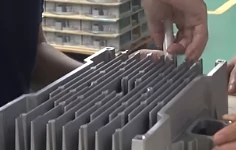
In addition, vacuum investment casting delivers outstanding surface quality. The controlled casting environment helps create smoother casting surfaces, finer detail reproduction, and a higher-quality finish directly from the mold. This can reduce downstream finishing requirements and contribute to improved production efficiency.
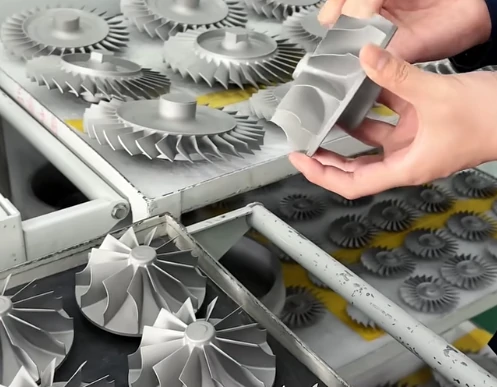
What Are the Common Applications of Vacuum Investment Casting in Industry?
The advantages of vacuum investment casting, including exceptional dimensional accuracy, reduced defects, and enhanced material integrity, make it widely used in industries that demand reliable performance under challenging operating conditions. The process is particularly valuable for producing complex components from high-performance alloys where quality and consistency are critical.
Aerospace
The aerospace industry frequently relies on vacuum investment casting to manufacture components that must combine lightweight construction with high mechanical strength. Turbine components, structural hardware, and other precision-engineered parts often feature complex geometries that benefit from the process’s ability to produce accurate, defect-minimized castings.
Defense
In the defense sector, many mission-critical components require outstanding durability and dimensional precision.We commonly use vacuum investment casting to produce parts for naval equipment, propulsion systems, and other high-performance defense applications where reliability and material quality are essential.
Energy
The energy industry utilizes vacuum investment casting to produce components that operate in demanding environments involving high temperatures, pressure, and corrosion. Parts used in gas turbines, industrial pumps, valve systems, and power-generation equipment benefit from the process’s ability to deliver superior mechanical properties and consistent performance over extended service life.
For industries where component failure is not an option, vacuum investment casting offers a dependable manufacturing solution for producing intricate, high-value parts with exceptional quality and performance.
Is Vacuum Investment Casting the Right Choice for Your Specific Project or Application?
Selecting the right casting process depends on the performance, complexity, and quality requirements of the final component.While traditional investment casting produces accurate metal parts, vacuum investment casting offers higher material quality and tighter process control.
By removing air and gases before pouring, it reduces defects like porosity and gas entrapment, resulting in cleaner structures, better consistency, and improved durability.
It also enables complex geometries, fine details, and thin-wall sections with tight tolerances, as improved mold filling ensures more accurate reproduction of intricate designs.
The process is also beneficial when superior surface finish and reduced secondary machining are important. Castings produced under vacuum conditions often require less post-processing, helping improve production efficiency while maintaining high-quality standards.
We apply vacuum investment casting to demanding applications exposed to high temperatures, heavy loads, or continuous mechanical stress, and we combine it with advanced materials such as nickel-based superalloys, cobalt-based superalloys, and titanium alloys. These high-performance alloys offer excellent strength, heat resistance, and long-term durability, making them well suited for critical engineering environments.
If your project requires precision, complex part geometry, enhanced material integrity, and dependable performance under demanding operating conditions, vacuum investment casting may provide a significant advantage over conventional casting methods.
Why Choose Welleshaft for Vacuum Investment Casting Manufacturing?
Welleshaft provides high-precision vacuum investment casting solutions for complex metal components that require tight tolerances and consistent performance. By combining controlled vacuum conditions with advanced process control, we help reduce defects such as porosity and oxidation, ensuring stronger internal structure and improved reliability of finished parts.
Our capability focuses on producing intricate geometries, thin-wall structures, and fine details with stable dimensional accuracy, which reduces the need for extensive secondary machining. This improves overall efficiency while maintaining high-quality surface finish directly from the casting process.
Welleshaft works with a wide range of engineering metals, including stainless steel, nickel-based superalloys, cobalt alloys, and titanium alloys. These materials are processed under vacuum to maintain purity and mechanical performance, especially in demanding environments.
FAQS About Vacuum Investment Casting?
How does vacuum investment casting improve casting quality?
This process produces defect-free, high-density components with superior surface finish and consistent mechanical properties, making it ideal for demanding applications such as aerospace and high-performance engineering.
How is it different from standard investment casting?
Manufacturers perform traditional investment casting under normal atmospheric conditions, making it cost-effective for general industrial hardware. In contrast, they carry out vacuum investment casting in a sealed vacuum chamber to prevent gas entrapment and oxidation.As a result, the process yields parts with higher structural integrity, greater density, and enhanced durability.
What are the key benefits of vacuum investment casting?
- We reduce porosity by largely removing air and gas pockets, improving fatigue resistance and long-term reliability.
- We achieve superior surface quality by retaining smooth mold surfaces, often reducing or eliminating the need for post-casting machining.
- We enable complex geometries by accurately reproducing fine details, thin-wall sections, sharp corners, and intricate designs.
- Material versatility: Compatible with reactive or high-temperature alloys such as nickel-based superalloys, cobalt-based superalloys, and titanium alloys, which are difficult to cast in open-air conditions.
What are the main limitations?
While the process offers exceptional quality, vacuum investment casting typically involves higher initial setup costs due to specialized vacuum furnaces and equipment. Production cycles may also be longer because maintaining and releasing the vacuum adds additional steps to the workflow.
This blog was provided by the Welleshaft Engineering Team, led by Mr. Xu, a senior quality engineer with extensive experience in precision casting and metal component manufacturing. The team focuses on delivering high-quality vacuum investment casting solutions with strong process control, material expertise, and reliable production support for global industrial applications.
 Español de Colombia
  English
  Português do Brasil
  Deutsch (Österreich)
  Deutsch (Schweiz)
  English (UK)
  English (Australia)
  English (New Zealand)
  Deutsch
  Français du Canada
  Français
  Français de Belgique
  Italiano
  English (South Africa)
  Português
  Español
  Español de México
  Español de Perú
  العربية
  日本語
日本語  Русский
  한국어
한국어  Tiếng Việt
  ไทย
ไทย
Valoraciones
No hay valoraciones aún.