
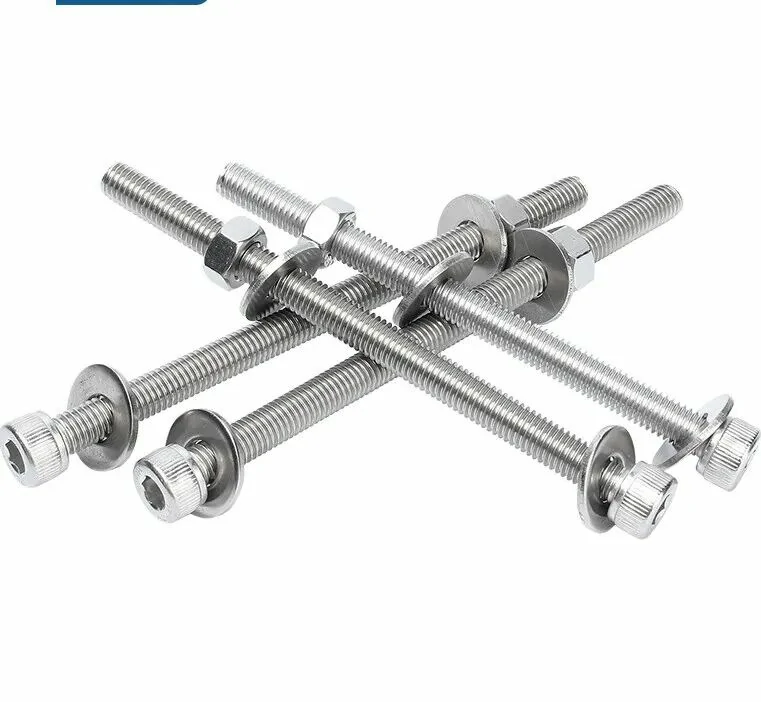
Which Stainless Steel Fasteners Are Best for Industrial Projects?
What Are the Specifications of Stainless Steel Fasteners?
When selecting stainless steel fasteners, understanding their specifications is crucial for reliable performance in industrial, construction, or mechanical projects. Specifications include material composition, bolt grades, tensile strength, hardness, corrosion resistance, and compliance with international standards like ISO, DIN, ASTM, and ASME. Stainless steel nut bolt combinations, such as 304 for mild environments and 316 for marine or chemical settings, ensure proper load distribution. Consulting grade charts helps reduce maintenance costs, prevent failures, and enhance safety across industrial applications. Choosing the right fasteners ensures long-term reliability.
Stainless Steel Fasteners Specifications
| Specification | Einzelheiten |
| Fastener Standards | IS, ANSI, ASTM, DIN, ISO, JIS, GB, ASME, BS, UNI, all International Standards |
| Bolt Standards | ASTM A193, ASME SA193 for bolts; ASTM A194, ASME SA194 for nuts |
| Sizes | M2, M2.5, M3, M4, M5, M6, M8, M10, M12, M14, M16, M20, M24, M30, M36 up to M160 |
| Length | 3 mm – 200 mm |
| Threads | BSF, UNF, METRIC, UNC, BSW, UTS (UNF, NPT, NPTF, UNS, UNC, UNEF) |
| Stud & Bolt Length | ASME B16.5; ANSI B28.2.4 1M, B18.2.4 2M; ASME B18.5 |
| Hex Nuts | ASME B18.2.2; DIN: 933, 931, 970, 934 |
| Material Sources | JSPL, Usha Martin, Tata, Mukund, RINL, Dhamm, etc. |
| Form | Square, Hex, Round, Threaded per Gauge |
| Head Drive | Phillips, Slotted, Phillips/Slot, Six-Lobe |
| Test Certificates | EN 10204 / 3.1 Manufacturer Test Certificate |
| Surface Finishes | Zinc (white, yellow, black, blue), black oxide, Dacromet, plated zinc-nickel, anodized, nickel plated, passivated, self-colour, bright zinc plated (BZP), hot-dip galvanised (HDG), Sherardized, Geomet, PTFE, Teflon |
| Production Process | Cold forging (M2–M24), hot forging (M24–M100), machining & CNC for custom parts |
| Packing | Bulk: pallet, carton; small boxes; customized packing on request |
Selecting stainless steel bolts, nuts, and fasteners from trusted suppliers ensures your components resist heavy loads, vibration, and harsh conditions. Proper specification, certified testing, and correct surface finishes reduce the risk of failure while providing long-term reliability. By consulting the specification table above, engineers and procurement teams can make informed decisions to match project requirements, minimize downtime, and protect industrial assets.
What Are the Main Types of Stainless Steel Bolts?
Stainless steel bolts come in various types to suit industrial applications, including hex bolts, socket head cap screws, threaded rods, anchor bolts, and specialty fasteners like acorn or blind nuts. Hex bolts provide strength and even load distribution for machinery and construction, while socket head screws fit tight or precision-critical spaces. Selecting the proper type and grade, such as 304, 316, or 18/8 stainless steel, ensures secure assembly, minimizes maintenance costs, and maintains safety and efficiency across industrial, automotive, and construction projects.
Popular Stainless Steel Fasteners
| Fastener Type | Details / Applications |
| Hex Bolts | Widely used in machinery, automotive, and construction |
| Socket Head Cap Screws | Precision fastening in tight spaces |
| SS Studs | Heavy load applications, structural support |
| Threaded Rods (M3, M8, M10) | Versatile fasteners for assembly and anchoring |
| Anchor Bolts | Secure structural elements, heavy-duty use |
| Toggle Bolts | Fastening in hollow walls or ceilings |
| Square U Bolts | Pipe and structural fastening |
| Lag Bolts | Wood and heavy timber connections |
| Custom Hex Bolts | Tailored sizes and grades for special projects |
| T-Head Bolts | Assembly requiring precise orientation |
| A2-70 Fasteners | High corrosion resistance in marine/chemical environments |
| Set Screw Fasteners | Securing components without protruding heads |
Selecting stainless steel bolts and nuts from trusted suppliers ensures components withstand vibration, heavy loads, and harsh environments. Understanding fastener types and material grades allows engineers and project managers to make informed choices, maintain safety, and improve operational efficiency across industrial, automotive, and construction projects worldwide.
What Are the Dimensions of Stainless Steel Nuts and Bolts?
Selecting the right stainless steel nuts and bolts begins with understanding key dimensions, including thread diameter, length, pitch, head size, and thread class. Correct sizing ensures efficient load transfer, prevents loosening, and maximizes performance in machinery or structural applications. Engineers consult stainless steel bolt grade charts to confirm strength and compatibility. Knowing bolt head types—hex, pan, or cap—helps choose proper tools and torque settings, enabling smooth installation, efficient assembly, and reduced maintenance, ensuring reliable performance across industrial, automotive, and construction projects.
Stainless Steel Bolt Dimensions
| Nominal Size (D) | Body Diameter (D Min – Max) | Head Thickness (H Min – Max) | Flats Across (F Min – Max) | Corners Across (C Min – Max) |
| M10 | 9.78 – 10.00 | 6.17 – 6.63 | 15.73 – 17.00 | 17.77 – 18.48 |
| M12 | 11.73 – 12.00 | 4.24 – 7.76 | 17.73 – 19.00 | 20.03 – 20.78 |
| M14 | 13.73 – 14.00 | 8.51 – 9.09 | 20.67 – 22.00 | 23.35 – 24.25 |
| M16 | 15.73 – 16.00 | 9.68 – 10.32 | 23.67 – 24.00 | 26.75 – 27.71 |
| M20 | 19.67 – 20.00 | 12.12 – 12.88 | 29.16 – 30.00 | 32.95 – 34.64 |
| M24 | 23.67 – 24.00 | 14.56 – 15.44 | 35.00 – 36.00 | 39.55 – 41.57 |
| M30 | 29.67 – 30.00 | 17.92 – 19.48 | 45.00 – 46.00 | 50.85 – 53.12 |
| M36 | 35.61 – 36.00 | 21.63 – 23.38 | 53.80 – 55.00 | 60.79 – 63.51 |
| M42 | 41.38 – 42.00 | 25.03 – 26.97 | 62.90 – 65.00 | 71.71 – 75.06 |
| M48 | 47.38 – 48.00 | 28.93 – 31.07 | 72.60 – 75.00 | 82.76 – 86.60 |
| M56 | 55.26 – 56.00 | 33.80 – 36.20 | 82.20 – 85.00 | 93.71 – 98.15 |
| M64 | 63.26 – 64.00 | 38.68 – 41.32 | 91.80 – 95.00 | 104.65 – 109.70 |
| M72 | 71.26 – 72.00 | 43.55 – 46.45 | 101.40 – 105.00 | 115.60 – 121.24 |
| M80 | 79.26 – 80.00 | 48.42 – 51.58 | 111.00 – 115.00 | 126.54 – 132.72 |
| M90 | 89.13 – 90.00 | 54.26 – 57.74 | 125.50 – 130.00 | 143.07 – 150.11 |
| M100 | 99.13 – 100.00 | 60.10 – 63.90 | 140.00 – 145.00 | 159.60 – 167.43 |
Accurate sizing and grade selection from reliable stainless steel hardware suppliers ensures smooth installation, precise torque performance, and long-lasting reliability. Using the right fasteners minimizes downtime, prevents equipment failure, and optimizes load distribution across industrial, automotive, and construction applications worldwide.
How Do Stainless Steel Nuts Compare by Size?
Understanding the size of stainless steel nuts and bolts is as crucial as selecting the right bolt. Nut dimensions—width across flats, width across corners, and thickness—affect how securely bolts fasten components. Mismatched fasteners can cause vibration loosening, uneven load transfer, or structural failure. Engineers use stainless steel bolt and nut grade charts to ensure compatibility. Specialty nuts, such as cap or acorn types, require precise sizing for safety-critical or aesthetic applications. Accurate selection guarantees reliable performance in industrial, automotive, and outdoor projects while minimizing maintenance and operational risks.
Stainless Steel Nut Dimensions
| Nominal Size | Width Across Flats (F) | Width Across Corners (G) | Thickness (H) |
| 1/4 | 0.428 – 0.438 | 0.488 – 0.505 | 0.212 – 0.226 |
| 5/16 | 0.489 – 0.500 | 0.557 – 0.577 | 0.258 – 0.273 |
| 3/8 | 0.551 – 0.562 | 0.628 – 0.650 | 0.479 – 0.337 |
| 7/16 | 0.675 – 0.688 | 0.768 – 0.794 | 0.365 – 0.385 |
| 1/2 | 0.736 – 0.750 | 0.840 – 0.866 | 0.427 – 0.448 |
| 9/16 | 0.861 – 0.875 | 0.982 – 1.010 | 0.473 – 0.496 |
| 5/8 | 0.922 – 0.938 | 1.051 – 1.083 | 0.535 – 0.559 |
| 3/4 | 1.088 – 1.125 | 1.240 – 1.299 | 0.617 – 0.665 |
| 7/8 | 1.269 – 1.312 | 1.447 – 1.516 | 0.724 – 0.776 |
| 1 | 1.450 – 1.500 | 1.653 – 1.732 | 0.831 – 0.887 |
| 1-1/8 | 1.631 – 1.688 | 1.859 – 1.949 | 0.939 – 0.999 |
| 1-3/8 | 1.994 – 2.062 | 2.273 – 2.382 | 1.138 – 1.206 |
| 1-1/2 | 2.175 – 2.250 | 2.480 – 2.598 | 1.245 – 1.245 |
| 1-5/8 | 2.356 – 2.438 | 2.686 – 2.815 | 1.353 – 1.429 |
| 1-3/4 | 2.538 – 2.625 | 2.893 – 3.031 | 1.460 – 1.540 |
| 2 | 2.900 – 3.000 | 3.306 – 3.464 | 1.675 – 1.763 |
| 2-1/4 | 3.263 – 3.375 | 3.719 – 3.897 | 1.890 – 1.986 |
| 2-1/2 | 3.625 – 3.750 | 4.133 – 4.330 | 2.105 – 2.209 |
| 2-3/4 | 3.988 – 4.125 | 4.546 – 4.763 | 2.319 – 2.431 |
Using correctly sized stainless steel nuts and bolts from trusted suppliers ensures secure fastening, smooth torque application, and long-term reliability. Proper dimension selection prevents wear, reduces maintenance costs, and guarantees consistent performance in heavy-duty industrial projects, automotive assemblies, and outdoor structures exposed to harsh environments.
What Is the Recommended Torque for Stainless Steel Hex Bolts?
Applying correct torque to stainless steel hex bolts is vital for safety, performance, and durability. Over-torquing can strip threads or deform bolts, while under-torquing may cause loosening under vibration. Recommended torque depends on bolt grade, size, thread type, and material, such as 304 or 316 stainless steel. Engineers consult torque charts and bolt markings from trusted suppliers to ensure accurate clamping force. Proper torque maintains assemblies, ensures even load distribution, minimizes maintenance, and extends the service life of stainless steel fasteners in industrial, automotive, and construction projects.
Recommended Torque for Stainless Steel Bolts
| Bolt Size | Threads per Inch | 304 SS Torque | 316 SS Torque | Unit |
| #2 | 56 | 2.5 | 2.6 | in-lb |
| #2 | 64 | 3.0 | 3.2 | in-lb |
| #3 | 48 | 3.9 | 4.0 | in-lb |
| #3 | 56 | 4.4 | 4.6 | in-lb |
| #4 | 40 | 5.2 | 5.5 | in-lb |
| #4 | 48 | 6.6 | 6.9 | in-lb |
| #5 | 40 | 7.7 | 8.1 | in-lb |
| #5 | 44 | 9.4 | 9.8 | in-lb |
| #6 | 32 | 9.6 | 10.1 | in-lb |
| #6 | 40 | 12.1 | 12.7 | in-lb |
| #8 | 32 | 19.8 | 20.7 | in-lb |
| #8 | 36 | 22.0 | 23.0 | in-lb |
| #10 | 24 | 22.8 | 23.8 | in-lb |
| #10 | 32 | 31.7 | 33.1 | in-lb |
| 1/4 | 20 | 75.2 | 78.8 | in-lb |
| 1/4 | 28 | 94.0 | 99.0 | in-lb |
| 5/16 | 18 | 132 | 138 | in-lb |
| 5/16 | 24 | 142 | 147 | in-lb |
| 3/8 | 16 | 236 | 247 | in-lb |
| 3/8 | 24 | 259 | 271 | in-lb |
| 7/16 | 14 | 376 | 393 | in-lb |
| 7/16 | 20 | 400 | 418 | in-lb |
| 1/2 | 13 | 517 | 542 | in-lb |
| 1/2 | 20 | 541 | 565 | in-lb |
| 9/16 | 12 | 682 | 713 | in-lb |
| 9/16 | 18 | 752 | 787 | in-lb |
| 5/8 | 11 | 1110 | 1160 | in-lb |
| 5/8 | 18 | 1244 | 1301 | in-lb |
| 3/4 | 10 | 1530 | 1582 | in-lb |
| 3/4 | 16 | 1490 | 1558 | in-lb |
| 7/8 | 9 | 2328 | 2430 | in-lb |
| 7/8 | 14 | 2318 | 2420 | in-lb |
| 1 | 8 | 3440 | 3595 | in-lb |
| 1 | 14 | 3110 | 3250 | in-lb |
| 1-1/8 | 7 | 413 | 432 | ft-lb |
| 1-1/8 | 12 | 390 | 408 | ft-lb |
| 1-1/4 | 7 | 523 | 546 | ft-lb |
| 1-1/4 | 12 | 480 | 504 | ft-lb |
| 1-1/2 | 6 | 888 | 930 | ft-lb |
| 1-1/2 | 12 | 703 | 732 | ft-lb |
Using accurate torque values from certified suppliers ensures fasteners maintain structural integrity, provide uniform load distribution, and deliver long-term performance. Following torque charts minimizes risks of equipment failure and reduces maintenance costs, making stainless steel bolts and nuts reliable for industrial, automotive, and construction applications.
How Much Do SS Bolts and Nuts Weigh?
Knowing the weight of stainless steel bolts and nuts is crucial for logistics, installation planning, and structural calculations. Fastener weight varies by size, length, and grade, with 304 stainless steel lighter than 316 due to material density. Accurate weight information is essential for large-scale projects like bridges, wind turbines, or heavy machinery, where hundreds or thousands of fasteners are used. Trusted suppliers provide detailed charts, enabling engineers to plan handling, lifting, torque application, and cost estimation, while reducing labor, installation time, and assembly errors for industrial and construction projects.
Approximate Weight of Stainless Steel Bolts (per 100 pieces, IS 1363/67)
| Bolt Size | Typical Length Range (mm) | Weight Range (kg / 100 pcs) |
|---|---|---|
| M5 | 16 – 50 | 0.45 – 1.03 |
| M6 | 16 – 80 | 0.74 – 2.11 |
| M8 | 16 – 100 | 1.59 – 4.87 |
| M10 | 16 – 300 | 3.21 – 20.33 |
| M12 | 20 – 300 | 4.89 – 29.94 |
| M14 | 25 – 200 | 8.17 – 29.59 |
| M16 | 30 – 400 | 10.71 – 39.06 |
| M18 | 35 – 200 | 16.03 – 49.02 |
| M20 | 35 – 400 | 19.61 – 69.44 |
| M22 | 30 – 400 | 18.66 – 113.64 |
Accurate weight charts from reliable stainless steel suppliers make project planning, handling, and installation smoother while reducing labor costs and errors. For large-scale construction, automotive, or industrial projects, knowing bolt and nut weight ensures precise calculations, safer assembly, and cost-effective procurement.
What Are the Sizes of Stainless Steel Threaded Rods?
Stainless steel threaded rods are versatile fasteners for construction, machinery, and industrial projects. Key specifications include rod diameter, thread pitch, and length, typically listed in stainless steel bolt grade charts. Grades like 304 and 316 provide high tensile strength and corrosion resistance. Choosing the right threaded rods with compatible nuts ensures secure connections, reliable load-bearing, and long-term performance. Sourcing from trusted stainless steel fastener manufacturers guarantees consistent quality, accurate dimensions, and torque compliance, enhancing safety, efficiency, and operational reliability in demanding industrial and mechanical applications.
Stainless Steel Threaded Rods and Compatible Nut Sizes
| Rod Diameter (mm) | Nut Size (mm) | Jam Nut | Hex Nut | Nylock Nut |
| 4 | 2 | 1.2 | 1.6 | – |
| 5 | 2.5 | 1.6 | 2 | – |
| 5.5 | 3 | 1.8 | 2.4 | 4 |
| 7 | 4 | 2.2 | 3.2 | 5 |
| 8 | 5 | 2.7 | 4 | 5 |
| 10 | 6 | 3.2 | 5 | 6 |
| 11 | 7 | 3.5 | 5.5 | – |
| 13 | 8 | 4 | 6.5 | 8 |
| 17 | 10 | 5 | 8 | 10 |
| 19 | 12 | 6 | 10 | 12 |
| 22 | 14 | 7 | 11 | 14 |
| 24 | 16 | 8 | 13 | 16 |
| 27 | 18 | 9 | 15 | 18.5 |
| 30 | 20 | 10 | 16 | 20 |
Selecting the right stainless steel threaded rod and nut combination ensures secure assembly, prevents loosening under load, and supports safe, long-lasting performance in structural, industrial, and mechanical projects. Reliable suppliers also provide torque and material data, making installation and procurement efficient and cost-effective.
What Are the Standard Sizes of Stainless Steel U Bolts?
Stainless steel U bolts are essential for securing pipes, tubes, and cylindrical components in construction, automotive, and industrial projects. Key dimensions include diameter, leg length, and thread length, while material choice—304 or 316 stainless steel—affects corrosion resistance and load capacity. Using the correct bolt-nut combination ensures safe clamping, even force distribution, and long-term durability. Dimension charts from reliable suppliers simplify selection, ensuring torque compatibility and reducing downtime during assembly or maintenance of critical systems.
Stainless Steel U Bolts – Compatible Nut Sizes
| Nut Size (mm) | Diameter* (mm) | Height (mm) | Hex Nuts | Jam Nuts | Nylock Nuts |
| 2 | 4 | 1.6 | 1.2 | – | |
| 2.5 | 5 | 2 | 1.6 | – | |
| 3 | 5.5 | 2.4 | 1.8 | 4 | |
| 4 | 7 | 3.2 | 2.2 | 5 | |
| 5 | 8 | 4 | 2.7 | 5 | |
| 6 | 10 | 5 | 3.2 | 6 | |
| 7 | 11 | 5.5 | 3.5 | – | |
| 8 | 13 | 6.5 | 4 | 8 | |
| 10 | 17 | 8 | 5 | 10 | |
| 12 | 19 | 10 | 6 | 12 | |
| 14 | 22 | 11 | 7 | 14 | |
| 16 | 24 | 13 | 8 | 16 | |
| 15 | 27 | 9 | 18.5 | 20 | |
| 16 | 30 | 10 | 20 | – |
*Diameter across flats; also the wrench size to use.
Selecting the right stainless steel U bolts and compatible nuts ensures secure installation, reduces the risk of slippage or stress concentration, and supports long-term reliability in harsh environments. Sourcing standard sizes from trusted suppliers also streamlines procurement, installation, and maintenance for industrial and construction projects.
What Are the Material Grades of Stainless Steel Fasteners?
Stainless steel fasteners come in various grades, each balancing corrosion resistance, tensile strength, and cost. Common grades like 304, 316, and specialty alloys suit different applications—from general construction to marine or chemical environments. Engineers use stainless steel bolt grade charts to match materials with project requirements, ensuring reliable performance, compliance, and safety. Choosing the right grade from trusted suppliers prevents rust, mechanical failure, and maintenance issues while maximizing service life and ensuring compatibility with nuts, washers, and assemblies in industrial or construction projects.
Stainless Steel Grades and European Standards
| All Grade | European Standards – DIN | European Standards Name | Unified Numbering System |
| 430 | 1.4016 | X6Cr17 | S43000 |
| 410 | – | – | S41000 |
| 440A | 1.4109 | X65CrMo14 | S44002 |
| 440B | 1.4112 | X90CrMoV18 | S44003 |
| 301LN | 1.4318 | X2CrNiN18-7 | – |
| 440C | 1.4125 | X105CrMo17 | S44004 |
| 440F | – | – | S44020 |
| 316 | 1.4408 | G-X 6 CrNiMo 18-10 | S31600 |
| 409 | 1.4512 | X6CrTi12 | S40900 |
| 301 | 1.431 | X10CrNi18-8 | S30100 |
| 304L | 1.4307 | X2CrNi18-9 | S3043 |
| 304LN | 1.4311 | X2CrNiN18-10 | S30453 |
| 304L | 1.4306 | X2CrNi19-11 | S30403 |
| 304 | 1.4301 | X5CrNi18-10 | S30400 |
| 304H | 1.4948 | X6CrNi18-11 | S30409 |
| 305 | 1.4303 | X5CrNi18-12 | S30500 |
| 310 | 1.4841 | X22CrNi2520 | S31000 |
| 312 | – | X5CrNi30-9 | – |
| 310S | 1.4845 | X5CrNi2520 | S31008 |
| 316L | 1.4404 | X2CrNiMo17-12-2 | S31603 |
| 321 | 1.4541 | X6CrNiTi18-10 | S32100 |
| 321H | 1.4878 | X12CrNiTi18-9 | S32109 |
| 316 | 1.4401 | X5CrNiMo17-12-2 | S31600 |
| 316LN | 1.4406 | X2CrNiMoN17-12-2 | S31653 |
| 316L | 1.4432 | X2CrNiMo17-12-3 | S31603 |
| 316 | 1.4436 | X3CrNiMo17-13-3 | S31600 |
| 316Ti | 1.4571 | X6CrNiMoTi17-12-2 | S31635 |
| 316LN | 1.4429 | X2CrNiMoN17-13-3 | S31653 |
| – | 1.4529 | X1NiCrMoCuN25-20-7 | N08926 |
| 317L | 1.4438 | X2CrNiMo18-15-4 | S31703 |
| 2304 | 1.4362 | X2CrNi23-4 | S32304 |
| 316L | 1.4435 | X2CrNiMo18-14-3 | S31603 |
| 2205 | 1.4462 | X2CrNiMoN22-5-3 | S31803/S32205 |
| J405 | 1.4501 | X2CrNiMoCuWN25-7-4 | S32760 |
| 904L | 1.4539 | X1NiCrMoCu25-20-5 | N08904 |
| 254SMO | 1.4547 | X1CrNiMoCuN20-18-7 | S31254 |
Selecting the right stainless steel grade ensures your fasteners resist corrosion, handle required loads, and remain durable in industrial, marine, or chemical environments. Reliable suppliers provide grade charts, material certifications, and guidance, streamlining procurement and installation while minimizing maintenance costs and ensuring safety.
Could Incorrect SS Bolts or Bolt Nut Stainless Steel Cause Equipment Failure or Safety Risks?
Yes, choosing the wrong SS bolts or bolt nut stainless steel can have serious consequences. Using mismatched stainless steel bolts nuts or incorrect ss bolt grades may compromise tensile strength, corrosion resistance, and mechanical reliability. For example, pairing a grade 304 bolt with a lower-strength nut can lead to thread stripping under load. Improperly sized or non-compatible stainless steel fasteners may loosen due to vibration, causing structural instability or mechanical failure. Equipment failures can result in downtime, costly repairs, or even workplace accidents. Engineers and procurement teams must carefully consult stainless steel bolt markings, stainless steel bolt grade charts, and supplier specifications to ensure all fasteners meet project requirements. Proper installation using correct torque, material grade, and bolt-nut pairing is critical. Investing in high-quality stainless steel nuts bolts suppliers minimizes risk, improves operational efficiency, and enhances safety across construction, industrial, or automotive projects.
Stainless Steel Bolts and Nuts FAQ
Can you use stainless steel nuts on galvanized bolts?
Yes, but it requires caution. Mixing stainless steel fasteners with galvanized bolts may cause galvanic corrosion over time, especially in moist or marine environments. Consider using matching materials for long-term reliability.
How do I identify different SS bolt grades?
Bolt grades are typically marked on the head with numbers or symbols. For example, 8.8, 10.9, or 12.9 indicate tensile strength. Consulting a stainless steel bolt grade chart ensures proper selection.
What are the differences between stainless steel bolts and hard steel bolts?
Stainless steel bolts excel in corrosion resistance, while hard steel bolts provide higher tensile strength. Choosing the right material depends on environmental exposure and load requirements.
Why Should You Choose Welleshaft for Stainless Steel Bolts and Fasteners?
Welleshaft specializes in stainless steel bolts and nuts, SS fasteners, and high-strength solutions tailored for industrial, automotive, and construction applications. Our team ensures that every fastener, from SS 304 bolts to hardened steel bolts, meets stringent quality standards. We provide detailed stainless steel bolt grade charts, torque recommendations, and material guidance to help engineers and procurement teams select the right fasteners for any project. By sourcing from Welleshaft, companies reduce downtime, avoid safety risks, and gain reliable, long-lasting performance. Our expertise in stainless steel hardware suppliers and fastener solutions ensures compliance with international standards like ISO, DIN, and ASTM. Choosing Welleshaft means investing in high-strength stainless steel fasteners, backed by professional support, precise specifications, and durable, dependable quality for critical industrial and construction projects worldwide.
This blog was provided by the Welleshaft Engineering Team. Mr. Xu and our experts specialize in stainless steel bolts, nuts, and fasteners, ensuring reliable performance, precise specifications, and compliance with international standards.

 Deutsch (Österreich)
  English
  Português do Brasil
  Deutsch (Schweiz)
  English (UK)
  English (Australia)
  English (New Zealand)
  Deutsch
  Français du Canada
  Français
  Français de Belgique
  Italiano
  English (South Africa)
  Português
  Español
  Español de México
  Español de Perú
  Español de Colombia
  العربية
  日本語
日本語  Русский
  한국어
한국어  Tiếng Việt
  ไทย
ไทย