
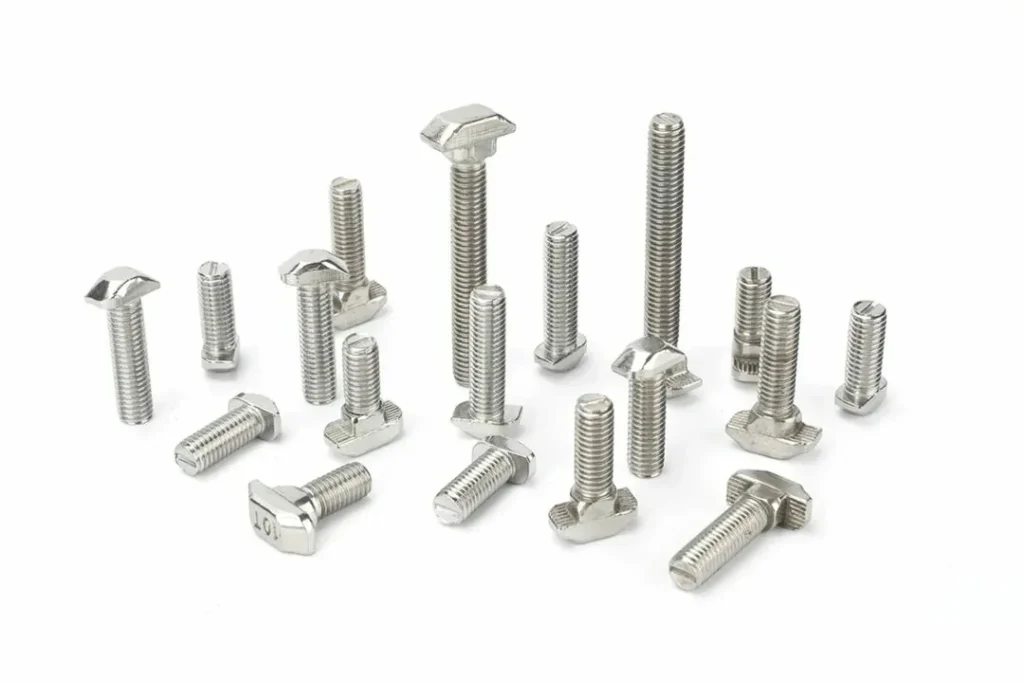
Stainless Steel Nuts and Bolts: Grades, Standards, and Sourcing Guide
What Are the Main Stainless Steel Material Grades for Nuts and Bolts?
SS Nuts And Bolts come in various grades, each with unique characteristics, making it essential to choose the right material for durability and performance. The most common ones include 316, 410, 304 and 18-8 stainless steel.
- 316 Stainless Steel: 316 stainless steel uses a mix of about 16–18% chromium, 10–14% nickel, and a touch of molybdenum, which gives it noticeably better corrosion resistance than 304 or standard 18-8 stainless. That extra protection is why 316 is the go-to choice for harsh, wet, or coastal environments—salt in the air alone can ruin regular fasteners over time. If you’re dealing with boats, docks, piers, pools, or even chemical-industry setups, 316 stainless fasteners are usually the safest, most reliable option.
- 410 Stainless Steel: 410 stainless steel contains roughly 11.5%–13.5% chromium with a low carbon limit, and it can be hardened up to around 40 Rockwell C. That gives it noticeably higher hardness and wear resistance than 18-8 stainless, though it sacrifices some corrosion resistance. Because of that balance, 410 is widely used for roofing screws, siding screws, and many self-tapping fasteners. Its martensitic structure also makes it a solid choice for mechanical parts that take a beating, like shafts and gears.
- 304 Stainless Steel: Excellent corrosion resistance, widely used in general industrial applications, kitchens, and outdoor fixtures.
- 18-8 Stainless Steel: 18-8 stainless steel simply refers to the classic 300-series blend with around 18% chromium and 8% nickel—basically another way of saying 304 stainless. It’s one of the most common grades you’ll see in stainless steel fasteners because it offers solid corrosion resistance and long service life. In freshwater or general outdoor use, 18-8/304 performs well, though it’s not as tough as 316 stainless in harsh salt-water conditions. It resists rusting and oxidation, may dull a bit over time, and is roughly equivalent to metric A2 stainless steel.
Using the correct grade ensures durability, especially when fasteners are exposed to harsh environments. For instance, ss nuts and bolts in coastal regions often require 316 stainless fasteners to prevent rusting.
How Are Stainless Steel Fasteners Classified into Austenitic, Martensitic, and Ferritic Types?
Stainless steel fasteners are divided into three main types, based on their crystal structure:
| Type | Characteristics | Common Applications |
| Austenitic | High corrosion resistance, non-magnetic, excellent ductility | 304 & 316 bolts, kitchen equipment, chemical industry |
| Martensitic | Magnetic, harder, wear-resistant | 410 bolts, shafts, industrial machinery |
| Ferritic | Moderate corrosion resistance, magnetic, less ductile | Automotive trim, industrial panels |
Austenitic Stainless Steel
Austenitic stainless steel—typically holding about 15–20% chromium and 5–19% nickel—is the group most people rely on for stainless steel nuts and bolts because it balances strength and strong corrosion resistance. Grades like 302, 303, 304, 304L, 316, 321, 347, and 348 all fall into this family. They usually deliver around 80,000 to 150,000 PSI in tensile strength, which is why these alloys are the everyday choice for general hardware, especially when durability and rust resistance both matter.
Martensitic Stainless Steel
Martensitic stainless steel, which typically contains about 12–18% chromium, is the go-to option when hardness matters most. It’s magnetic, can be heat-treated for extra strength, and is commonly used for hardened steel bolts or ss nut bolts in demanding mechanical setups. Welding isn’t ideal with this family, but grades like 410, 416, 420, and 431 deliver serious performance, reaching roughly 180,000 to 250,000 PSI in tensile strength.
Ferritic Stainless Steel
Ferritic stainless steel, usually running about 15–18% chromium, is often picked for jobs where appearance matters or where the environment is only mildly corrosive—think stainless steel jack nuts or other metal nuts used in general construction. It’s magnetic, can’t be heat-treated, and isn’t great for welding, but it still offers decent corrosion resistance. With a tensile strength around 65,000–87,000 PSI, grades like 430 and 430F work well when you need a clean look without the demands of harsher conditions.
How Do International Stainless Steel Bolt Grades Compare?
Stainless steel bolt grades vary worldwide, and different regions rely on ASTM, ISO, DIN, or BS standards. Knowing how these grades match across systems makes it much easier for engineers and suppliers to pick compatible stainless steel nuts and bolts for global projects. Below is a unified comparison table showing the most common 304/316/310/410/431 grade equivalents across major standards.
Unified Global Stainless Steel Grade Comparison
| Common Grade | EN Number | ASTM / AISI | UNS | British Standard | DIN |
| 304 | 1.4301 | ASTM A193 B8 | S30400 | BS 970 | X5CrNi18-10 |
| 304L | 1.4306 | ASTM A320 B8 | S30403 | BS 970 | X2CrNi19-11 |
| 316 | 1.4401 | ASTM A193 B8M | S31600 | BS 970 | X5CrNiMo17-13-2 |
| 316L | 1.4404 | ASTM A320 B8M | S31603 | BS 970 | X2CrNiMo17-13-2 |
| 310 | 1.4841 | ASTM A479 | S31000 | BS 970 | X12CrNi25-21 |
| 310S | 1.4845 | — | S31008 | BS 970 | X12CrNi25-21 |
| 410 | 1.4006 | — | S41000 | BS 970 | X10Cr13 |
| 431 | 1.4057 | — | S43100 | BS 970 | X20CrNi17-2 |
| 316S31 | 1.4401 | ASTM A193 B8M | S31600 | BS 970 | X5CrNiMo17-12-2 |
What Stainless Steel Bolt Grades Do We Commonly Supply?
At Welleshaft, we specialize in sourcing and inspecting a wide range of stainless steel fasteners:
- 18-8 Stainless Steel: Standard corrosion resistance and mechanical performance.
- 305 Stainless Steel: Slightly lower corrosion resistance than 304 but cost-effective.
- 316 Stainless Steel: Marine-grade and chemical-resistant fasteners.
- 410 Stainless Steel: Martensitic, high-strength ss nut bolts for industrial machinery.
These grades cover most stainless steel hardware supplier requests for industrial, automotive, and MRO components.
What Are the Specifications for SS 304 Stainless Steel Fasteners?
SS 304 fasteners are popular because they strike a solid balance between corrosion resistance, durability, and cost. They’re suitable for a wide range of applications, including stainless steel nuts, ss bolts, washers, barrel nuts, jack nuts, and screws. Typical mechanical specs include a tensile strength of 520–750 MPa and hardness around 70–90 HRB. Threads usually follow Unified Thread Standard (UTS) or metric sizes. Choosing the right specification ensures your fasteners can handle both mechanical stress and environmental exposure, whether for industrial machinery, construction, or general hardware.
Below is a practical size guide covering common 304 stainless fasteners:
| Fastener Type | Size Range | Length Range | Standard Compliance |
| 304 Stainless Nuts | M3 – M56 | 3/16″ – 2″ | DIN, ASTM, BS, International Standards |
| 304 SS Bolts / Screws | M3 – M56 | 3 mm – 200 mm | ASTM A193 / A194, ASME SA193 / SA194 |
| 304 Stainless Screws | M1.6 – M12 | — | DIN, ASTM, BS |
| 304 SS Washers | M3 – M56 | 3/16″ – 2″ | DIN, ASTM, BS |
| Stainless Steel Grade | SS 304 | — | — |
Using this guide, engineers and procurement teams can quickly select the right SS 304 fastener for industrial, marine, or general-purpose applications without worrying about mismatched threads or inadequate mechanical strength.
What Types of SS 304 Bolts and Nuts Are Available?
From hex bolts to acorn nuts, SS 304 fasteners cover a wide range:
- Hex bolts, socket head cap screws
- Button head bolts and pan head screws
- Barrel nuts and threaded rods
- Acorn and cap nuts
- Metric and imperial sizes
This variety ensures compatibility with diverse steel nuts and bolts applications in machinery, construction, and industrial assembly.
What Are the Standard Dimensions of 304 Stainless Steel Hex Bolts?
304 stainless steel hex bolts are versatile and widely used in industrial, structural, and assembly applications. Standard diameters range from M3 to M30 (or 1/4”–1 1/2”) with lengths from 10–300 mm. Threads are usually coarse, but fine threads are available for precision adjustments. Using the correct diameter, thread pitch, and length is crucial to ensure proper torque, structural integrity, and durability for stainless steel bolts and nuts.
Here’s a detailed size guide for common SS 304 hex bolts:
| Nominal Size (D) | Thread Pitch | Length Range | Ứng dụng | Body Diameter (Min–Max mm) | Head Thickness (Min–Max mm) | Flats (Min–Max mm) | Corners (Min–Max mm) |
| M6 / 1/4″ | 1.0 mm / 13 TPI | 10–100 mm / 1–6” | Small assemblies / Structural | 5.78–6.00 | 6.17–6.63 | 15.73–17.00 | 17.77–18.48 |
| M12 / 1/2″ | 1.75 mm / 13 TPI | 50–200 mm / 1–6” | Industrial machinery / Structural | 11.73–12.00 | 4.24–7.76 | 17.73–19.00 | 20.03–20.78 |
| M14 | 2.0 mm | 50–200 mm | General machinery | 13.73–14.00 | 8.51–9.09 | 20.67–22.00 | 23.35–24.25 |
| M16 | 2.0 mm | 50–200 mm | Heavy assemblies | 15.73–16.00 | 9.68–10.32 | 23.67–24.00 | 26.75–27.71 |
| M20 | 2.5 mm | 50–200 mm | Structural bolts | 19.67–20.00 | 12.12–12.88 | 29.16–30.00 | 32.95–34.64 |
| M24 | 3.0 mm | 50–200 mm | Large machinery | 23.67–24.00 | 14.56–15.44 | 35.00–36.00 | 39.55–41.57 |
| M30 | 3.5 mm | 50–200 mm | Industrial construction | 29.67–30.00 | 17.92–19.48 | 45.00–46.00 | 50.85–53.12 |
For sizes above M30, dimensions scale similarly. Selecting the right diameter, thread pitch, and head size is key to maintain torque performance and ensure bolts fit precisely in assemblies.
What Is the Dimension Standard for 304 Stainless Steel Nuts?
304 stainless steel nuts are widely used because they combine good corrosion resistance with reliability, making them a perfect match for stainless steel bolts, ss fasteners, or threaded rods. Standard hex nuts follow ISO, DIN, or ANSI standards and come in both metric (M6–M30) and imperial (1/4”–1 1/2”) sizes. Thickness is generally based on the thread diameter, and nuts can have hex head, flange, or acorn designs. Choosing the correct size ensures proper fit, structural integrity, and torque performance in assemblies, whether for machinery, construction, or general hardware.
Here’s a practical size chart for common 304 stainless steel hex nuts:
| Nominal Size | Width Across Flats (F, min–max) | Width Across Corners (G, min–max) | Thickness (H, min–max) |
| 1/4″ (M6) | 0.250 – 0.312 | 0.488 – 0.577 | 0.218 – 0.250 |
| 5/16″ (M8) | 0.312 – 0.375 | 0.546 – 0.650 | 0.280 – 0.314 |
| 3/8″ (M10) | 0.375 – 0.438 | 0.669 – 0.794 | 0.341 – 0.377 |
| 7/16″ (M11) | 0.437 – 0.500 | 0.728 – 0.866 | 0.403 – 0.441 |
| 1/2″ (M12) | 0.500 – 0.562 | 0.850 – 1.010 | 0.464 – 0.504 |
| 9/16″ (M14) | 0.562 – 0.625 | 0.909 – 1.083 | 0.526 – 0.568 |
| 5/8″ (M16) | 0.625 – 0.688 | 1.031 – 1.227 | 0.587 – 0.631 |
| 3/4″ (M20) | 0.750 – 0.812 | 1.212 – 1.443 | 0.710 – 0.758 |
| 7/8″ (M22) | 0.875 – 0.938 | 1.394 – 1.660 | 0.833 – 0.885 |
| 1″ (M24) | 1.000 – 1.062 | 1.575 – 1.876 | 0.956 – 1.012 |
Larger sizes continue similarly up to 4″ (M100). Using the correct width across flats, corner, and thickness is essential to ensure proper torque, prevent loosening, and maintain safety in any stainless steel assembly.
What Is the Size Chart for AISI 304 Stainless Steel Fasteners?
Selecting the right stainless steel fastners is crucial for any industrial or commercial project. Using proper dimensions prevents mismatched ss nut bolts, ensures safe mechanical assembly, and keeps your machinery or structures secure. A complete size chart helps engineers and procurement teams pick the right fastener quickly, whether it’s a hex bolt, socket head cap screw, or hex nut. Standard lengths and diameters vary depending on the fastener type, but material is usually 304 stainless steel for its balance of corrosion resistance and strength.
Here’s a practical size guide covering common 304 SS bolts and nuts:
| Fastener Type | Thread Diameter | Standard Length | Material |
| Hex Bolt | M6 | 20–100 mm | 304 SS |
| Hex Nut | M6 | 5 mm | 304 SS |
| Socket Head Cap Screw | M8 | 16–80 mm | 304 SS |
For nuts specifically, here’s a more detailed breakdown by type and height:
| Nut Size (mm) | Diameter (mm) | Hex Nut Height (mm) | Jam Nut Height (mm) | Nylock Nut Height (mm) |
| 2 | 4 | 1.6 | 1.2 | – |
| 2.5 | 5 | 2 | 1.6 | – |
| 3 | 5.5 | 2.4 | 1.8 | 4 |
| 4 | 7 | 3.2 | 2.2 | 5 |
| 5 | 8 | 4 | 2.7 | 5 |
| 6 | 10 | 5 | 3.2 | 6 |
| 7 | 11 | 5.5 | 3.5 | – |
| 8 | 13 | 6.5 | 4 | 8 |
| 10 | 17 | 8 | 5 | 10 |
| 12 | 19 | 10 | 6 | 12 |
| 14 | 22 | 11 | 7 | 14 |
| 16 | 24 | 13 | 8 | 16 |
| 18 | 27 | 15 | 9 | 18.5 |
| 20 | 30 | 16 | 10 | 20 |
Referencing these charts makes it easier to pick the right 304 SS nut or bolt for your project, ensuring a secure fit and reliable performance, whether in industrial equipment, construction, or general mechanical assemblies.
What Is the UNS S30400 Bolt Torque Chart?
For proper assembly, knowing the torque values for stainless steel bolts is crucial. Correct torque prevents bolt or nut failure and ensures the fasteners perform reliably in industrial applications. Below is a combined, easy-to-use torque guide for UNS S30400 (304) and 316 stainless steel bolts.
| Bolt Size | Threads Per Inch | Recommended Torque (304 SS, Nm) | Recommended Torque (316 SS, Nm) | Notes |
| M6 | – | 10 | 10 | Coarse thread |
| M8 | – | 25 | 25 | Standard torque |
| M12 | – | 70 | 70 | High-load applications |
| #2 | 56 | 0.28 | 0.30 | Small screws |
| #2 | 64 | 0.34 | 0.36 | – |
| #3 | 48 | 0.44 | 0.46 | – |
| #3 | 56 | 0.50 | 0.52 | – |
| #4 | 40 | 0.59 | 0.62 | – |
| #4 | 48 | 0.75 | 0.78 | – |
| #5 | 40 | 0.87 | 0.91 | – |
| #5 | 44 | 1.06 | 1.11 | – |
| #6 | 32 | 1.09 | 1.15 | – |
| #6 | 40 | 1.38 | 1.45 | – |
| #8 | 32 | 2.85 | 2.97 | – |
| #8 | 36 | 3.16 | 3.30 | – |
| #10 | 24 | 3.28 | 3.43 | – |
| #10 | 32 | 4.55 | 4.75 | – |
| 1/4″ | 20 | 8.5 | 8.9 | Standard inch bolt |
| 1/4″ | 28 | 10.6 | 11.2 | – |
| 5/16″ | 18 | 15.0 | 15.7 | – |
| 5/16″ | 24 | 16.1 | 16.7 | – |
| 3/8″ | 16 | 27.0 | 28.3 | – |
| 3/8″ | 24 | 29.7 | 31.0 | – |
| 7/16″ | 14 | 42.9 | 44.8 | – |
| 7/16″ | 20 | 45.3 | 47.3 | – |
| 1/2″ | 13 | 58.5 | 61.3 | – |
| 1/2″ | 20 | 61.3 | 64.0 | – |
| 9/16″ | 12 | 77.5 | 81.0 | – |
| 9/16″ | 18 | 85.3 | 89.3 | – |
| 5/8″ | 11 | 126 | 132 | – |
| 5/8″ | 18 | 141 | 147 | – |
| 3/4″ | 10 | 173 | 179 | – |
| 3/4″ | 16 | 168 | 175 | – |
| 7/8″ | 9 | 263 | 274 | – |
| 7/8″ | 14 | 262 | 273 | – |
| 1″ | 8 | 389 | 406 | – |
| 1″ | 14 | 352 | 368 | – |
| 1 1/8″ | 7 | 445 | 466 | Large inch bolt |
| 1 1/8″ | 12 | 420 | 440 | – |
| 1 1/4″ | 7 | 564 | 589 | – |
| 1 1/4″ | 12 | 518 | 544 | – |
| 1 1/2″ | 6 | 957 | 1,003 | – |
| 1 1/2″ | 12 | 757 | 789 | – |
What Is the Composition of 304 Stainless Steel Threaded Rods?
304 stainless steel rods and fasteners are widely used because of their excellent corrosion resistance, good durability, and moderate mechanical strength. Here’s a quick look at what makes them special:
Chromium (Cr): 18–20% – gives corrosion resistance and strength
Nickel (Ni): 8–10.5% – adds toughness and prevents rust
Carbon (C): ≤0.08% – keeps the steel strong but not brittle
Manganese (Mn): ≤2% – improves hardness and wear resistance
Silicon (Si): ≤0.75% – enhances durability
Phosphorus (P): ≤0.045% – trace amounts, keeps steel ductile
Sulfur (S): ≤0.03% – small amounts to aid machining
Nitrogen (N): ≤0.10% – boosts strength slightly
Here’s a handy table summarizing the composition:
| Element | Typical Range (%) | Notes |
| Carbon (C) | ≤0.08 | Low carbon for moderate strength |
| Manganese (Mn) | ≤2.0 | Improves hardness |
| Silicon (Si) | ≤0.75 | Enhances durability |
| Phosphorus (P) | ≤0.045 | Trace amount, maintains ductility |
| Sulfur (S) | ≤0.03 | Small amount to improve machinability |
| Chromium (Cr) | 18–20 | Main contributor to corrosion resistance |
| Molybdenum (Mo) | – | Not significant in 304 |
| Nickel (Ni) | 8–10.5 | Adds toughness and corrosion resistance |
| Nitrogen (N) | ≤0.10 | Slight strength improvement |
Tip: Because of this balanced composition, 304 stainless steel bolts, rods, and studs are durable, resist rust well, and are suitable for most industrial and construction applications.
How Are SS 304 Hex Bolts Analyzed Mechanically?
When working with 304 stainless steel hex bolts, several mechanical tests are done to make sure they’re strong, durable, and meet industrial standards. These include:
Tensile testing – measures how much pulling force the bolt can handle before breaking
Hardness testing – usually Rockwell B or Brinell methods, to check surface strength
Impact testing (Charpy) – ensures bolts can withstand sudden shocks
Fatigue and torque performance – confirms the bolt holds up under repeated stress and twisting
Here’s a quick summary of the typical mechanical properties for 304 stainless steel bolts:
| Property | Value | Notes |
| Tensile Strength | ≥515 MPa | Maximum load before breaking |
| Yield Strength (0.2% Proof) | ≥205 MPa | Load at which the bolt starts to deform permanently |
| Elongation | ≥40% (in 50 mm) | Measures ductility, how much it can stretch before breaking |
| Hardness (Rockwell B, HR B) | ≤92 | Surface hardness limit |
| Hardness (Brinell, HB) | ≤201 | Alternative hardness test |
Tip: Running these tests ensures your 304 SS bolts are safe, reliable, and meet international bolt grade requirements. Perfect for industrial and construction applications where strength and durability matter.
What Materials Are Equivalent to 304 Stainless Steel Studs?
When selecting stainless steel studs, it’s useful to know equivalent materials and standards. Choosing the right one ensures your studs match performance expectations and are compatible with nuts and bolts.
Common equivalents and alternatives:
18-8 Stainless Steel Studs – Offers similar corrosion resistance as 304 SS, usually a bit cheaper.
316 Stainless Steel Studs – Higher corrosion resistance, ideal for marine or highly corrosive environments.
Other Austenitic Alloys – Custom stainless steel fasteners for industrial, automotive, or specialized applications.
Standard Equivalents for 304 Stainless Steel:
| AISI Grade | JIS Equivalent | Stainless Steel Notation | EN/DIN Numerical | UNS Designation | EN/DIN Symbolic Equivalent |
| 304 | SUS304 | SS 304 | EN 1.4301 | UNS S30400 | X4CrNi18-10 |
SS Nuts and Bolts FAQ’S
What Are the Differences Between 304 and 316 Stainless Steel Fasteners?
304 is more cost-effective, suitable for most general applications. 316 offers superior corrosion resistance, ideal for chemical, marine, and outdoor fasteners.
How Can I Verify the Grade of Stainless Steel Bolts?
Visual inspection, magnet tests, and lab chemical analysis help distinguish grades. Welleshaft inspections ensure your bolts meet certified ss bolt grades.
Can Welleshaft Help With Custom Stainless Steel Nut and Bolt Requirements?
Yes, we provide inspection, sourcing, and custom fastener solutions, from stainless steel nuts bolts to high-strength ss studs, tailored to industrial or commercial needs.
How to Choose the Right Stainless Steel Bolt and Nut Grade for Industrial Use?
Consider these factors when selecting ss bolts and nuts:
- Environment: 316 SS for marine or chemical exposure
- Mechanical load: Martensitic bolts for high-stress machinery
- Compatibility: Match nuts and bolts by grade to avoid galvanic corrosion
- Industry standards: Refer to ASTM, ISO, or SAE bolt grades charts
Selecting the right grade reduces maintenance costs and ensures operational safety.
Why Choose Welleshaft for Stainless Steel Fastener Sourcing?
Trục giếng specializes in helping manufacturers and industrial clients source high-quality stainless steel fasteners with confidence. We handle everything from supplier qualification and factory audits to custom sourcing of nuts, bolts, studs, and other components for automotive, industrial, and MRO applications. Our team ensures all fasteners meet international standards for strength, durability, and corrosion resistance, including 304, 316, and martensitic grades. By combining hands-on manufacturing knowledge with rigorous inspection processes, we help clients reduce production risks, maintain consistent quality, and streamline their supply chain for reliable, ready-to-use stainless steel fasteners.
This blog was provided by the Trục giếng Engineering Team, led by Mr. Xu, a specialist with 20 years of experience in industrial fastener inspection and sourcing. Welleshaft helps clients worldwide procure reliable stainless steel fasteners, perform quality audits, and ensure compliance with international standards for industrial, automotive, and MRO applications.

 Tiếng Việt
  English
  Português do Brasil
  Deutsch (Österreich)
  Deutsch (Schweiz)
  English (UK)
  English (Australia)
  English (New Zealand)
  Deutsch
  Français du Canada
  Français
  Français de Belgique
  Italiano
  English (South Africa)
  Português
  Español
  Español de México
  Español de Perú
  Español de Colombia
  العربية
  日本語
日本語  Русский
  한국어
한국어  ไทย
ไทย