
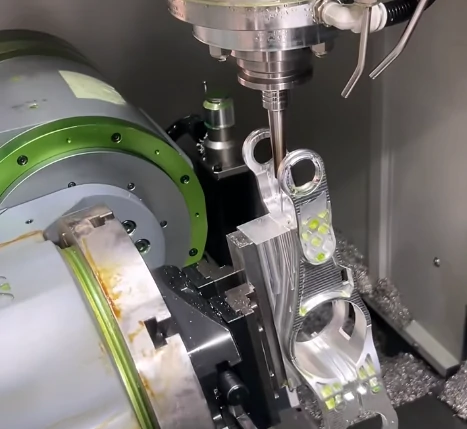
Robotics Components CNC Machining and Manufacturing Services
What is Custom Robotics Parts CNC Machining Manufacturing?
Custom robotics parts CNC machining manufacturing focuses on producing highly accurate and performance-oriented components using advanced subtractive manufacturing technologies. Manufacturers fabricate complex robotic parts with tight tolerances and consistent repeatability through processes such as milling, turning, drilling, boring, grinding, and EDM.
Modern production often integrates multi-axis machining and electrical discharge machining (EDM) to handle intricate geometries and hard-to-machine materials. These technologies enable components that meet strict dimensional and functional requirements, ensuring stability, durability, and reliable operation in demanding automation environments.
CNC Machining Processes and Their Advantages
| Machining Process | Key Advantages |
| CNC Machining | High automation, repeatability, and suitability for complex geometries |
| CNC Milling | Ideal for complex shaped robotic components, supports multi-tool operations |
| CNC Turning | Best for cylindrical parts with smooth finishes and high-speed production |
| CNC Drilling | Precise hole placement with consistent depth, diameter, and alignment |
| CNC Boring | Enlarges holes with high accuracy and improved surface quality |
| CNC Grinding | Achieves tight tolerances and refined surface finishes |
| Precision Machining | Delivers micrometer-level tolerance CNC machining for robotics parts |
Precision and Technical Capabilities
- Precision Range:Micrometer-level tolerances suitable for high-performance robotic assemblies
- Applicable Robot Types:Collaborative robots, industrial manipulators, SCARA systems, AGVs, AMRs, and material handling robots
- Quality Standards:Alignment with global quality management systems for consistency and reliability
Performance-Driven Robotic Components
CNC machining enables the production of a wide range of robotic components including gears, actuators, enclosures, brackets, housings, shafts, and tooling fixtures.
Advanced machining processes allow compatibility with materials such as aluminum alloys, stainless steel, carbon steel, and engineered plastics. This material flexibility ensures components meet both mechanical performance and environmental requirements.
Customization vs Standard Components
Engineers design custom-machined robotic components based on exact engineering specifications rather than standardized off-the-shelf dimensions. This approach eliminates compatibility issues and improves integration within robotic assemblies.
Typical custom applications include:
- Robotic arm structural and joint components
- Sensor housings and precision coupling interfaces
- Brackets, mounts, and end-effector supports
- Gear assemblies and transmission components
- Modular automation system components
- Specialized hardware for service robots and demonstration platforms
What are Robotic CNC Machining Part Solutions?
Robotic CNC machining part solutions integrate machining, engineering support, and complementary processes to transform complex designs into functional, high-performance components.
A comprehensive manufacturing approach combines CNC machining with assembly, welding, and brazing to produce both individual parts and integrated subassemblies. This ensures that components meet strict functional, structural, and dimensional requirements in robotic systems.
Engineering and Manufacturing Capabilities
Multidisciplinary teams including engineers, machinists, and assembly specialists support manufacturing capabilities. This ensures alignment between design intent and final production output.
Key strengths include:
- High precision CNC machining with tight tolerance control
- Custom robotic components manufacturing for automation systems
- Integrated machining, assembly, welding, and brazing services
- Engineering support to improve manufacturability and reduce risks
Collaboration across engineering and production stages ensures consistency, efficiency, and repeatability in manufacturing.
Experience in Robotics Manufacturing Projects
Experience across robotics manufacturing enables handling of diverse geometries, tolerances, and material requirements. This includes both prototype development and large-scale production.
Capabilities include:
- Production of complex robotic geometries
- Execution of custom CNC machining for prototypes and production parts
- Balancing cost efficiency with performance optimization
- Supporting multi-stage project development from concept to mass production
Such experience improves design feasibility and reduces iteration cycles.
Rapid Prototyping and Low-Volume Production
Rapid prototyping supports early-stage design validation before full production. CNC machining allows fast conversion from CAD models or samples into functional prototypes.
Capabilities include:
- CNC-based rapid prototyping for robotic components
- Low-volume pilot production for testing and validation
- Quick design iteration based on feedback
- Short transition cycles from prototype to production
This approach helps engineers verify fit, function, and performance efficiently.
Application Areas in Robotics Systems
Robotics applications demand components that can withstand repetitive motion, load stress, and continuous operation while maintaining high precision. Through advanced CNC machining, manufacturers produce critical elements such as actuators, gears, housings, and structural frames to support accurate motion control and system stability. Engineers design these custom high precision robot components and structural assemblies for long-term durability in complex environments.
At the same time, manufacturers widely use robotic CNC machining part solutions for motion control systems and automation applications across various fields, including motion control assemblies, sensor mounting structures, educational robotics platforms, and maintenance or upgrade components for industrial systems such as ABB robotic units. By aligning manufacturing processes with these real-world applications, manufacturers optimize components for seamless integration, ensuring reliability, precision, and consistent performance within the overall robotic system.
Technical Insight and System Integration Awareness
Beyond machining capabilities, a strong understanding of how components function within a complete robotic system is critical. This includes knowledge of load distribution, motion dynamics, and interface compatibility between subsystems.
Such technical awareness enables:
- Improved recommendations during the design phase
- Early identification of potential manufacturability challenges
- Optimization of part geometry for performance and durability
- Better alignment between mechanical design and system-level requirements
What are the Types and Components of Robotics Parts?
Robotics Arm, Drive Train, and Motion Structures
Robotic motion systems rely on a combination of robotics arm components, drive train elements, and motion structures that work together to deliver precise and repeatable movement. This group includes precision gears, joints, link arms, swivel mounts, gearbox seats, bearing supports, shafts, pulleys, and transmission brackets, all designed with tight tolerances to ensure stability, smooth torque transfer, and accurate positioning.Manufacturers commonly produce components such as precision gears for robotics drive systems and robot linkage structural components through CNC machining to maintain consistent performance under continuous and repetitive operation.
Automation Housings and Control System Components
Automation-related mechanical parts focus on protecting and organizing electronic systems while enabling efficient integration. Automation housings and control system components include enclosures for controllers and PCBs, control cabinet frames, servo module brackets, sensor housings, mounting brackets, cable routing structures, and protective covers. Engineers design these parts for compact layouts, thermal management, and ease of maintenance, including examples such as control cabinet structural frames for robotics and sensor mounting brackets with protective shielding, ensuring both protection and accessibility in industrial environments.
Actuators, End Effectors, and Interface Components
Actuation and end-effector-related components are responsible for how robots interact with tools and external objects. This category includes gripper bases, tool connection plates, modular interface blocks, custom mounts, and specialized tooling components used in welding, assembly, and material handling applications. These parts are engineered to balance strength and weight, improving motion efficiency and operational flexibility.
Industry-Specific Robotics Parts
Different industries require robotic components tailored to specific operating environments and compliance standards.Manufacturers build conveyor system parts such as rollers, guides, and mounting supports for continuous operation and durability, while they produce medical robotics parts using biocompatible materials and strict quality assurance processes.Aerospace robotics parts demand high-performance materials and adherence to stringent certification standards for reliability in extreme conditions. Across these sectors, precision CNC machined robotic parts for automation systems are essential to ensure consistency, durability, and performance across demanding applications.
CNC-Machined Robotic Components
Robotic systems also depend on a wide range of custom-machined parts that support structural integrity, motion control, and system integration. These include custom frames and chassis, bearing housings, bushings, actuator housings, motor mounts, precision shafts, couplings, pulleys, sprockets, fasteners, linkage mechanisms, gripper jaws, vacuum mounts, cooling plates, and electronic enclosures. Key examples such as precision motor mounts for robotic systems, custom actuator housings with integrated mounting interfaces, and high-precision power transmission components for CNC-machined robotics help ensure accurate alignment, efficient energy transfer, thermal stability, and long-term operational reliability across robotic assemblies.
What are Robotics Part Common Materials and Surface Finishing Options?
Material selection and surface finishing are essential for durability, corrosion resistance, wear resistance, and long-term stability. Robotics components often require a combination of metals, alloys, and engineering plastics tailored to functional needs.
Common Materials Used in Robotics Parts
Robotic systems rely on a variety of materials tailored to specific mechanical and electrical requirements. These materials are chosen based on their strength, machinability, thermal stability, and resistance to fatigue.
Typical material categories include:
- Superalloys– Used in high temperature robotic components machining for actuators and gear systems where extreme conditions are present
- Titanium alloys– Ideal for lightweight robotic frame structures and precision joints due to high strength-to-weight ratio
- Aluminum alloys– Common in robot chassis CNC machining and structural frames for reduced weight and good machinability
- Copper and copper alloys– Applied in robotic electrical components manufacturing such as wiring, connectors, and motor parts due to excellent conductivity
- Brass and bronze– Frequently used in precision gears, bushings, and wear-resistant robot components
- Carbon steel and alloy steel– Suitable for robot structural parts and load-bearing assemblies requiring high strength
- Stainless steel– Preferred for corrosion resistant robotic parts for industrial environments
- Engineering plastics– Used for non-load-bearing parts such as housings, insulation components, and grips
- Ceramic materials– Applied in specialized wear resistant and insulating robotic applications
Material Selection and Application Overview
| Material Type | Typical Applications |
| Superalloy | Actuators, gear systems, high-temperature robotic components |
| Titanium | Lightweight frames, joints, surgical and precision robots |
| Aluminum | Structural frames, chassis, robotic arm components |
| Copper | Motors, connectors, electrical systems |
| Brass | Bearings, bushings, precision gears |
| Bronze | Wear-resistant bearings and sliding components |
| Carbon Steel | Frames, joints, load-bearing structures |
| Stainless Steel | Fasteners, structural parts, corrosion-prone environments |
| Plastics | Housings, insulation parts, non-structural components |
| Ceramic | Insulation, friction parts, sensors |
Material Grades for Robotics and Automation Parts
Robotic and automation components often require standardized material grades to ensure consistency and reliability across production.
- Steel & stainless steel grades:316/316L, 15-5, 1045, 4140, A36
- Aluminum alloys:6061-T6, 7075-T6, 5052, 5083-H111, 2024-T351
- Brass & copper alloys:C360, C110, C101
- Thermoplastics:PC (Polycarbonate), ABS, PEEK, PET
- Commodity polymers:PE, PP, PVC
These materials support a wide range of precision CNC machining for robotics materials selection, ensuring compatibility with different robotic system requirements.
Robotics Part Surface Finishing Techniques
Surface finishing is essential to improve durability, corrosion resistance, and appearance of robotic components. It also enhances performance by reducing friction and protecting against environmental damage.
Common finishing processes include:
- Anodizing (including hard anodizing and colored anodizing)
- Electroplating and electroless nickel plating
- PVD (Physical Vapor Deposition) coatings
- Powder coating and painting
- Polishing and electropolishing
- Sandblasting, bead blasting, and media blasting
- Passivation and chromate conversion coatings
- Black oxide finishing
- Brushing and texturing
These processes are widely used in robotic CNC machined parts surface finishing for corrosion resistance and wear protection, helping extend component lifespan in demanding environments.
Surface Treatment Selection by Functional Requirement
Different robotic components require different finishing strategies depending on their role:
Structural and load-bearing parts
- Materials: alloy steel, quenched and tempered steel
- Treatments: heat treatment, surface hardening, precision grinding
- Focus: fatigue resistance, torsional stiffness, and long-term durability
Lightweight and high-speed moving parts
- Materials: aluminum alloys and extrusions
- Treatments: anodizing, hard coating, color coding
- Focus: weight reduction while maintaining rigidity for lightweight robotic components machining solutions
Corrosion-exposed components
- Materials: stainless steel and coated metals
- Treatments: passivation, electroplating, corrosion-resistant coatings
- Focus: protection in humid, dusty, or chemically active environments
Material and Finishing Integration in CNC Machining
In advanced robotics manufacturing, material selection and surface finishing are closely integrated with CNC machining processes such as turning and milling. This ensures that both geometry and surface characteristics meet design requirements.
For example:
- CNC turning for cylindrical robotic parts with smooth finishes
- Combination of machining and coating to enhance durability
- Post-processing treatments applied after machining to achieve final performance standards
By combining custom robotic CNC machining materials and surface finishing solutions, manufacturers can optimize both mechanical performance and aesthetic quality.
Performance-Oriented Material Strategy
Selecting the right combination of material and surface treatment directly impacts robotic system performance.
Through optimized robotics part material selection and surface finishing solutions, components can achieve improved wear resistance, better thermal stability, and enhanced operational lifespan across different robotic platforms, including industrial robots and automated systems.
How Do Robotic Parts Move from Prototyping to Production?
This lifecycle includes prototyping, engineering validation, pilot production, and mass production. CNC machining, EDM, grinding, additive manufacturing, and molding processes are used across stages to ensure smooth transition from concept to final product..
Prototyping, CAD Development, and Early Validation
The initial phase focuses on transforming design concepts into physical or digital prototypes for evaluation.
Key activities include:
- rapid prototyping for robotic parts using CNC machining and additive manufacturing
- CAD modeling and digital simulation for design verification
- Fabrication of functional prototypes using engineering-grade metals and plastics
- Quick iteration cycles to refine geometry, fit, and performance
- Early-stage feasibility analysis and concept validation
This stage allows engineers to assess functionality, detect design issues early, and establish a foundation for further development.
DFM Engineering, Material Selection, and Pre-Production Support
Design for Manufacturability (DFM) and engineering support are critical for ensuring that designs are optimized for efficient production.
Combined capabilities include:
- DFM analysis for geometry, tolerances, and manufacturability
- Material selection guidance based on mechanical, thermal, and environmental requirements
- Prototype review and design optimization recommendations
- Custom fixtures, jigs, and 3D-printed tooling for validation
- Engineering consultation for assembly compatibility and tolerance stack-up
These services contribute to DFM services for robotic CNC parts development, reducing risks and improving manufacturability before scaling.
Engineering Verification, Testing, and Structural Evaluation
Once prototypes are developed, they undergo comprehensive testing to confirm performance and reliability.
This phase integrates:
- Functional testing of mechanical components and assemblies
- Dimensional inspection and tolerance verification
- Structural strength and load evaluation
- Surface quality and appearance assessment
- Assembly fit and interface compatibility checks
Through iterative feedback and refinement, engineering validation and testing for robotic components ensures that designs meet required specifications before advancing to production.
Production Verification, Pilot Runs, and Process Stabilization
Before full-scale manufacturing, pilot production is used to validate processes and ensure consistency.
Key elements include:
- Small-batch production for process validation
- Tooling and fixture optimization for repeatability
- Quality control implementation across sample batches
- Process parameter tuning for stability and efficiency
- Supply chain and material flow assessment
This phase supports production verification for robotic parts in low-volume CNC manufacturing, helping identify and resolve potential issues prior to mass production.
Scalable Manufacturing and Mass Production
After validation, production transitions into high-volume manufacturing with optimized workflows and systems.
Capabilities include:
- High-volume CNC machining with consistent dimensional accuracy
- Automated and semi-automated production processes
- Integrated inspection and quality assurance systems
- Scalable output from thousands to millions of components
- Continuous monitoring and process optimization
These capabilities enable mass production CNC machining for robotic components with consistent quality control, ensuring reliable delivery and performance at scale.
Manufacturing Technologies Across the Lifecycle
A combination of advanced manufacturing processes supports each stage of development:
- CNC milling and turning for precision component fabrication
- Multi-axis machining for complex geometries
- Swiss machining for high-precision slender parts
- Wire EDM for intricate internal features and tight tolerances
- CNC grinding for high surface accuracy
- CNC drilling, threading, and tapping for functional interfaces
- Additive manufacturing for rapid prototyping
- Injection molding for high-volume plastic components
- Surface finishing processes for protection and performance
These technologies collectively enable end-to-end robotic parts manufacturing processes from prototyping to production, ensuring seamless transitions between stages.
Industry Applications and Use Cases
Manufacturing and integrated services support a wide range of robotics applications, including motion control systems, automation assemblies, sensor modules, interface components, educational robotics kits, and maintenance or replacement parts for industrial systems (e.g., ABB assemblies).
What is the Robotics Parts Quality Control and Assurance Process?
A structured and well-defined quality system is implemented to ensure consistent performance and reliability of robotics components across all stages of production. The Robotics Parts Quality Control and Assurance Process integrates multiple inspection stages, documentation controls, and advanced measurement technologies to maintain strict compliance with engineering specifications and international standards.
A comprehensive quality management framework is applied, covering incoming materials, in-process verification, final inspection, and shipment validation. Dedicated personnel oversee each stage, ensuring real-time monitoring, traceability, and transparent communication throughout the entire manufacturing workflow.
Quality Management System Overview
Each stage is supported by standardized inspection procedures and recorded documentation to ensure repeatability and accountability.
- Incoming raw materials are verified before production begins
- In-process inspections ensure dimensional and functional compliance
- Final inspections validate finished components prior to shipment
- Inspection records and reports are archived for long-term traceability
Advanced laboratory facilities are equipped with precision instruments such as 2D/3D projectors and automated measurement systems to support high-accuracy evaluation.
Inspection and Reporting Documentation
A variety of inspection reports and certifications are generated throughout the process to ensure full transparency and compliance:
- CMM Inspection Report
- Full Dimensional Inspections
- Material Test Report
- Material Certificate
- Certificate of Conformity
- First Article Inspections
These documents provide verifiable evidence of product quality and are maintained as part of the long-term quality archive system.
Process Quality Management
The Robotics Parts Quality Control and Assurance Process incorporates strict process-level controls to maintain consistency across production batches.
- Critical dimension verification checklists are applied to all robotic components
- Batch-based inspection records are maintained for traceability
- Real-time process monitoring enables immediate detection of deviation
- Continuous feedback loops support tolerance optimization and process improvement
These measures ensure that each component meets predefined engineering tolerances and functional requirements before moving to the next stage.
Advanced Metrology & Calibration
Precision measurement and calibration play a key role in maintaining dimensional accuracy for robotics parts.
- Calibrated gauges are used for verifying precision hole fits
- Locating surfaces and assembly reference points are validated against design specifications
- Measurement data is continuously reviewed to refine tolerance control
- High-precision instruments ensure repeatable and reliable inspection results
This metrology-driven approach supports tight tolerance requirements commonly required in robotics applications
Documentation & Traceability
A robust traceability system is implemented to ensure that every part can be tracked throughout its lifecycle.
- Dimensional certificates and material certifications are recorded and archived
- Heat treatment records and surface finish documentation are maintained
- Full batch traceability enables rapid identification and resolution of quality issues
- Historical records are preserved for long-term audits and compliance verification
This documentation framework ensures accountability and provides complete visibility from raw material sourcing to final shipment.
What are Welleshaft Robotice Parts Manufacturing Capabilities Services?
Welleshaft, provides end-to-end robotics parts manufacturing services from prototyping to mass production, integrating advanced CNC machining, diversified processes, and engineering support to deliver high-precision components with consistent quality, tight tolerances, and efficient lead times.
Core capabilities include high-accuracy CNC machining (up to ±0.005 mm), multi-axis machining (3-axis to 5-axis), Swiss machining, and EDM, supported by equipment such as CNC milling and turning centers, Swiss lathes, EDM systems, and sheet metal fabrication tools. These enable the production of complex geometries with stable repeatability and scalable output.
A full range of processes is available, including milling, turning, drilling, threading, grinding, and rapid prototyping, allowing smooth transition from design validation to production. Engineering support such as DFM analysis, CAD/CAM optimization, and prototype validation helps improve manufacturability and reduce development risks.
Material options cover metals and engineering plastics, including aluminum, stainless steel, carbon steel, titanium, copper, brass, and polymers. Surface finishing processes such as anodizing, plating, polishing, blasting, and passivation further enhance durability, corrosion resistance, and appearance.
Overall, Welleshaft delivers integrated CNC machining and manufacturing solutions for robotic components, supporting applications across automation, industrial robotics, and related advanced manufacturing industries.
Why choose Welleshaft for Robotics Prototypes and Parts Manufacturing?
welleshaft, based in China, focuses on delivering precision-driven manufacturing solutions for robotics and automation applications. With extensive industry experience and advanced production capabilities, the focus is on supporting projects from early-stage development through to scalable production with consistent quality and efficiency.
Fast Turnaround and Responsive Communication
Efficient workflows and digital manufacturing systems enable shorter lead times without compromising quality.
- Rapid quotation and project evaluation
- Short prototyping cycles to accelerate development
- Clear communication with engineering and production teams
- Efficient scheduling to meet project deadlines
This supports clients who require fast turnaround CNC machining for robotics prototypes and parts in competitive development environments.
Global Experience and Market Support
welleshaft has experience working with clients across multiple regions, supporting diverse industry standards and expectations.
- Structured communication processes for cross-border collaboration
- Reliable logistics and delivery coordination
This global perspective supports projects requiring custom robotics parts supplier for international markets with quality assurance.
FAQ
Can the delivery date be guaranteed? How fast can prototypes be produced?
Multiple CNC teams and continuous machine operation ensure stable output. Prototypes can be completed quickly depending on complexity, supporting fast CNC prototyping for robotics components with short lead timeand reliable batch delivery.
Do offer assembly or kitting for robotic subsystems?
Assembly, fastening, testing, and kitting with organized packaging are provided, supporting robotic subsystem assembly and kitting services with quality verification.
Can produce parts for sealed or waterproof robotic enclosures?
Precision-machined housings and sealing interfaces with accurate O-ring grooves support IP65/IP67 requirements, aligned with precision machining of waterproof robotic enclosures with IP-rated sealing requirements.
Do you work with lightweight materials like titanium or magnesium?
Materials such as titanium, magnesium, aluminum, and composites are machined using optimized processes, supporting machining lightweight materials for robotics applications such as titanium and magnesium components.
Can you machine tight-tolerance features for robotic motion systems?
Components like bearing seats, shafts, and alignment features are produced with strict tolerances and inspection control, supporting tight tolerance CNC machining for robotic motion system components with high precision requirements.
This blog was provided by the Welleshaft Engineering Team, led by Mr. Xu, a specialist in precision CNC machining and robotics components. Welleshaft delivers end-to-end robotic parts manufacturing from prototyping to mass production, supported by advanced machining capabilities and strict quality control to ensure consistent performance and reliability.

 Deutsch (Schweiz)
  English
  Português do Brasil
  Deutsch (Österreich)
  English (UK)
  English (Australia)
  English (New Zealand)
  Deutsch
  Français du Canada
  Français
  Français de Belgique
  Italiano
  English (South Africa)
  Português
  Español
  Español de México
  Español de Perú
  Español de Colombia
  العربية
  日本語
日本語  Русский
  한국어
한국어  Tiếng Việt
  ไทย
ไทย